
Official statement
Other statements from this video 11 ▾
- □ Is CTR really a reliable proxy for measuring search query relevance?
- □ Should you prioritize low-ranking queries with high CTR to maximize your organic traffic growth?
- □ Should you really focus on improving queries you're already ranking for instead of chasing new keywords?
- □ Should you really ignore traffic-generating queries that don't match your business?
- □ Are structured data really stealing your clicks from the top position?
- □ Why are your competitors stealing clicks from you in the SERPs?
- □ Why does Google emphasize the precision of title tags, meta descriptions, and ALT attributes so much?
- □ Do header tags really help Google understand and rank your content better?
- □ Should you really leverage related keywords to expand your keyword strategy?
- □ Can Google Trends really uncover SEO opportunities before your competitors do?
- □ Why is a top ranking with low CTR not necessarily a problem?
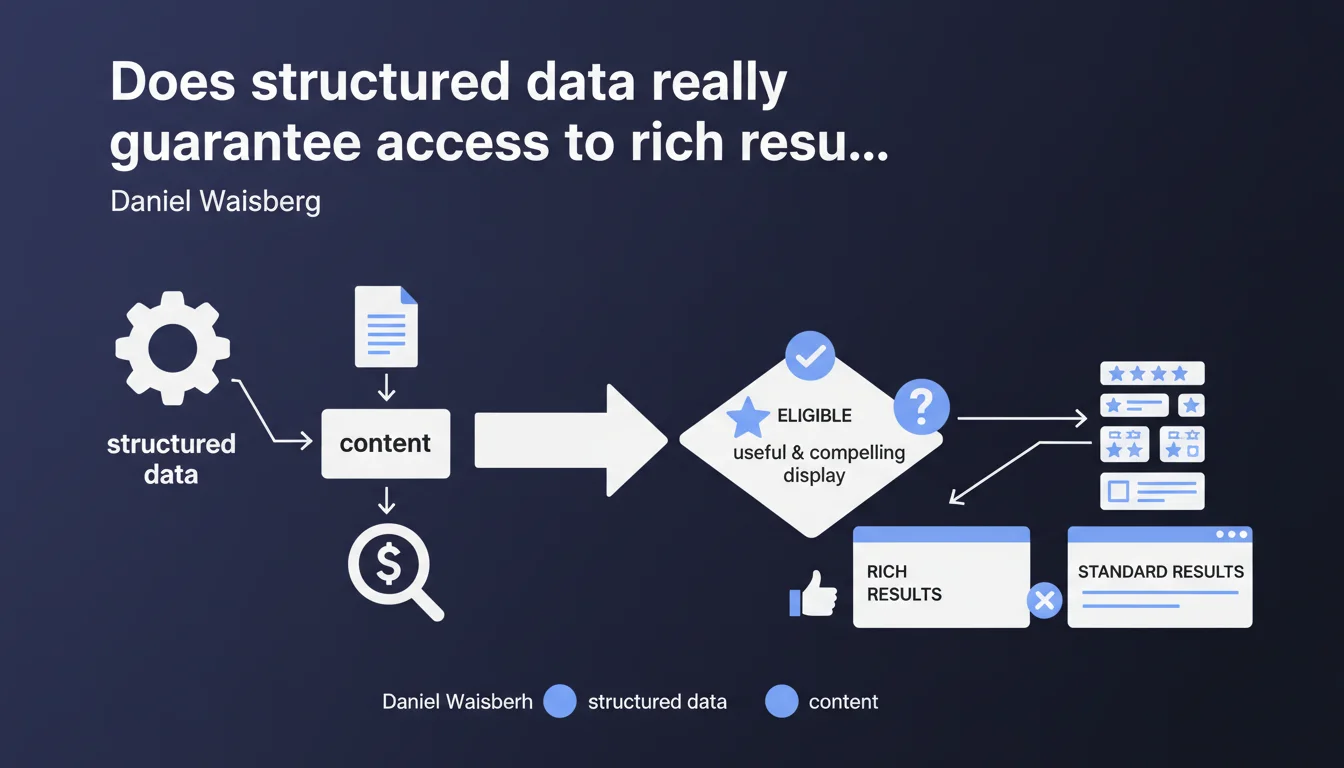
Google confirms that adding structured data makes a site eligible for rich results, but doesn't guarantee their display. The nuance is important: implementing Schema.org correctly opens the door to rich snippets, without certainty of appearance. Eligibility also depends on markup quality and compliance with guidelines.
What you need to understand
What's the difference between eligibility and actual display?
Daniel Waisberg emphasizes a precise term: eligible. This means that structured data gives content the potential to appear in enriched form, without absolute guarantee.
Google reserves the right not to display rich snippets even if the markup is technically correct. Algorithms evaluate relevance, content quality, and other signals before triggering enriched display.
Why does Google insist on this distinction?
This cautious wording protects Google against unrealistic expectations. Many sites implement Schema.org and are surprised to never see their stars or FAQs appear in SERPs.
Real-world experience shows that rich results display depends on multiple factors: competition on the query, domain trust level, data consistency with visible content, and even the user's geographic region.
What types of rich results are covered?
The statement covers all formats supported by Google: reviews and ratings, FAQs, recipes, events, products, job offers, videos, articles, breadcrumbs, and many others.
Each type has its own prerequisites documented in Search Central documentation. Some formats like Product snippets require very strict mandatory properties, while others like Article are more permissive.
- Structured data creates eligibility but doesn't guarantee display
- Google evaluates markup quality through Search Console and the Rich Results Test
- Each format (FAQ, Product, Recipe, etc.) has its own rules and mandatory properties
- Enriched display also depends on quality signals and domain trust
- Technically valid markup may never display if content lacks relevance
SEO Expert opinion
Is this eligibility/display distinction a convenient loophole?
Let's be honest: this wording allows Google to never be in the wrong. A site can have perfect Schema.org and never get rich snippets — Google will simply say it was eligible but not selected.
On the ground, we observe glaring inconsistencies. Sites with approximate markup display stars, while others that are technically flawless get nothing. [Needs verification]: the exact selection criteria are not publicly documented.
What are the truly determining factors for display?
Beyond technical markup, several field observations emerge. Domains with a high trust history obtain rich snippets more easily. Recent sites or those that suffered manual penalties struggle more.
Competition on the query plays hugely. On saturated keywords, Google sometimes displays fewer rich results than before — probably to preserve advertising space and avoid overcrowded SERPs. Mobile format also influences: some rich snippets only appear on desktop or vice versa.
Is it really worth investing time in structured data?
Despite the uncertainties, the answer remains yes. Sites that correctly implement Schema.org maintain a net competitive advantage over those that don't. Even without guarantee, eligibility remains an absolute prerequisite.
Structured data also makes it easier for Google to understand content, beyond just rich snippets. It can influence the Knowledge Graph, improve relevance on certain queries, and optimize display in Google Discover or Google Assistant.
Practical impact and recommendations
What should you prioritize implementing on your site?
Start with formats that deliver the most visible value in your field. For e-commerce: Product, Offer, and AggregateRating. For media: Article, Breadcrumb, and potentially VideoObject. For a local site: LocalBusiness with all relevant properties.
Use Google's Rich Results Test to validate each implementation before going live. Invalid markup is worse than no markup at all — it signals to Google a lack of technical competence.
What errors systematically block enriched display?
First cause of failure: the marked-up content is not visible on the page. Google requires strict correspondence between markup and what users see. Marking up non-existent reviews triggers penalties.
Second trap: using the wrong Schema type for your content. A blog article marked up as Product will be ignored. Google detects these inconsistencies and may lose trust in all your markup.
Third common error: omitting mandatory properties. Each type has required fields documented. A Product without "name" or "offers" will never be eligible, even if everything else is perfect.
How can you verify that implementation actually works?
Search Console offers a dedicated "Enhancements" report that lists eligible pages, those with errors, and those with warnings. Monitor this report weekly — errors can appear after a technical change or Google update.
Also track the evolution of organic CTR on marked-up pages. The appearance of stars or FAQs in SERPs normally generates a measurable increase in click-through rate, even without ranking changes.
- Audit strategic pages to identify relevant markup opportunities
- Implement Schema.org in JSON-LD (format recommended by Google) rather than microdata
- Test each implementation with the Rich Results Test before deployment
- Verify that all marked-up content exactly matches visible content on the page
- Monitor the Search Console Enhancements report to detect errors quickly
- Absolutely avoid markup spam: no fake reviews, no hidden data
- Document implementations to facilitate maintenance during site evolutions
- Measure actual impact on CTR and conversions, not just technical validation
❓ Frequently Asked Questions
Un site peut-il avoir des données structurées valides sans jamais obtenir de résultats enrichis ?
Quel format de données structurées Google recommande-t-il ?
Les données structurées influencent-elles le positionnement organique ?
Peut-on perdre ses résultats enrichis après les avoir obtenus ?
Combien de temps après l'implémentation les rich snippets apparaissent-ils ?
🎥 From the same video 11
Other SEO insights extracted from this same Google Search Central video · published on 13/04/2023
🎥 Watch the full video on YouTube →
💬 Comments (0)
Be the first to comment.