
Official statement
Other statements from this video 11 ▾
- □ Is CTR really a reliable proxy for measuring search query relevance?
- □ Should you prioritize low-ranking queries with high CTR to maximize your organic traffic growth?
- □ Should you really focus on improving queries you're already ranking for instead of chasing new keywords?
- □ Should you really ignore traffic-generating queries that don't match your business?
- □ Why are your competitors stealing clicks from you in the SERPs?
- □ Why does Google emphasize the precision of title tags, meta descriptions, and ALT attributes so much?
- □ Do header tags really help Google understand and rank your content better?
- □ Does structured data really guarantee access to rich results?
- □ Should you really leverage related keywords to expand your keyword strategy?
- □ Can Google Trends really uncover SEO opportunities before your competitors do?
- □ Why is a top ranking with low CTR not necessarily a problem?
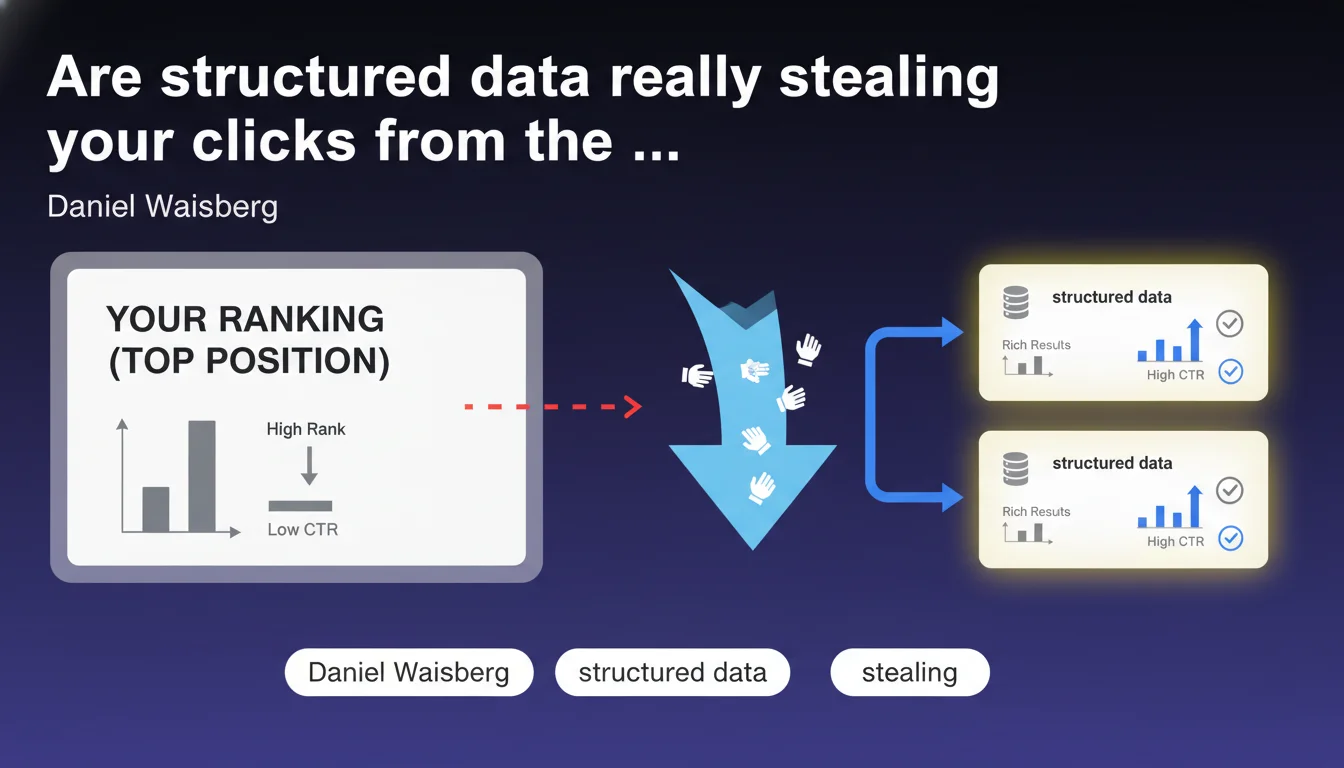
Google confirms that even in the top position, low CTR can be explained by competitors better equipped with structured data. Rich snippets capture visual attention and divert clicks to lower positions. Technical optimization becomes a direct competitive lever, not just a bonus.
What you need to understand
Why is Google addressing this question now?
The statement comes in a context where SERP display has become a visual battleground. Being first is no longer enough: rich snippets, stars, prices, FAQs and other enrichments create a visual hierarchy that short-circuits the natural order of results.
Google implicitly acknowledges that organic position and visual attractiveness are two separate battles. A site ranking #1 can lose clicks against a competitor in #3 or #4 displaying impactful structured data.
What does this mean concretely for a practitioner?
This validates a field observation: CTR is no longer linear based on position. A rich result catches the eye before the user even reads the title. Review stars, FAQ snippets or recipes create immediate visual salience.
To diagnose this phenomenon, you must cross two metrics in Search Console: average position and CTR. An abnormal gap (high position + low CTR) often signals that your competitors are exploiting structured data more effectively.
- Position ≠ visibility: rich results redefine visual hierarchy
- Organic CTR: becomes an indicator of technical competitiveness, not just editorial
- Competitor audit: analyze SERPs, not just your own site
- Structured data: shifts from "nice to have" status to "must have" on competitive queries
Which structured data has the most visual impact?
Not all structured data are equal in terms of CTR impact. Review (stars) and Product (prices) dominate in e-commerce. FAQ and HowTo deploy considerable display real estate, sometimes more visible than the typical #1 result.
Breadcrumb and Organization improve readability but have marginal CTR effect. Event, Recipe, and JobPosting create dominant visual blocks in their respective verticals.
SEO Expert opinion
Is this statement consistent with field observations?
Absolutely. A/B tests showing the impact of structured data on CTR have been numerous for several years. What's new is that Google explicitly verbalizes it as a direct competition factor between results.
However — and this is where it gets tricky — Google remains vague about which structured data really impact CTR and in what proportions. The statement is true but lacks actionable granularity. [To verify]: the impact varies drastically depending on the vertical and query type.
In what cases does this rule not apply?
On navigational queries (known brand), CTR remains high at #1 even without structured data. The user is looking for a specific site and clicks on the first legitimate result.
On simple informational queries where Google displays the answer directly (featured snippet, knowledge panel), neither your position nor your structured data will save the CTR — the click disappears, period. The logic changes: you must aim for direct display, not the click.
Finally, certain structured data do not display systematically even if the markup is valid. Google decides based on its relevance algorithm. A site can do everything right technically and never get a rich snippet if competition is too tough or if Google deems the content insufficient.
What nuances should be made about CTR impact?
The CTR gain linked to structured data is not linear. Review stars can boost CTR by 20-35% in e-commerce, but this effect erodes if all competitors have them too. Scarcity creates the advantage.
Rich FAQ increases display real estate but can paradoxically reduce CTR if the answer satisfies the user directly in the SERP. It's a strategic trade-off: visibility vs. traffic.
Practical impact and recommendations
What should you do concretely to recover these lost clicks?
First step: audit the competitive SERP. For each query where you rank well but with abnormally low CTR, visually capture the SERP and identify which competitors display enrichments. Chrome DevTools or SEO Minion-type extensions allow you to quickly see what structured data is present.
Next, prioritize by impact. Review and Product schema in e-commerce are critical. FAQ and HowTo work well on long-tail informational queries. Breadcrumb and Organization are basics to implement everywhere but don't expect CTR miracles.
- Analyze the 20-30 main queries where high position + low CTR exists
- Capture SERPs and identify competitor rich snippets
- Implement missing schemas (Review, Product, FAQ, HowTo depending on context)
- Validate markup with Google Rich Results Test
- Monitor CTR evolution in Search Console over 4-6 weeks
- Test different FAQ/HowTo formats to maximize display
- Avoid stuffing with non-relevant schemas: Google penalizes structured data spam
What errors should be avoided in implementation?
Do not mark up invisible or deceptive content. Google penalizes markup spam: fake reviews, auto-generated FAQ without value, inaccurate prices. Markup must reflect real, visible and relevant content.
Avoid schema conflicts. Some CMS or plugins automatically add structured data that conflicts with your manual additions. Result: Google ignores everything. Audit regularly with Schema Markup Validator.
Don't implement massively without a measurement plan. If you roll out 10 schema types simultaneously, it's impossible to know which impacts CTR. Progressive deployment and systematic measurement: one page category at a time, weekly follow-up.
How do you measure the real impact on your traffic?
Search Console remains the primary tool. Compare average CTR per query before/after implementation over an identical period (same seasonality). Segment by page type if possible.
Watch for bias: a position change distorts measurement. Filter for queries where position stays stable (+/- 1 rank) to isolate the pure effect of the rich snippet. Third-party tools like SEMrush or Ahrefs allow you to track SERP feature appearance over time.
Optimizing structured data has become a direct competitiveness lever, but it requires precise technical expertise and rigorous follow-up. Between choosing relevant schemas, implementing without conflicts, validating and measuring impact, the process can prove complex for a non-specialized internal team. Working with an experienced SEO agency allows you to structure this approach methodically and avoid costly mistakes, while benefiting from industry benchmarking on what really works in your niche.
❓ Frequently Asked Questions
Les données structurées garantissent-elles un affichage enrichi dans Google ?
Peut-on perdre du trafic en implémentant des FAQ structurées ?
Quelles données structurées ont le plus d'impact CTR en e-commerce ?
Google pénalise-t-il les sites qui abusent des données structurées ?
Combien de temps faut-il pour mesurer l'impact des données structurées sur le CTR ?
🎥 From the same video 11
Other SEO insights extracted from this same Google Search Central video · published on 13/04/2023
🎥 Watch the full video on YouTube →
💬 Comments (0)
Be the first to comment.