
Official statement
Other statements from this video 11 ▾
- □ Is CTR really a reliable proxy for measuring search query relevance?
- □ Should you prioritize low-ranking queries with high CTR to maximize your organic traffic growth?
- □ Should you really focus on improving queries you're already ranking for instead of chasing new keywords?
- □ Are structured data really stealing your clicks from the top position?
- □ Why are your competitors stealing clicks from you in the SERPs?
- □ Why does Google emphasize the precision of title tags, meta descriptions, and ALT attributes so much?
- □ Do header tags really help Google understand and rank your content better?
- □ Does structured data really guarantee access to rich results?
- □ Should you really leverage related keywords to expand your keyword strategy?
- □ Can Google Trends really uncover SEO opportunities before your competitors do?
- □ Why is a top ranking with low CTR not necessarily a problem?
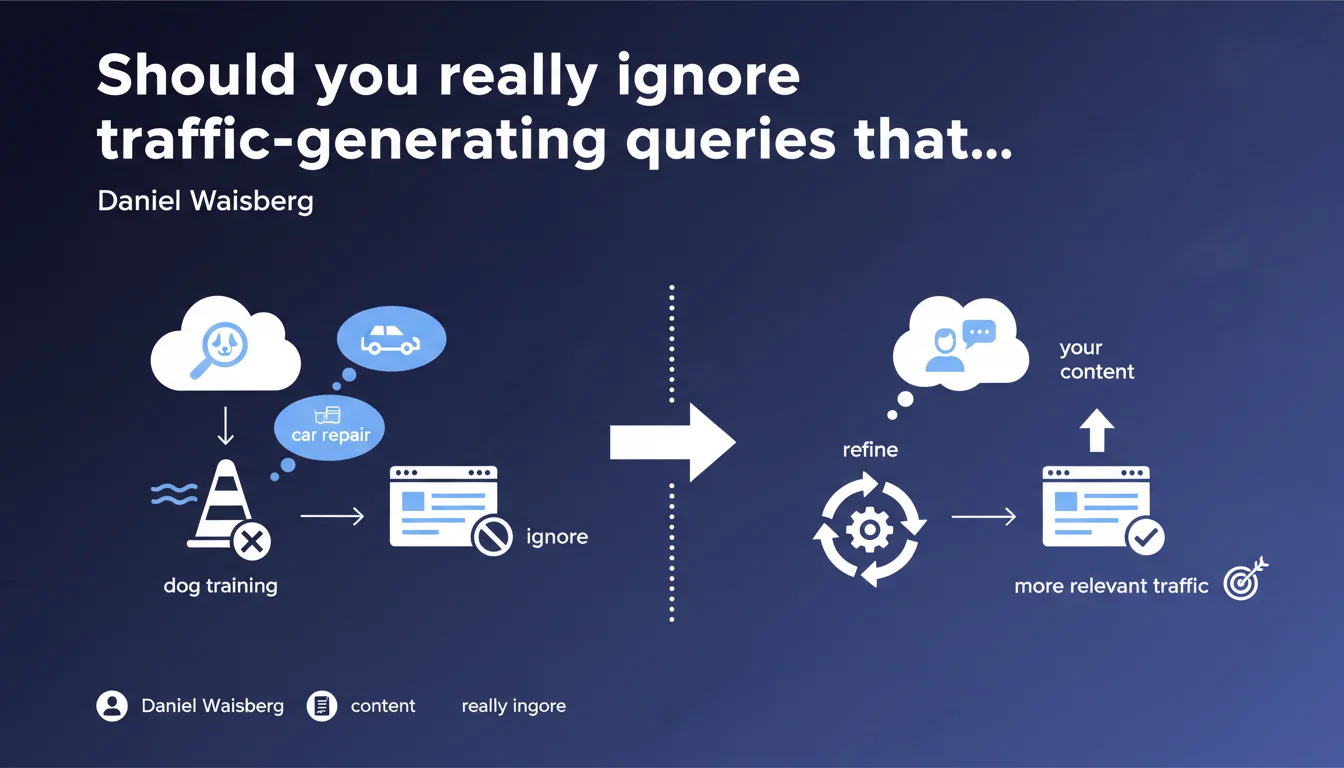
Google suggests refining your content to avoid attracting traffic from search queries unrelated to your business. The goal: focus your SEO efforts on queries that actually convert rather than artificially inflating your traffic metrics. An approach that questions the real value of a visitor.
What you need to understand
Why does Google encourage moving away from certain traffic-generating queries?
Daniel Waisberg raises a point that many marketing teams prefer to ignore: raw traffic is not an end goal in itself. When a site attracts visitors on queries unrelated to its offer, it creates noise in analytics and dilutes resources.
Google is pushing here a logic of SEO efficiency: better 1,000 qualified visits than 10,000 random visits. This statement fits with the ongoing discourse on "user-helpful content" — a site that attracts by mistake on off-topic subjects degrades the experience.
What does "refining content" concretely mean in this context?
The idea is to deliberately narrow the semantic scope of your pages. If a page ranks for "easy pancake recipes" when you sell cosmetics, you need to either rephrase it or remove the elements triggering this ranking.
This can involve revising title/meta tags, removing ambiguous sections, or even deliberately deoptimizing certain terms. A counter-intuitive concept for those used to wanting to maximize visibility at all costs.
What signals does Google use to qualify the relevance of a query?
The statement remains vague on this point — as is often the case. One can assume that Google analyzes post-click behavior: bounce rate, time spent, actions taken. If users leave immediately, it's a non-relevance signal.
The problem is that Google never shares the thresholds. From what bounce rate does it consider a query "non-relevant" for your site? A mystery. We navigate blindly, as usual.
- Quality over Quantity: Google values relevant traffic that engages, not raw volume
- Refining = restricting: sometimes it means deliberately deoptimizing certain terms
- Behavioral signals: probably at the heart of relevance evaluation (but undocumented)
- Optimization opportunity: redirect SEO effort toward high-value queries
SEO Expert opinion
Is this recommendation really applicable in all cases?
Let's be honest: it all depends on your business model. For an editorial site that monetizes through ad display, traffic — even non-relevant — generates revenue. In that context, why refuse visitors who view your pages and see your ads?
Google reasons here with logic oriented toward e-commerce or lead generation, where each visitor has a cost (crawl, server, analytics) and should ideally convert. But this model doesn't suit everyone. [To verify]: Does Google really penalize a site that attracts "off-topic" traffic but with decent engagement metrics? Nothing formally proves it.
What risks do you take by ignoring this advice?
The main danger is diluting your topical authority. If Google sees your site ranking for 50 different subjects without coherence, it struggles to identify you as an expert in a specific domain. In a universe where E-E-A-T is omnipresent, that's problematic.
Another risk: false signals in your analytics. You think you're succeeding because traffic is up, when in reality your conversion rate is collapsing. That muddies strategic decisions. And if you optimize for the wrong metrics, you waste time and budget.
How do you distinguish "non-relevant" traffic from legitimate "top-of-funnel" traffic?
That's where it gets tricky. Google gives no objective criteria. My approach: cross-reference Search Console with conversion data. If a query brings traffic but zero micro-conversions (newsletter signup, download, product click), that's a strong indicator.
But watch out for false negatives. A query can be legitimate in the discovery phase and only convert on second contact. Deoptimizing too quickly potentially cuts a doorway into your funnel. Analysis requires finesse — and ideally advanced behavioral tracking, not just basic metrics.
Practical impact and recommendations
What should you concretely do to identify these problematic queries?
First reflex: open Search Console and sort by impressions/clicks. Spot queries generating volume but whose topic seems off from your core business. Export the list and categorize manually — yes, it's tedious, but essential.
Next, cross-reference with Google Analytics. For each suspicious query, look at: bounce rate, session duration, pages per session, conversion rate. If all indicators are in the red, you've found a refining candidate. If some are good, dig deeper — maybe that query belongs in your broader editorial strategy.
What refinement actions should you implement without breaking what works?
Start by adjusting metadata (title, meta description) to make them more specific and filter unqualified clicks. If a page ranks for "easy recipe" when you sell cooking robots, refine the title to "cooking robot for easy recipes." You keep the semantics but you qualify the intent.
If that's not enough, revise the page content. Remove sections creating ambiguity. For example, if you have a general intro discussing cooking broadly before mentioning your product, trim or remove it. You thus reorient the signals sent to Google.
In extreme cases, consider targeted deindexing (noindex) if the page has no real business value and generates more confusion than opportunity. But be careful: it's drastic. Make sure you've measured the impact before cutting.
How do you measure the effectiveness of these adjustments?
Set up a before/after tracking. Note the query's metrics before modification (impressions, clicks, bounce rate, conversions). Wait 4 to 6 weeks after refinement — time for Google to recrawl and reevaluate — then compare.
Ideally, you should see a drop in unqualified traffic (that's the goal) and a rise or stability in overall conversions. If overall traffic drops but conversion rate rises, that's often a good sign. Don't panic seeing your traffic curve descend if quality improves.
- Export Search Console data and identify high-volume, low-relevance queries
- Cross-reference with Google Analytics to analyze behaviors (bounce, duration, conversion)
- Adjust title/meta tags to qualify search intent
- Revise page content to eliminate ambiguous or off-topic elements
- Consider noindex only as a last resort, after impact analysis
- Track evolution over 4 to 6 weeks and adjust strategy based on results
- Document each modification to facilitate retrospective analysis
❓ Frequently Asked Questions
Est-ce que Google pénalise un site qui attire du trafic sur des requêtes non pertinentes ?
Faut-il systématiquement désoptimiser les requêtes non pertinentes qui génèrent du trafic ?
Comment savoir si une requête est vraiment non pertinente ou juste en haut de funnel ?
Quel délai attendre après une modification pour évaluer son impact ?
Le noindex est-il une solution acceptable pour gérer ce type de trafic ?
🎥 From the same video 11
Other SEO insights extracted from this same Google Search Central video · published on 13/04/2023
🎥 Watch the full video on YouTube →
💬 Comments (0)
Be the first to comment.