
Official statement
Other statements from this video 11 ▾
- □ Is CTR really a reliable proxy for measuring search query relevance?
- □ Should you prioritize low-ranking queries with high CTR to maximize your organic traffic growth?
- □ Should you really focus on improving queries you're already ranking for instead of chasing new keywords?
- □ Should you really ignore traffic-generating queries that don't match your business?
- □ Are structured data really stealing your clicks from the top position?
- □ Why are your competitors stealing clicks from you in the SERPs?
- □ Why does Google emphasize the precision of title tags, meta descriptions, and ALT attributes so much?
- □ Do header tags really help Google understand and rank your content better?
- □ Does structured data really guarantee access to rich results?
- □ Should you really leverage related keywords to expand your keyword strategy?
- □ Why is a top ranking with low CTR not necessarily a problem?
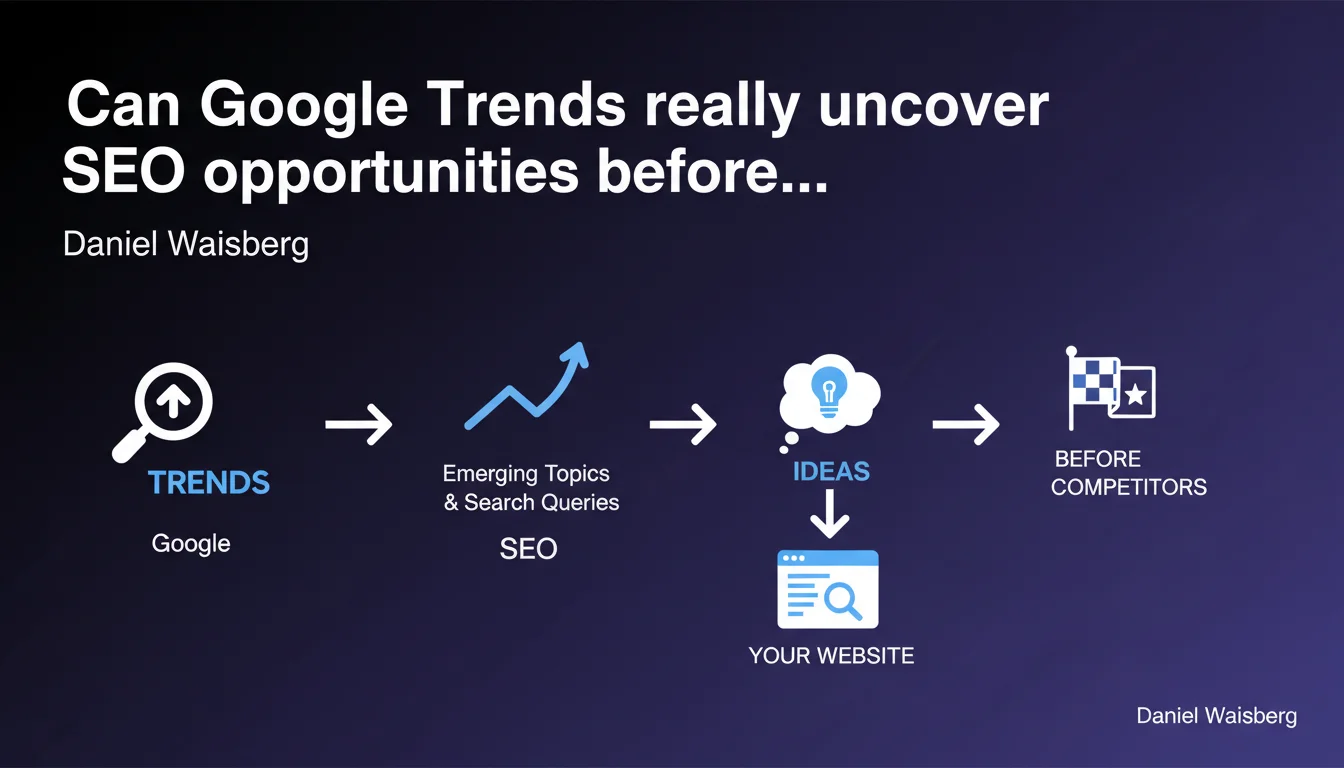
Google officially recommends using Trends to detect emerging topics and search queries related to your industry. The tool is said to help you anticipate search trends and adjust your content strategy accordingly. The real question is whether the data is granular enough to make tactical decisions.
What you need to understand
Does Google Trends really give you a competitive edge?
Daniel Waisberg's statement positions Google Trends as a legitimate tool for identifying emerging queries. The idea: anticipate spikes in interest before they explode in conventional search volume metrics.
In practical terms, this means Google validates the use of Trends not just to observe the past, but to detect weak signals. A topic that's starting to gain traction can justify content production before competitors catch on.
What data does Trends actually provide?
The tool aggregates relative search volumes, not absolute ones. You see curves, geographic variations, related queries. But you never know if "rising" means 100 searches or 10,000.
The "Related topics" and "Related queries" sections display terms in growth mode, sometimes with the label "Breakout." That's where the gold is hidden — or the noise, depending on your ability to filter.
Why is Google pushing this tool now?
Trends has existed for years, but this official recommendation comes at a time when Google wants creators to produce useful and reactive content. Identifying emerging trends means creating content at the right moment.
It's also a way of saying: don't rely solely on Keyword Planner, which mostly reflects historical data. Trends captures the present and near future.
- Google Trends is officially validated as a source of SEO opportunities.
- Data is relative, not absolute — you'll never know exact volumes.
- The focus is on emerging topics and queries, not established trends.
- Using Trends complements traditional keyword research tools.
SEO Expert opinion
Are Trends data really actionable in SEO?
Let's be honest: Google Trends is useful, but limited. Relative curves let you compare two terms, see seasonality, detect spikes. But without absolute volumes, it's hard to prioritize among 10 opportunities.
For an e-commerce site hesitating between two product categories, Trends gives you a macro trend. For a blogger looking for high-potential topics, it's murkier. You need to cross-reference with other tools — Search Console, Semrush, Ahrefs — to validate real potential.
Does this recommendation really change the game?
Not really. Experienced SEOs have been using Trends for years. What's interesting is Google putting it officially front and center — it validates a practice and signals that anticipating trends is an implicit quality criterion.
But be careful: Trends reflects search interest, not commercial value or intent. A topic can explode and generate zero conversions. Always cross-reference with intent analysis.
When does Trends become truly relevant?
Trends excels in three scenarios: event detection (news, buzz, crises), seasonality identification (predictable peaks to anticipate), and competitive intelligence (comparing interest in your brand vs. competitors).
For everything else — traditional keyword research, precise volume, difficulty analysis — specialized tools remain superior. [To verify]: Google doesn't specify how often Trends updates or how it handles very low volumes.
Practical impact and recommendations
How to integrate Trends into your SEO workflow?
Start by defining 5 to 10 main keywords related to your topic. Enter them into Trends and observe the curves over 12 months. Identify seasonal peaks — that's when you should publish content in advance, not at peak time.
Explore the "Related queries" and "Related topics" sections. Filter those marked "Breakout" or "Rising." Export these lists, cross-reference them with your volume tools, validate intent.
What mistakes should you avoid with Google Trends?
Never rely solely on Trends to prioritize topics. A rising curve guarantees neither volume nor commercial relevance. Always cross-reference with absolute data.
Avoid comparing unrelated terms — Trends normalizes curves, which can make a marginal term look as important as a massive volume. And that's where it gets tricky: the relative scale masks reality.
What should you do concretely today?
- List your 10 main keywords and enter them into Google Trends.
- Analyze curves over 12 months to detect seasonality patterns.
- Export "Breakout" and "Rising" queries and topics.
- Cross-reference this data with Search Console and your volume tools.
- Plan your editorial calendar by anticipating peaks 4 to 6 weeks ahead.
- Set up Google Trends alerts for your strategic terms.
- Monitor geographic trends if you operate across multiple markets.
❓ Frequently Asked Questions
Google Trends donne-t-il accès aux volumes de recherche exacts ?
Peut-on utiliser Trends pour identifier des mots-clés de longue traîne ?
À quelle fréquence Google Trends est-il mis à jour ?
Trends reflète-t-il l'intention commerciale d'une requête ?
Faut-il utiliser Trends plutôt que Keyword Planner ?
🎥 From the same video 11
Other SEO insights extracted from this same Google Search Central video · published on 13/04/2023
🎥 Watch the full video on YouTube →
💬 Comments (0)
Be the first to comment.