
Official statement
Other statements from this video 11 ▾
- □ How can you leverage massive Search Console data exports to BigQuery to transform your SEO strategy?
- □ Does Google really reward content quality regardless of how it's produced?
- □ Is using AI to generate SEO content spam or a legitimate opportunity?
- □ Does Google really treat AI-generated content the same as human-written content in rankings?
- □ Does Google really expect you to justify who, how, and why for every piece of content you create?
- □ Is Google's Status Dashboard Really a Game-Changer for SEO Professionals?
- □ Why is Google making Experience a core ranking factor alongside Expertise, Authority, and Trustworthiness?
- □ Does Google's Updated rel=canonical Documentation Change How You Should Handle Duplicate Content?
- □ Why did Google just release an official gallery of search visual elements?
- □ Why is Google publishing a specific guide on links for web designers?
- □ Is Google's product review system expanding globally? Here's what's changing for your website and why it matters
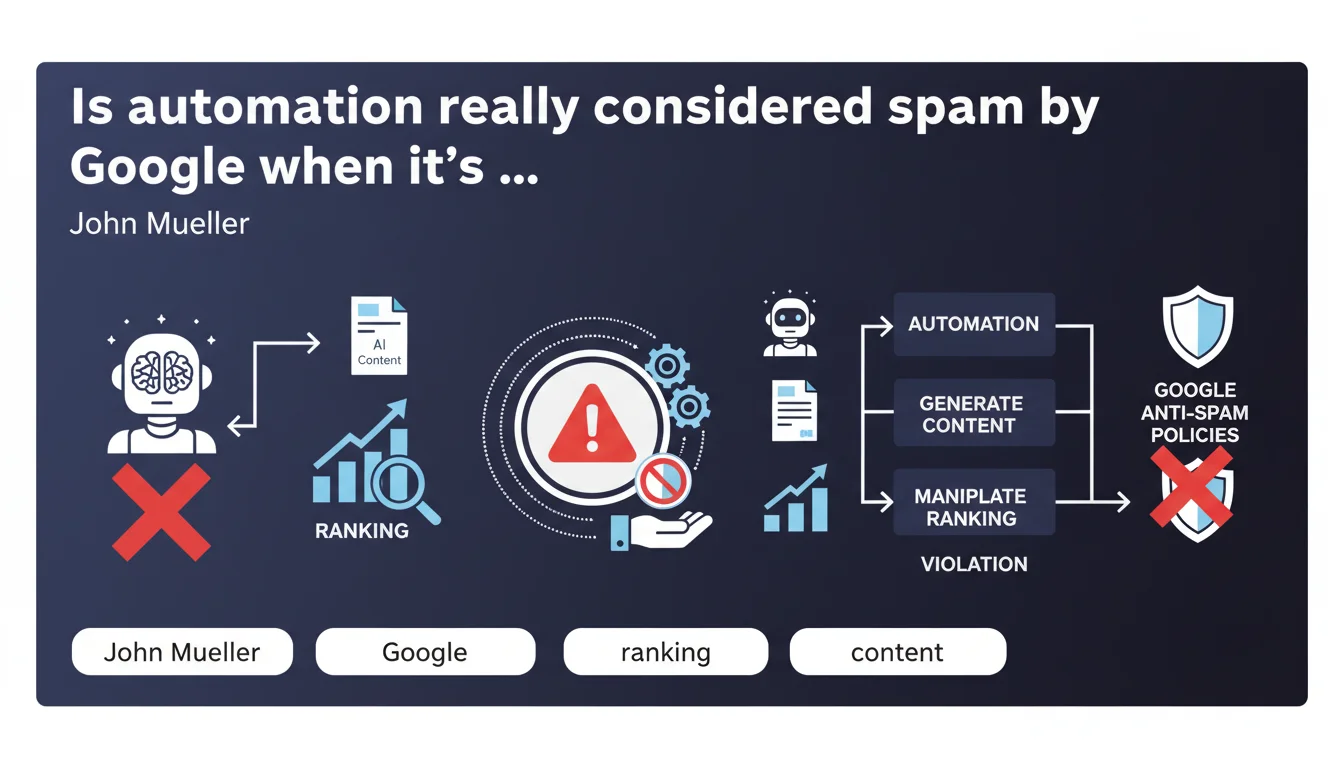
Google confirms that any automation — including AI — aimed at manipulating rankings is spam. Intent matters more than the method: if the primary goal is to rank without delivering value, it's forbidden. The nuance lies in the concept of "primary purpose", which is deliberately vague.
What you need to understand
Why is Google cracking down on automation now?
This statement isn't particularly new in itself — it reformulates Google's historic anti-spam policy by explicitly integrating generative AI into it. Since the explosion of tools like ChatGPT, low-cost content farms have multiplied, and Google is laying out a clear framework: automate to manipulate = spam.
Let's be honest: Google has never tolerated mass-generated content without oversight. What's changing is that AI makes it possible to produce at an industrial scale grammatically correct text that's devoid of added value. The red line remains the same: the intent to manipulate.
What does Google mean by "primary purpose of manipulating"?
The wording is deliberately broad. Google doesn't say that all automation is banned — it says that automation whose primary purpose is artificially inflating rankings is problematic. If you use AI to write thousands of pages targeting keyword variations without providing a unique answer, you're in their crosshairs.
On the other hand, using AI to structure a draft, generate personalized product descriptions, or automate repetitive writing tasks — while maintaining human oversight — theoretically remains acceptable. The catch is that Google provides no clear metrics to distinguish one from the other.
How does this rule apply in practice?
Google doesn't detect AI as such — it evaluates content quality and usefulness. Algorithms look for manipulation signals: thin pages, semantic duplication, lack of added value, degraded user experience. If your content checks these boxes, it doesn't matter whether it was written by a human or a machine.
- Automation isn't banned — manipulation is
- The "primary purpose" remains a gray area left to Google's interpretation
- Google prioritizes evaluating final quality, not production method
- Spam signals remain classic: thin content, duplication, absence of E-E-A-T
SEO Expert opinion
Is this statement consistent with what we observe in the real world?
Yes and no. Google does penalize sites that abuse generative AI to create thousands of low-quality pages — we've observed this since mid-2023 with several waves of manual action targeting niche affiliate sites. But reality is more nuanced: some sites producing AI content at scale continue to rank without apparent issues.
The determining factor seems to be perceived added value. A site that automates generating detailed product sheets, well-structured, with unique data (technical specs, comparisons) can fly under the radar. A site that churns out 10,000 generic articles on long-tails without human oversight eventually gets deindexed. [To verify]: Google discloses no public data on the actual detection rate of low-quality AI content or the evaluation criteria Quality Raters use in this context.
What nuances should we add to this rule?
Google conflates automation with manipulation, but they're not the same thing. Automation is a tool — manipulation is an intent. An automated crawler generating structured data from official sources and enriching it with human context has nothing to do with a bot paraphrasing existing articles to capture traffic.
The problem is that Google provides no clear threshold. How many AI pages per month? What level of human oversight? What proportion of original vs. reformulated content? Radio silence. So SEO teams navigate blind, testing limits without guarantees. It's frustrating — and it leaves room for arbitrary interpretations during manual actions.
In what cases doesn't this rule really apply?
Practically speaking? When automation serves to improve user experience rather than artificially inflating indexable page volume. Examples: automatic personalized summaries, assisted translation with human review, dynamic FAQ generation based on structured data, automating content updates for evolving information (prices, availability).
Google also tolerates automation in contexts where it's expected and transparent: financial data aggregators, weather sites, sports results, structured directories. In these cases, automation is the only realistic way to maintain freshness and comprehensiveness. But once you move into general editorial content, the rules become fuzzy.
Practical impact and recommendations
What should you do concretely if you're already using AI to produce content?
First step: audit your page inventory. Identify those generated automatically without substantial human oversight. If these pages deliver real value — unique data, clear structure, answering a specific intent — they can stay. If they're minor variations of the same template with no differentiating value, they're at risk.
Second step: establish a human validation process. AI can produce the draft, but an expert must review, enrich, correct, and validate. Google can't detect AI as such, but it spots patterns of generic content, repetitive phrasing, absence of original perspective. A human breaks these patterns.
What mistakes should you absolutely avoid?
Never publish AI content without human review. Hallucinations, factual inconsistencies, and awkward phrasing are low-quality signals Google knows how to identify. Don't create pages targeting ultra-similar keyword variations without substantial differentiation either — that's keyword stuffing in disguise, AI or not.
Also avoid flooding your site with massive new page volumes over a few weeks. A sudden publishing spike can trigger manual review, especially if engagement metrics (time on page, bounce rate) degrade. Velocity matters — natural publishing pace is less suspicious than sudden explosion.
- Audit automatically generated pages and assess their real added value
- Implement systematic human oversight on all AI content
- Diversify formulations, structures, and perspectives to break repetitive patterns
- Monitor engagement metrics: time on page, bounce rate, navigation depth
- Limit publishing velocity to avoid manipulation signals
- Prioritize quality over volume: better 10 excellent pages than 100 average ones
- Document editorial processes to justify during manual actions
How do you verify your site meets Google's requirements?
Run each page through E-E-A-T criteria: experience, expertise, authority, trustworthiness. Ask yourself: does this page better answer user intent than competitors ranking for it? If the answer is "it's equivalent but we have 500 more", you're in dangerous territory.
Also use tools like the Quality Rater Guidelines to evaluate your pages by Google's internal standards. Compare your AI content with manually written content: are there visible differences in depth, originality, perspective? If yes, that's a signal automation is harming perceived quality.
Automation isn't the problem — manipulation is. Google penalizes the intent to artificially inflate rankings, not the use of modern tools. The key: rigorous human oversight, differentiating added value, respect for E-E-A-T standards. If you're navigating the gray zone between legitimate automation and manipulation, or if your content inventory is massive and hard to audit, partnering with a specialized SEO agency to secure your strategy and avoid nasty surprises might be wise. An expert outside perspective can make the difference between a thriving site and one that tips into spam in Google's eyes.
❓ Frequently Asked Questions
Google détecte-t-il automatiquement le contenu généré par IA ?
Peut-on utiliser l'IA pour rédiger des descriptions produit sans risque ?
Combien de pages IA par mois peut-on publier sans déclencher de pénalité ?
Les contenus IA déjà publiés doivent-ils être supprimés ?
Qu'est-ce qui constitue une "supervision humaine" suffisante selon Google ?
🎥 From the same video 11
Other SEO insights extracted from this same Google Search Central video · published on 18/04/2023
🎥 Watch the full video on YouTube →
💬 Comments (0)
Be the first to comment.