
Official statement
Other statements from this video 12 ▾
- □ Does Google really rewrite your title tags whenever it wants?
- □ Can heading tags really replace your title tag in the SERPs?
- □ Can external anchor texts really take over your title tags in Google search results?
- □ Does Google really pull snippets only from what users see when they land on your page?
- □ How can you disable snippet display in Google search results using the nosnippet tag?
- □ Can you really control how long your snippets appear in Google search results with max-snippet?
- □ How can you prevent specific content from showing up in your Google snippets?
- □ Does your URL structure really impact how Google displays breadcrumbs in search results?
- □ Can you actually control how your site name appears in search results using structured data?
- □ Does your favicon really impact your site's SEO performance in Google search results?
- □ Does Google really respect your publication dates… or does it just make them up as it goes?
- □ Why does Google display multiple links from the same domain underneath a single search result?
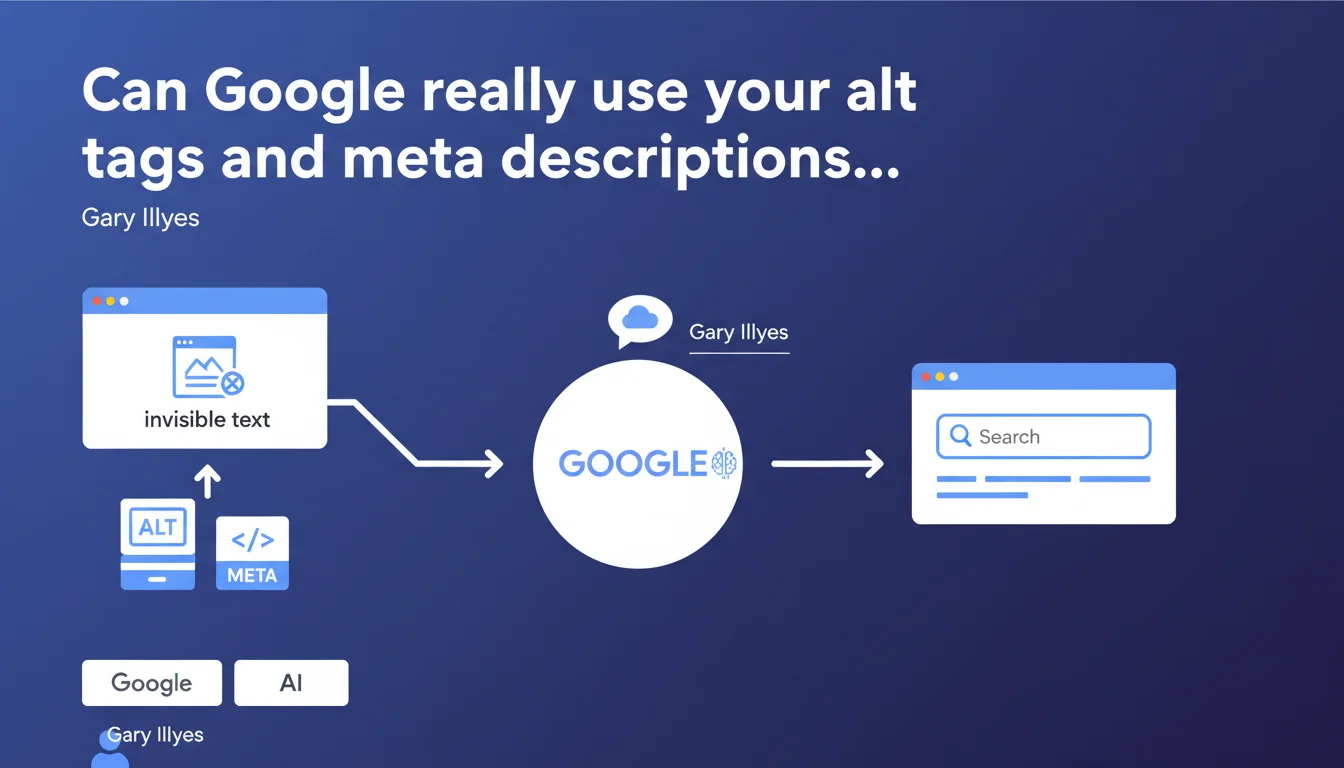
When a page lacks exploitable text, Google falls back on alternative sources to generate the snippet: image alt attributes and the meta description. In other words, these elements serve more than just standard SEO — they become your page's storefront in search results if textual content is insufficient.
What you need to understand
Why would Google look beyond the body text?
The search engine always prioritizes main content to build the snippet displayed in the SERPs. But some pages — particularly highly visual ones with infographics, photo galleries, or interfaces dominated by interactive elements — offer little exploitable text.
In these specific cases, Google switches to alternative sources: image alt attributes and the meta description tag. This is a fallback logic, not a default choice. If your page contains a minimum of structured text, the engine will use it as a priority.
What does "otherwise invisible text" mean in this context?
The term can be confusing. Google is not talking about hidden or deliberately masked text here — which remains penalizable. It refers to text present in the HTML but not directly visible on screen in the classical reading flow.
Alt attributes, for example, appear on hover or if the image fails to load. The meta description, on the other hand, is never displayed on the page itself. These two elements thus become legitimate candidates when the body text falls short.
In what concrete cases does this situation occur?
Very minimalist product pages (visual e-commerce), photographer portfolios, some ultra-synthetic landing pages. All these formats can offer text content too reduced for Google to extract a relevant excerpt from.
Gary Illyes' statement confirms that the engine adapts: rather than displaying an empty or incoherent snippet, it leverages available resources. This is not a malfunction, it is an integrated safety mechanism in the algorithm.
- Google always prioritizes content visible in the page body to generate snippets.
- In the absence of sufficient text, it falls back on alt attributes and the meta description.
- This practice mainly concerns highly visual or minimalist pages.
- The "invisible" text here refers to HTML elements present but not displayed in the main flow.
- This is not an exploitable loophole, but a safety net to improve SERP display.
SEO Expert opinion
Is this statement consistent with what we observe in the field?
Yes, and it is actually quite well documented. We regularly see snippets that reproduce the meta description word for word while the page contains text in the main or in sections. Except that this text is sometimes too fragmented, full of structural tags or buried in schema.org markup.
The engine does not just look for text, it looks for text that is contextualized and coherent. If the main content is scattered into small blocks without narrative flow, Google switches to the meta description. This is especially true for pages whose main content is generated dynamically in JavaScript.
What nuances should be added to this statement?
Gary Illyes speaks of pages with "not enough text". But what does "enough" mean? — No numerical data. [To verify] on real page corpora to identify the threshold from which the switch occurs.
Another point: does this logic apply uniformly according to query type? An informational vs transactional search can influence how Google composes the snippet. Certain SERP formats (featured snippets, people also ask) already exploit alternative sources. This statement does not clarify whether the mechanism is identical.
What opportunities or pitfalls might this practice entail?
On the opportunities side: highly visual pages (portfolios, galleries, design landing pages) can finally have coherent snippets without having to stuff artificial text. This is good news for sites betting on imagery and UX.
On the pitfall side: some might be tempted to create near-empty pages with only a carefully crafted meta description and optimized alts, betting on this mechanism. It will not work. Google always evaluates the overall quality of the page — and a page without substantial content will not rank, even with a perfect snippet.
Practical impact and recommendations
How to optimize alt attributes and meta descriptions in this logic?
Alt attributes must precisely describe the image content, without keyword stuffing. If Google uses them to compose a snippet, they must form coherent and informative sentences. Avoid keyword lists separated by commas.
The meta description should be written like a commercial pitch of the page: clear, engaging, with a call-to-action verb if relevant. It should make people want to click while faithfully summarizing the content. If your page is poor in text, it is the description that will carry all the weight of the snippet.
What mistakes should you absolutely avoid?
Do not rely on this mechanism to bypass the need for quality textual content. Google will not favor an empty page just because it has a well-crafted meta description. The snippet is just a storefront — if what lies behind it does not hold up, ranking will suffer.
Another pitfall: duplicating meta descriptions and alt attributes across multiple pages. If Google falls back on them to generate snippets, you risk ending up with identical excerpts in the SERPs for different URLs. Result: cannibalization and declining click-through rates.
How to verify that my pages are optimized for this mechanism?
Audit your pages that are poorest in text: portfolios, galleries, minimalist product cards. Verify that each image has a unique and descriptive alt attribute. Check that each meta description is written, unique, and relevant.
Test display in the SERPs using the URL inspection tool in Search Console. If the snippet displayed matches neither the main content nor your meta description, Google is pulling from elsewhere — or worse, it is not finding anything exploitable.
- Write descriptive and coherent alt attributes for all your important images.
- Ensure that each meta description is unique, engaging, and faithfully summarizes the page.
- Audit pages poor in text to identify those likely to switch to these alternative sources.
- Avoid duplication of meta descriptions and alts between different pages.
- Test snippet display via Search Console to verify what Google actually displays.
- Never rely on this mechanism to compensate for poor quality or nonexistent textual content.
This statement reminds us that every HTML element counts — even those you do not see directly on screen. Alt attributes and meta description are not mere SEO formalities, they can become the first impression users will have of your page in search results.
Optimizing these elements requires a methodical approach and a fine understanding of how Google evaluates and displays content. If this type of audit seems complex to carry out alone, or if you wish to ensure that every technical detail is covered, calling on a specialized SEO agency can save you valuable time and prevent costly visibility errors.
❓ Frequently Asked Questions
Google utilise-t-il systématiquement la meta description si la page manque de texte ?
Un attribut alt peut-il vraiment apparaître tel quel dans un snippet ?
Peut-on se passer de contenu textuel en misant uniquement sur ces sources alternatives ?
Cette pratique fonctionne-t-elle pour tous les types de pages ?
Doit-on éviter le JavaScript pour que Google trouve du texte exploitable ?
🎥 From the same video 12
Other SEO insights extracted from this same Google Search Central video · published on 23/04/2024
🎥 Watch the full video on YouTube →
💬 Comments (0)
Be the first to comment.