
Official statement
Other statements from this video 9 ▾
- □ Is Googlebot really flagging soft 404s on your empty geolocalized pages?
- □ Is geolocation-based cloaking really acceptable to Google?
- □ Does Google really consider showing default national content as cloaking?
- □ Is cloaking really a problem if the user isn't being deceived?
- □ Is Googlebot really crawling your website from multiple countries?
- □ Is log file analysis really the game-changer that large-scale sites are overlooking?
- □ Is an empty page destroying your user experience and SEO potential?
- □ How can you guarantee a user experience that matches expectations without risking a cloaking penalty?
- □ Should you really compare the actual state of your pages before and after a traffic drop?
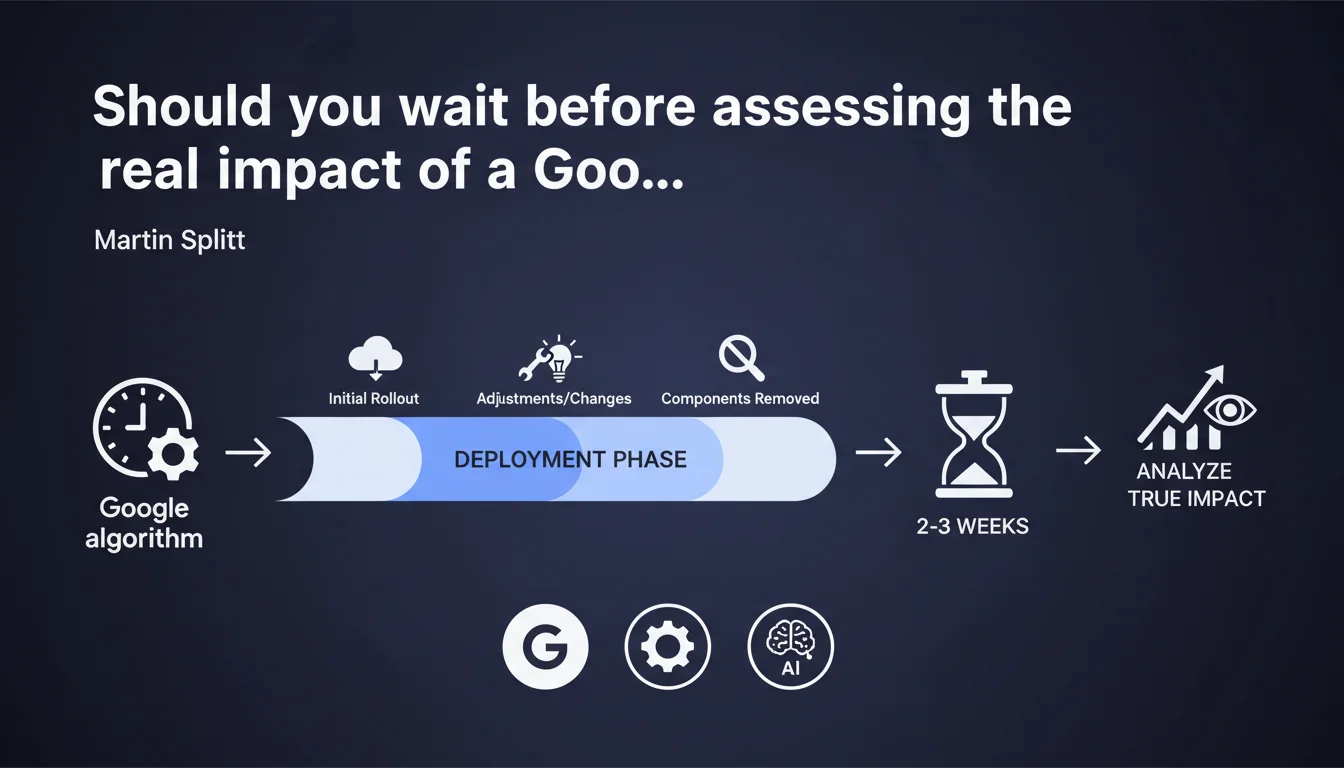
Google's algorithm updates deploy over several weeks, with potential adjustments happening along the way. Analyzing an update's impact before 2-3 weeks leads to false conclusions. Patience is a strategic skill in SEO, not optional.
What you need to understand
Why do Google updates take so long to roll out?
Google doesn't deploy its algorithms all at once across all its servers. The process is progressive and iterative, with phases of testing, adjustment, and field validation. Some components can be removed or modified during rollout if results don't match expectations.
This gradual approach allows Google to minimize collateral damage. A brutal rollout would cause massive, uncontrollable fluctuations. Progressive deployment provides room to fine-tune parameters based on initial feedback.
What actually happens during those 2-3 weeks?
In the first few days, you observe erratic movements: a site climbs on Monday, drops on Wednesday, rises again on Friday. That's normal. The algorithm hasn't reached all datacenters yet, and the signals it processes aren't stabilized.
Adjustments can happen mid-deployment. Google tests different weightings, observes results, corrects course. What you measure on day 5 often has no connection to the final result on day 20.
When does the impact become reliable?
Martin Splitt sets the bar at 2-3 weeks minimum. Before that threshold, you're taking a snapshot of an ongoing process. Trends only stabilize once deployment is complete and signals are consolidated.
This means articles published 48 hours after an update launch—claiming victory or disaster—are statistically unreliable. They ride the news cycle, not actionable data.
- Progressive rollout: takes weeks, not instant
- Possible adjustments: components removed or modified during deployment
- Reliable analysis window: 2-3 weeks minimum
- Initial fluctuations: normal and not representative
- Stabilization: necessary before drawing conclusions
SEO Expert opinion
Does this timeline match what we actually see in the field?
Yes, and it's rarely contested by experienced practitioners. Tracking tools show violent oscillations during the first weeks, then gradual convergence. Sites appearing as winners on day 3 can become losers by day 15.
What becomes problematic is commercial and media pressure. Clients want immediate answers. Web newsrooms want fresh content. This race for instant results produces noise rather than signal.
Why does this insight remain so poorly applied?
Because impatience is structural. A small business owner seeing traffic drop 30% in three days won't wait three weeks for explanations. Agencies must therefore report on unstable data, knowing it is.
There's also a psychological bias: when you spot a variation, you immediately try to rationalize it. Accepting that you need to wait without doing anything feels counterintuitive. Yet any corrective action taken too early rests on shifting foundations.
What nuances should we add to this advice?
Waiting 2-3 weeks doesn't mean sitting idle. You can—and should—observe, document, compare. Note patterns, affected pages, possible correlations. But don't draw final conclusions, and especially don't launch rushed overhauls.
[To verify]: Martin Splitt doesn't specify whether certain updates (spam, core, helpful content) have different timelines. Field experience suggests anti-spam updates may have more immediate effects, while core updates genuinely require several weeks for stabilization.
Practical impact and recommendations
What should you actually do during those 2-3 weeks?
Document without concluding. Set up rigorous monitoring: daily positions, organic traffic by segment, key landing pages. Cross-reference with your crawl tools to detect any technical issues unrelated to the update.
Identify the most impacted pages—both gains and losses. Look for patterns: content type, depth, backlinks, freshness. But keep these observations as working notes, not conclusions. You're building hypotheses, not certainties.
What mistakes must you avoid?
Don't massively modify your site during this period. If you change 50 titles, redesign 30 pages, and pile on new content, you contaminate the analysis. Then it's impossible to know what stems from the update versus your actions.
Also avoid reporting too quickly to your client or leadership. Announcing a 40% drop on day 4 when you're at +10% on day 18 destroys credibility. Instead, communicate: "We're observing normal fluctuations; reliable initial analysis in X days."
How do you turn this waiting period into strategic advantage?
Audit your site on criteria independent of the update: technical structure, content quality, user experience. If the update impacts you negatively, you'll already have a roadmap ready. If it favors you, you'll consolidate gains.
This is also the time to benchmark competitors. Compare their movement patterns to yours. Sites rising together often share common characteristics you'll need to identify once data stabilizes.
- Set up daily tracking (positions, traffic, conversions)
- Document impacted pages with their characteristics
- Avoid any major SEO modifications for 2-3 weeks
- Prepare a factual interim report without premature conclusions
- Cross-check data with crawl tools (technical vs. algorithm)
- Compare your movement against direct competitors
- Plan a technical and content audit in parallel
- Communicate the actual timeline to clients or stakeholders
❓ Frequently Asked Questions
Peut-on vraiment ne rien faire pendant 2-3 semaines après une update ?
Comment savoir si une baisse de trafic est due à l'update ou à un problème technique ?
Les 2-3 semaines s'appliquent-elles à toutes les mises à jour Google ?
Que dire à un client qui panique après 3 jours de baisse ?
Peut-on commencer à optimiser avant la fin du déploiement ?
🎥 From the same video 9
Other SEO insights extracted from this same Google Search Central video · published on 13/12/2022
🎥 Watch the full video on YouTube →
💬 Comments (0)
Be the first to comment.