
Official statement
Other statements from this video 10 ▾
- □ Has web accessibility become an unavoidable SEO criterion?
- □ Does Google really prioritize color contrast for SEO rankings, and should you care?
- □ Does text spacing and structure really influence your Google rankings?
- □ Does your keyboard tab order really impact SEO rankings?
- □ Do skip links really improve your SEO, or are they just an accessibility checkbox?
- □ Why does Google insist on visible keyboard focus indicators for all interactive elements?
- □ Should you really test accessibility with native screen readers for SEO purposes?
- □ Why Should Accessibility Education Come Before Technical Auditing?
- □ Does text size really matter for Google rankings, or is it just about user experience?
- □ Did you know that 90% of websites fail accessibility criteria—and what's the real SEO impact?
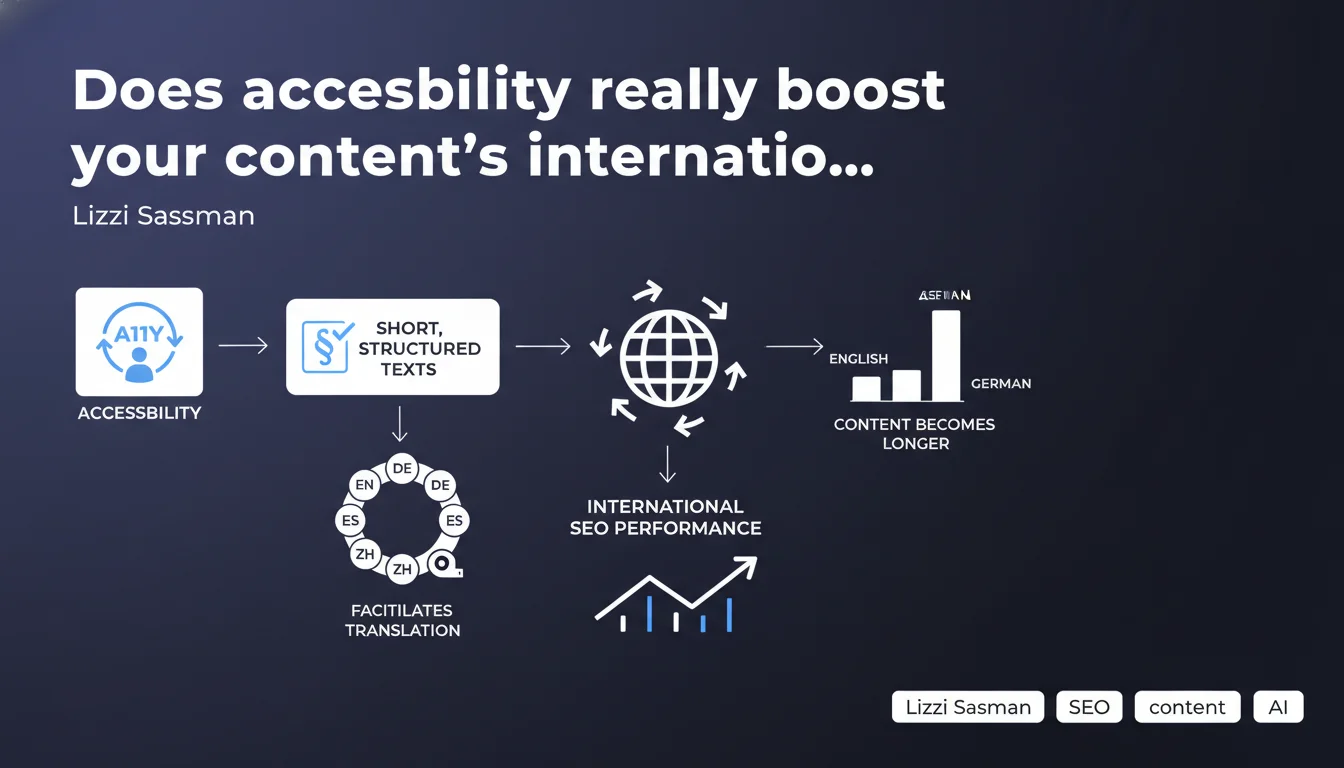
Google confirms that writing short, well-structured texts improves not only accessibility but also translation into other languages. The challenge: certain languages like German generate content up to 30% longer than English, which can cause layout and user experience issues. Starting with concise text limits these side effects.
What you need to understand
What's the real connection between accessibility and translation in SEO?
Google draws a direct link between web accessibility and content translation. The logic: a well-structured text with short sentences and clear hierarchy translates more faithfully into other languages.
This approach reduces semantic ambiguities when using automated or human translation tools. Accessible content is inherently more explicit, less open to interpretation — exactly what professional translators and systems like Google Translate integrated into localization processes need.
Why do certain languages cause text expansion problems?
German, Finnish, and Dutch systematically generate longer content than their English equivalents — sometimes 30 to 35% more characters. If your UI design plans a CTA button at 120px based on an 8-character English text, the German version risks overflowing.
This phenomenon directly impacts user experience on localized versions: broken interfaces, truncated text, increased reading time. Google factors these UX signals into its assessment of a page's local relevance.
What does "well-structured text" actually mean according to Google?
Google doesn't provide a precise technical definition here, but we can deduce: systematic use of HTML5 semantic tags (section, article, aside), clear heading hierarchy H1-H6, short paragraphs, bullet lists when appropriate.
Add to that ARIA markup for accessibility and you get content that assistive technologies and translation systems can parse without friction. The collateral benefit: Googlebot better understands the logical structure of your content.
- Concise texts reduce linguistic expansion during translation
- Clear semantic structure facilitates parsing by translation tools
- Accessibility and translatability share the same fundamentals: clarity, explicitness, hierarchy
- Poorly optimized localized versions generate negative UX signals for Google
SEO Expert opinion
Is this statement really breaking news for experienced SEO professionals?
Let's be honest: no. Any SEO who's managed multilingual sites has long known about linguistic expansion issues. What Google is doing here is formalizing the link between accessibility and localization — two silos that rarely work together in organizations.
The real value of this statement? It provides business ammunition for SEO teams to justify web accessibility investments to executives who only see short-term ROI. "We're not doing this for the 5% of users with disabilities; we're doing it to improve our performance across 40 international markets."
What are the practical limitations of this approach?
First trap: reducing text length to facilitate translation can directly conflict with the semantic depth requirements needed for SEO. A 300-word article translated perfectly won't rank better than a 2,000-word competitor that's less perfectly translated but more comprehensive.
Second caveat — and Google never mentions this: some markets culturally expect more developed content. German and Japanese users often prefer exhaustive precision over Anglo-Saxon conciseness. Adapting length to your target market remains more relevant than applying a universal rule.
Can you measure the real impact of this optimization?
Difficult. Google provides no metrics that allow you to isolate the "accessibility-translation" effect on international ranking. Accessibility audit tools (Lighthouse, WAVE) don't cross their data with SEO performance by language in Search Console.
[To verify] The claim that starting with concise text "benefits everyone" deserves hard data case studies. We're missing empirical evidence demonstrating that a 30% reduction in initial text volume actually improves SEO KPIs on translated versions — especially against local SERPs where long-form content dominates.
Practical impact and recommendations
How can you audit the translatability of your existing content?
Start with a semantic structure audit: verify that your pages correctly use HTML5 tags and that heading hierarchy is consistent. Lighthouse and Screaming Frog can automate much of this work.
Then test linguistic expansion: take your 20 strategic pages, run them through Google Translate to German, Dutch, and Finnish. Measure the length increase. If it exceeds 35%, your UI designs risk breaking on these markets.
What mistakes should you avoid when optimizing for translation?
Don't shorten to the point of sacrificing semantic richness. Concise but shallow text won't rank, regardless of its translatability. Balance is found in eliminating redundancy and convoluted phrasing — not in removing useful information.
Another trap: automating translation without local human validation. Tools are improving, but a short sentence poorly translated causes more UX damage than a long sentence correctly rendered. Invest in native proofreading at minimum for your strategic pages.
- Audit the HTML5 semantic structure of your main templates
- Measure linguistic expansion on a representative content sample
- Verify that your UI designs support +35% character increase without breaking
- Implement consistent ARIA markup on all interactive elements
- Test translated content with native speakers before large-scale rollout
- Cross Search Console data by language with Core Web Vitals metrics
- Document local semantic variations missed by literal translation
Should you overhaul your entire international content strategy?
Not necessarily a complete redesign. Prioritize high-impact business pages: product sheets, advertising landing pages, conversion pages. These are where a broken interface or truncated text directly costs revenue.
For editorial content like blogs, the approach can remain more flexible. Focus on structural clarity rather than systematic length reduction — especially if your local competitors publish detailed content.
❓ Frequently Asked Questions
L'accessibilité web impacte-t-elle directement le ranking Google ?
Quelle longueur de texte privilégier pour optimiser la traduction ?
Faut-il traduire automatiquement ou faire appel à des traducteurs humains ?
Comment mesurer l'expansion linguistique de mes contenus ?
L'optimisation pour la traduction fonctionne-t-elle sur tous les marchés ?
🎥 From the same video 10
Other SEO insights extracted from this same Google Search Central video · published on 11/08/2022
🎥 Watch the full video on YouTube →
💬 Comments (0)
Be the first to comment.