
Official statement
Other statements from this video 10 ▾
- □ L'accessibilité web est-elle devenue un critère SEO incontournable ?
- □ Pourquoi Google insiste-t-il autant sur le contraste des couleurs pour le SEO ?
- □ Pourquoi l'ordre de tabulation au clavier impacte-t-il votre SEO ?
- □ Faut-il vraiment implémenter des skip links pour améliorer son SEO ?
- □ Pourquoi Google insiste-t-il sur l'indicateur de focus clavier visible ?
- □ Faut-il vraiment tester l'accessibilité avec les lecteurs d'écran natifs pour le SEO ?
- □ Pourquoi l'éducation en accessibilité doit-elle précéder l'audit technique ?
- □ La taille du texte est-elle vraiment un critère de classement Google ?
- □ Pourquoi l'accessibilité améliore-t-elle vraiment la localisation SEO de vos contenus ?
- □ Pourquoi 90% des sites web échouent-ils sur les critères d'accessibilité et quel impact SEO ?
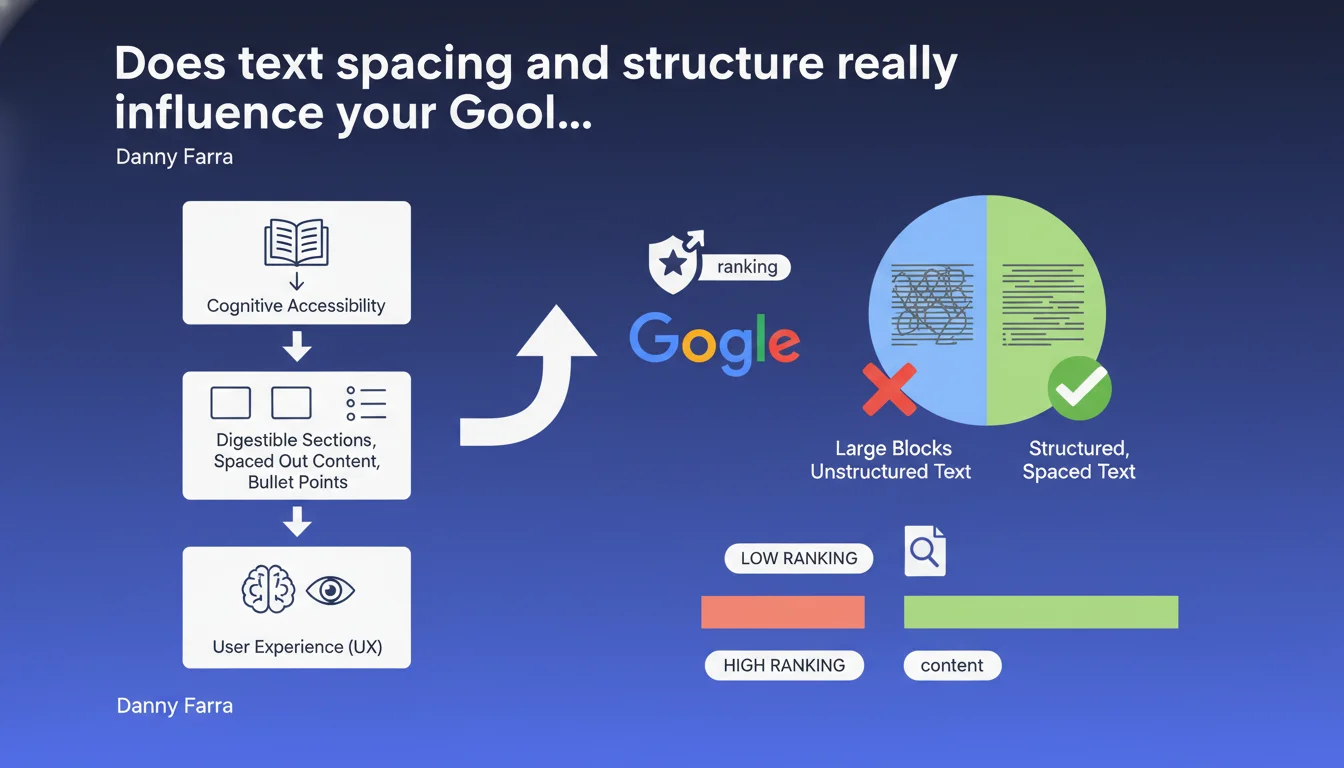
Google states that cognitive accessibility relies on clear structure: short paragraphs, spacing, bullet points. Compact text blocks harm all users, whether neurodivergent or not. This is an official position on user experience that aligns with UX criteria factored into the algorithm.
What you need to understand
Why is Google talking about cognitive accessibility now?
Cognitive accessibility refers to a piece of content's ability to be easily understood by everyone, including neurodivergent individuals (dyslexia, ADHD, autism spectrum disorders). Google is expanding its definition of accessibility beyond mere technical aspects (alt tags, contrast, screen readers).
This statement fits into a broader logic: improving overall user experience. Poorly structured text tires readers, increases bounce rate, reduces time on page. All signals that Google picks up on.
What does "consumable structure" actually mean?
A "consumable" paragraph is 2 to 4 lines maximum, one idea per block. Visual spacing between paragraphs allows the eye to breathe. Bullet points make rapid scanning easier.
Large, compact blocks — 10 lines in a row without breaks — create excessive cognitive load. The brain must exert extra effort to segment information. Google explicitly states this format harms everyone, not just neurodivergent users.
Does this statement have a direct SEO impact?
Google doesn't explicitly say "structure = better ranking." But it links cognitive accessibility to quality of user experience. Now, Core Web Vitals, bounce rate, session time indirectly influence rankings.
Well-structured content is also better crawled and understood by bots. Semantic tags (h2, h3, ul, li) facilitate extraction of featured snippets and direct answers. Structure helps the algorithm prioritize information.
- Cognitive accessibility: content that's easy to understand for everyone, including neurodivergent individuals
- Short paragraphs: 2-4 lines maximum, one idea per block
- Visual spacing: margins between paragraphs, text aeration
- Bullet points: facilitate rapid scanning and hierarchy
- Indirect SEO impact: better UX → positive signals → potentially better ranking
SEO Expert opinion
Is this statement consistent with real-world observations?
Yes, largely. Sites that perform well in SERPs almost always present clear structure: hierarchical headings, short paragraphs, lists, visuals. Dense text blocks are rare in the top 3, except on highly technical queries where the audience expects depth.
A/B tests show that aerated content increases time on page and reduces bounce rate. These behavioral signals matter. So indirectly, yes, structure impacts ranking.
What nuances should we consider?
Google provides no numerical thresholds. Maximum lines per paragraph? Ideal spacing? How many bullet points per page? [To verify] — no official data specifies these limits.
The notion of "consumable" is subjective. An academic article for researchers can tolerate longer paragraphs than a how-to guide for the general public. Context and audience matter. Blindly adapting all content to a single formula would be a mistake.
Another point: Google talks about accessibility, but the algorithm doesn't "read" like a human. It detects patterns (tags, block length, text density), but doesn't "feel" cognitive fatigue. SEO impact mainly comes through human behavioral signals.
When doesn't this rule apply?
Highly technical content — legal documentation, scientific articles, API guides — can require denser paragraphs. The target audience expects precision, not excessive simplification.
Long-form content (pillar content, 5000+ word guides) sometimes needs fuller sections. But even then, dividing into clear subsections remains relevant. Length doesn't excuse lack of structure.
Practical impact and recommendations
What should you do concretely with your existing content?
Audit your strategic pages. Identify text blocks longer than 5-6 lines and break them into separate paragraphs. One idea = one paragraph. If a paragraph contains two concepts, separate them.
Add bullet points whenever you list multiple items. "We offer X, Y, and Z" becomes a list. It's clearer for users, better scanned by Google.
Organize with H3 subheadings. Frame them as natural questions. This helps the algorithm understand structure and increases your chances of appearing in featured snippets.
What mistakes should you absolutely avoid?
Don't artificially break paragraphs to the point of destroying flow. One-line paragraphs repeated 20 times become unreadable. Aim for 2-4 lines, not absurd fragmentation.
Avoid overly long bullet lists (more than 8-10 items). If you exceed that, group into subcategories or split into multiple sections. A 25-point list won't get read.
Don't sacrifice depth for form. Superficial content with great structure will never beat dense, well-organized content. Structure serves content, it doesn't replace it.
How can you verify your content meets these criteria?
Test with a screen reader (NVDA, JAWS) to see if the hierarchy is clear. If the audio experience is confusing, structure isn't solid.
Use tools like Hemingway Editor to detect overly long sentences and dense paragraphs. Aim for readability scores appropriate to your audience (Flesch-Kincaid, Gunning Fog).
Have someone unfamiliar with the topic read your content. If they need to reread twice to understand, structure isn't clear enough.
- Audit strategic pages: identify text blocks of 5+ lines
- Cut each paragraph to 2-4 lines maximum, one idea per block
- Add bullet points for any list of 3 or more items
- Organize with H2/H3 headings, framed as natural questions
- Space visually: margins between paragraphs, padding around lists
- Test with a screen reader to verify clarity of navigation
- Measure readability (Flesch-Kincaid, Hemingway Editor)
- Have someone outside the context proofread to validate comprehension
❓ Frequently Asked Questions
Google pénalise-t-il les sites avec des gros blocs de texte ?
Combien de lignes maximum par paragraphe pour être « accessible » ?
Les listes à puces améliorent-elles le SEO ?
Cette déclaration concerne-t-elle uniquement les utilisateurs neurodivers ?
Faut-il restructurer tous les anciens contenus ?
🎥 From the same video 10
Other SEO insights extracted from this same Google Search Central video · published on 11/08/2022
🎥 Watch the full video on YouTube →
💬 Comments (0)
Be the first to comment.