
Official statement
Other statements from this video 9 ▾
- □ Was Google really prioritizing HTML over JavaScript for crawling and indexing?
- □ Can loading spinners really prevent Google from indexing your JavaScript pages?
- □ Why does Google take 3 to 6 months to index JavaScript content after crawling your site?
- □ Is your JavaScript slowing down how fast Google discovers your pages?
- □ Can JavaScript Really Be Indexed Faster Than HTML?
- □ Is your JavaScript really being rendered by Google? Here's how to verify it with the honeypot method.
- □ Are all JavaScript frameworks really treated equally by Google's crawling system?
- □ Is Google misleading you about JavaScript rendering, or just keeping things simple?
- □ Why does Google recommend testing in real conditions rather than relying solely on documentation?
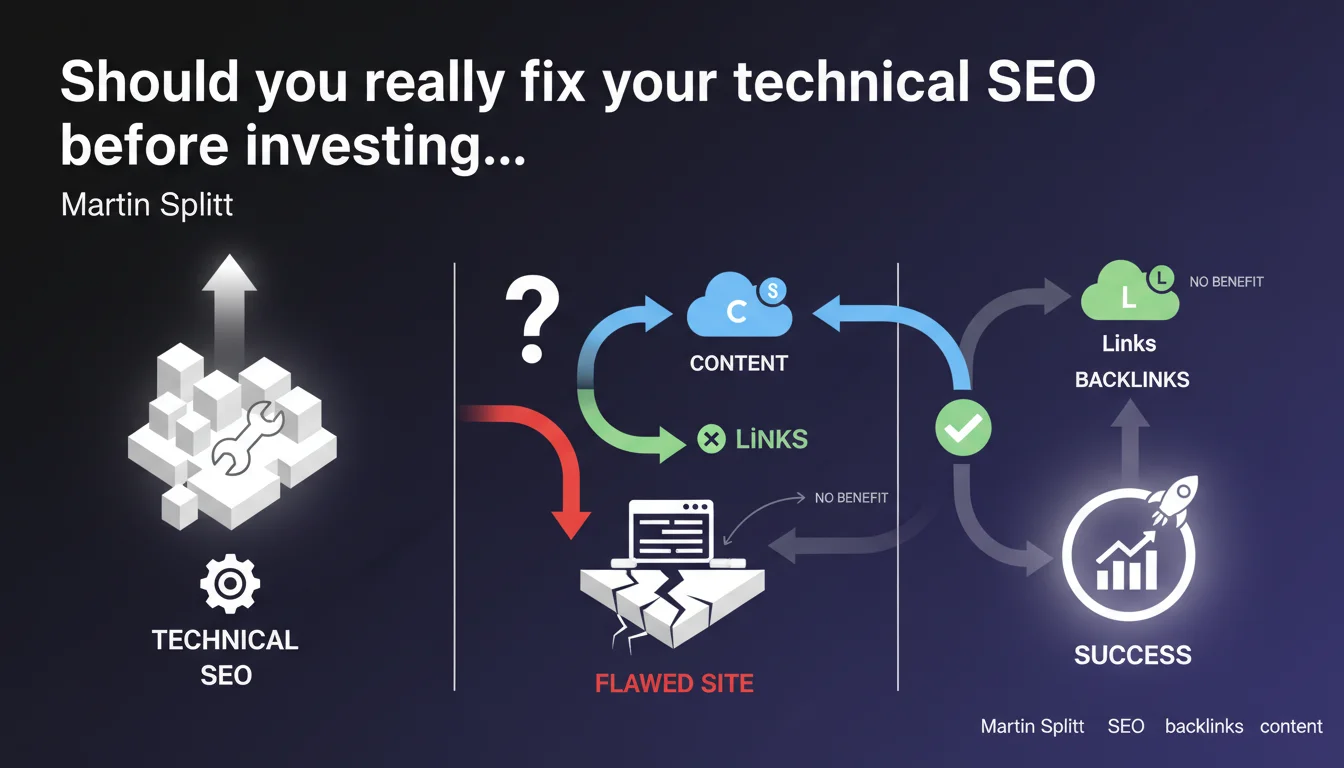
Google, through Martin Splitt's voice, states that a technically flawed website will not benefit from massive investments in content or backlinks. The technical foundation must be solid first. Without it, you're wasting budget and time on levers that won't be able to produce their effects.
What you need to understand
Why does Google insist so much on technical SEO?
Google's position is clear: a search engine must first be able to crawl, index, and understand your pages. If technical problems block crawling, slow down rendering, or prevent indexation, the best content in the world will remain invisible.
Concretely? A site with recurring 5xx errors, catastrophic server response times, or poorly managed JavaScript structure will never allow Googlebot to do its job correctly. Backlinks pointing to non-indexable URLs transmit no useful PageRank. Exceptional content on an orphaned or robots.txt-blocked page will never rank.
What exactly do we mean by "technical foundation"?
The "technical foundation" encompasses everything that allows a search engine to discover, crawl, index, and interpret content. This includes server availability, crawl budget management, site architecture, robots.txt and meta robots directives, redirects, HTTP status codes, and JavaScript handling both server-side and client-side.
But also — and this is often overlooked — performance. Core Web Vitals, loading time, visual stability. A slow or unstable site degrades user experience and sends negative signals to Google, even if the content is relevant.
Does this statement undermine the importance of content and backlinks?
Absolutely not. Google isn't saying that content or links don't matter. It's saying that these levers only work at full capacity if the technical foundation is sound. It's a matter of logical prioritization.
Investing €50,000 in a link-building campaign when 40% of your pages return 404 errors or your server response time exceeds 3 seconds is wasting money. Links will never compensate for a broken architecture.
- Technical SEO is not a "nice to have": it's a prerequisite for other SEO levers to work.
- A technically solid site maximizes the ROI of content and backlinks.
- Technical problems block crawling, prevent indexation, or degrade user experience — Google penalizes these signals.
- Performance (Core Web Vitals, loading time) is an integral part of the technical foundation.
SEO Expert opinion
Is this statement consistent with real-world observations?
Yes, absolutely. In the field, we regularly see sites with excellent content and quality backlinks that stagnate because of structural technical problems. Indexation errors, poorly managed canonicals, JavaScript blocking server-side rendering, broken pagination, disastrous server response times.
And that's where it gets stuck: many clients want "content" or "links" before fixing the fundamentals. Result? SEO gains are limited, or nonexistent. Once technical fixes are deployed, the same levers (content, backlinks) produce significantly better results.
What nuances should be noted?
Be careful not to fall into paralyzing perfectionism. "Solid technical foundation" does not mean "absolute perfection". If you wait to achieve a PageSpeed score of 100/100 on all your pages before publishing content, you'll never publish anything.
What matters is that the site is crawlable, indexable, and offers a correct user experience. A 2-second loading time with an LCP of 2.5s is acceptable. A site with 5% of pages returning 404 errors isn't catastrophic if they're minor and fixed quickly. Let's be honest: most sites have some imperfections — the issue is not having critical blockers.
Furthermore, this rule applies differently depending on context. [To verify] A small site with 50 pages can probably fix 90% of its technical issues in a few weeks. An e-commerce site with 500,000 URLs and complex technical stack might take 6 months to get everything in order. In that case, you need to prioritize: first fix critical blockers (indexation, crawling, 5xx errors), then gradually improve performance and architecture.
In what cases does this rule not fully apply?
There are a few situations where technical SEO takes a back seat — but they're rare. For example, if you already have a technically sound site, continuing to fine-tune micro technical optimizations at the expense of content or backlinks becomes counterproductive. At some point, you need to move on to other things.
Similarly, on ultra-competitive queries, a technically perfect site with weak content and no quality backlinks will never rank. Technical SEO is necessary, but not sufficient. It's a foundation, not an end in itself.
Practical impact and recommendations
What should you concretely do before investing in content or backlinks?
Start with a complete technical audit. Identify critical blockers: indexation errors in Search Console, pages not being crawled, high server response times, massive 5xx or 4xx errors, misconfigured robots.txt directives, looping canonicals, redirect chains.
Next, verify that your internal link architecture allows Googlebot to discover all your strategic pages. A page 10 clicks from the homepage has little chance of being crawled regularly. Fix orphaned pages, simplify navigation, optimize internal linking.
Finally, measure and improve performance: Core Web Vitals (LCP, CLS, INP), loading time, rendering stability. A slow or unstable site degrades user experience and sends negative signals to Google, even if the content is excellent.
What mistakes should you absolutely avoid?
Never assume "it works" without checking. I've seen sites with 30% of pages blocked by robots.txt without anyone noticing. Or canonicals pointing to non-existent URLs. Or average server response times of 8 seconds.
Another common mistake: fixing one technical problem by creating a new one. For example, adding a CDN without properly configuring HTTP headers, which breaks indexation. Or migrating to a new JavaScript stack without proper server-side rendering. Always test in a staging environment before deploying to production.
How do you verify your site is ready for content and link-building investments?
Use Search Console to detect indexation errors, coverage issues, and Core Web Vitals problems. If you have critical alerts, prioritize fixing them. Also check the "Pages" report to ensure your strategic URLs are properly indexed.
Do a complete crawl with Screaming Frog or Oncrawl. Identify 4xx/5xx errors, redirect chains, inconsistent canonicals, blocking meta robots tags. Verify that all your important pages are crawlable and indexable.
Finally, test performance with PageSpeed Insights or WebPageTest. If your Core Web Vitals are in the red, fix them before launching a big content campaign. A slow site doesn't convert, even if it ranks.
- Audit indexation errors in Search Console and fix critical blockers.
- Verify that all strategic pages are crawlable, indexable, and accessible in fewer than 5 clicks from the homepage.
- Fix 4xx/5xx errors, redirect chains, misconfigured canonicals.
- Optimize server response time (TTFB < 600 ms ideally).
- Improve Core Web Vitals: LCP < 2.5s, CLS < 0.1, INP < 200 ms.
- Test server-side JavaScript rendering if your site is a SPA (React, Vue, Angular).
- Properly configure robots.txt, XML sitemaps, meta robots tags.
- Verify that internal linking distributes PageRank effectively.
Technical SEO is not a luxury — it's a prerequisite. Without a solid foundation, your investments in content and backlinks will produce disappointing results. Start by diagnosing and fixing critical blockers, then you can fully exploit the other levers.
These diagnostics and fixes can be complex to implement, especially on large-scale sites or with sophisticated technical architectures. If you lack internal resources or specific expertise, support from a specialized SEO agency can help you prioritize work, avoid costly mistakes, and accelerate your site's technical compliance.
❓ Frequently Asked Questions
Dois-je vraiment attendre d'avoir un site techniquement parfait avant de publier du contenu ?
Quels problèmes techniques sont vraiment bloquants pour le SEO ?
Un site techniquement parfait peut-il se passer de backlinks ?
Comment prioriser les correctifs techniques sur un gros site ?
Les Core Web Vitals font-ils vraiment partie de la fondation technique ?
🎥 From the same video 9
Other SEO insights extracted from this same Google Search Central video · published on 01/02/2023
🎥 Watch the full video on YouTube →
💬 Comments (0)
Be the first to comment.