
Official statement
What you need to understand
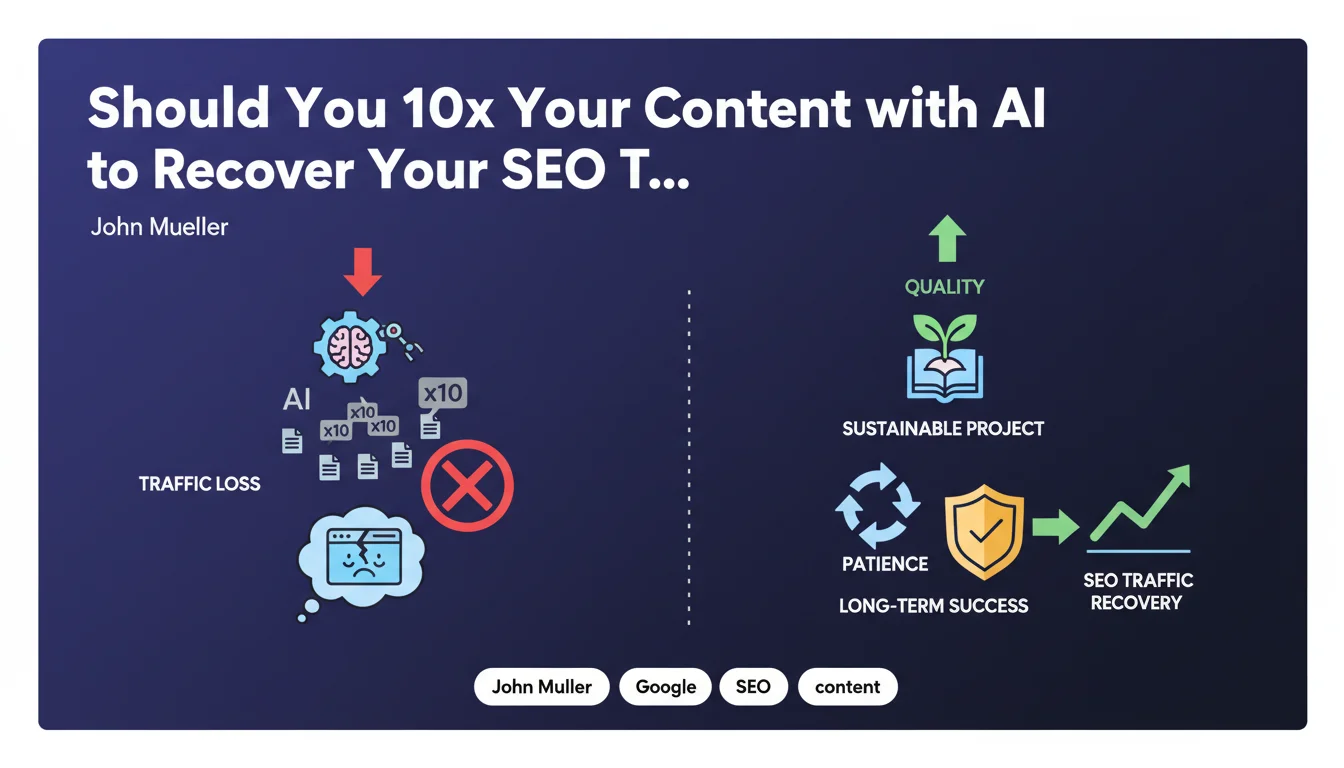
Google warns against artificial content inflation generated by AI to compensate for traffic losses. This position marks an important turning point in the company's communication about artificial intelligence usage.
The statement comes in a context where many sites have suffered visibility losses following recent algorithmic updates. Faced with this situation, the temptation is strong to massively produce content to numerically compensate for these declines.
Google reaffirms that quantity never replaces quality and that this volumetric approach is counterproductive. The algorithm is now capable of detecting content inflation strategies, whether AI-generated or not.
- AI is not prohibited but its massive use to inflate a site is discouraged
- Google favors sustainable and qualitative projects rather than quick fixes
- Patience and progressive building are valued by the algorithm
- A site with 500 quality articles performs better than a site with 5,000 mediocre articles
- Recent updates specifically target low-value-added content
SEO Expert opinion
This statement is perfectly consistent with field observations since the 2023 and 2024 updates. Sites that massively published poorly differentiated AI content have indeed been penalized, while those focusing on expertise have resisted.
Nevertheless, this position must be nuanced. AI remains a valuable tool for certain tasks: keyword research, content structuring, technical optimization, or writing assistance. The problem is not AI itself, but the absence of human added value and real expertise.
In certain sectors like e-commerce product descriptions or factual data, assisted AI can be effective if it is supervised, enriched, and personalized. The key lies in the ratio between automation and expert human intervention.
Practical impact and recommendations
- Audit your existing content: identify and improve low-performing pages rather than creating new ones
- Establish a quality/quantity ratio: aim for 1 excellent article per week rather than 10 average articles
- Integrate real expertise: add case studies, experience feedback, exclusive data that AI cannot generate
- Use AI as an assistant: for research, structure, optimization, but never as a final writer without supervision
- Document your expertise: detailed author biographies, certifications, publications, proof of legitimacy
- Prioritize EEAT content: Experience, Expertise, Authoritativeness, and Trustworthiness must be evident in every publication
- Absolutely avoid: massive publication of similar content, purely AI articles without editing, semantic duplication between pages
- Adopt a long-term vision: plan over 12-24 months rather than seeking immediate results
- Measure quality: reading time, engagement rate, natural backlinks rather than simply number of indexed pages
These optimizations require a comprehensive strategic approach that goes far beyond simple content production. Between semantic auditing, editorial restructuring, EEAT optimization, and performance monitoring, complexity can quickly become difficult to manage internally. Support from a specialized SEO agency enables you to structure this transformation with a proven methodology, avoid costly pitfalls, and accelerate the achievement of sustainable results.
💬 Comments (0)
Be the first to comment.