
Official statement
What you need to understand
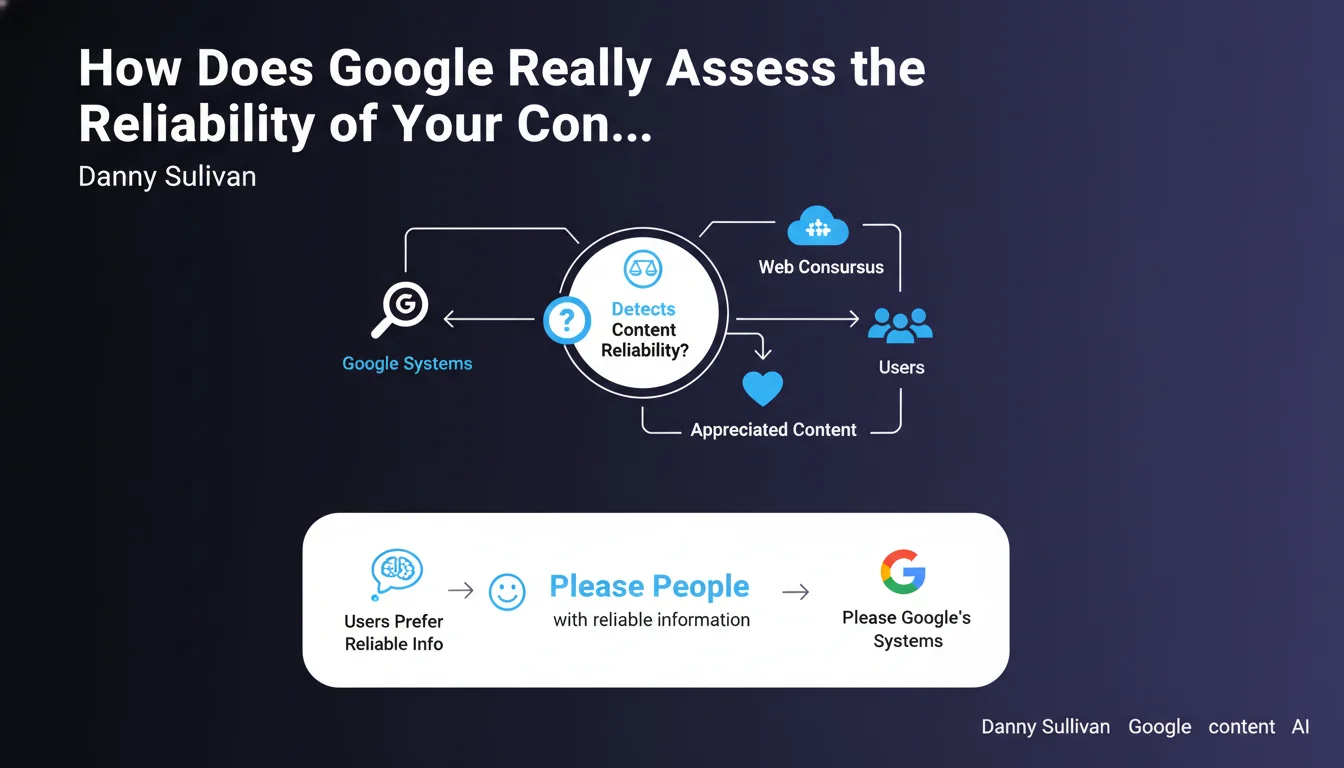
Google officially acknowledges that detecting content reliability is not a simple or automated process. The search engine uses multiple systems to evaluate whether content is trustworthy.
One of the central elements of this evaluation relies on the notion of consensus: Google seeks to identify whether information is the subject of general agreement on the web. This aspect notably mobilizes the MUM algorithm, capable of analyzing information across different sources and languages.
The statement emphasizes a fundamental principle: creating reliable content that pleases users should naturally satisfy Google's algorithms. This user-centric approach remains the search engine's official directive.
- No magic solution: Google admits it doesn't have a simple answer for verifying reliability
- Consensus as a signal: the convergence of information on the web serves as a reliability indicator
- MUM as an analysis tool: this algorithm helps determine informational consensus
- User-centered approach: meeting users' expectations regarding reliability
- Application to SGE: these mechanisms are particularly critical for the Search Generative Experience
SEO Expert opinion
This statement confirms what we've been observing for several years: Google favors content that benefits from ecosystem validation. Sites that perform well in SERPs are often those that are cited, referenced, and corroborated by other authoritative sources.
The use of MUM to detect consensus explains why isolated content, even well-written, sometimes struggles to rank. If your information is not picked up anywhere or contradicts the established consensus, you'll have more difficulty ranking, even if you're factually correct.
However, an important nuance: in emerging or specialized niches, consensus may be weak or non-existent. Google must then rely more heavily on other signals such as demonstrated expertise (E-E-A-T), content coherence, and user engagement.
Practical impact and recommendations
- Align with the established consensus in your field before proposing divergent angles
- Cite and link to recognized authoritative sources to reinforce the credibility of your claims
- Develop a mentions strategy: ensure that other sites relay or confirm your information
- Document your sources transparently, particularly in YMYL domains (health, finance, legal)
- Monitor sector consensus: use tools to identify which information is the subject of general agreement
- Build your topical authority progressively by regularly publishing on related topics
- Participate in the ecosystem: expert comments, external contributions, interviews strengthen your legitimacy
- Audit the overall coherence of your site: internal contradictions harm your perceived reliability
- For controversial topics, present multiple perspectives while solidly documenting your position
- Invest in E-E-A-T signals: author biographies, professional references, certifications
Implementing these recommendations requires a coordinated strategic approach affecting content production, link building, reputation management, and competitive analysis alike. These multidimensional optimizations demand sharp expertise and considerable time. For businesses wanting to quickly deploy an effective reliability strategy, support from a specialized SEO agency accelerates results while avoiding costly mistakes, particularly in sensitive sectors where credibility is a major business issue.
💬 Comments (0)
Be the first to comment.