
Official statement
Other statements from this video 13 ▾
- □ Does Google really prefer structured data over machine learning to understand your pages?
- □ Should you still bother with structured data if machine learning does the heavy lifting?
- □ Do structured data really give webmasters control over how Google displays their content?
- □ Does Google Really Check the Accuracy of Your Structured Data?
- □ Why should you implement generic structured data types before tackling specific ones?
- □ Why Can Your Valid Schema.org Markup Get Rejected by Google?
- □ Should you implement structured data that Google isn't using yet?
- □ Does structured data really influence how Google understands a page's topic?
- □ Does cramming your pages with structured data really boost your rankings?
- □ Should you abandon JSON-LD in favor of Microdata for structured data?
- □ Can external JSON-LD really cause synchronization problems for Google's indexing?
- □ Are Google's Testing Tools Really Reliable for Detecting Your Missing Structured Data?
- □ Should your structured data always reflect exactly what visitors actually see on your page?
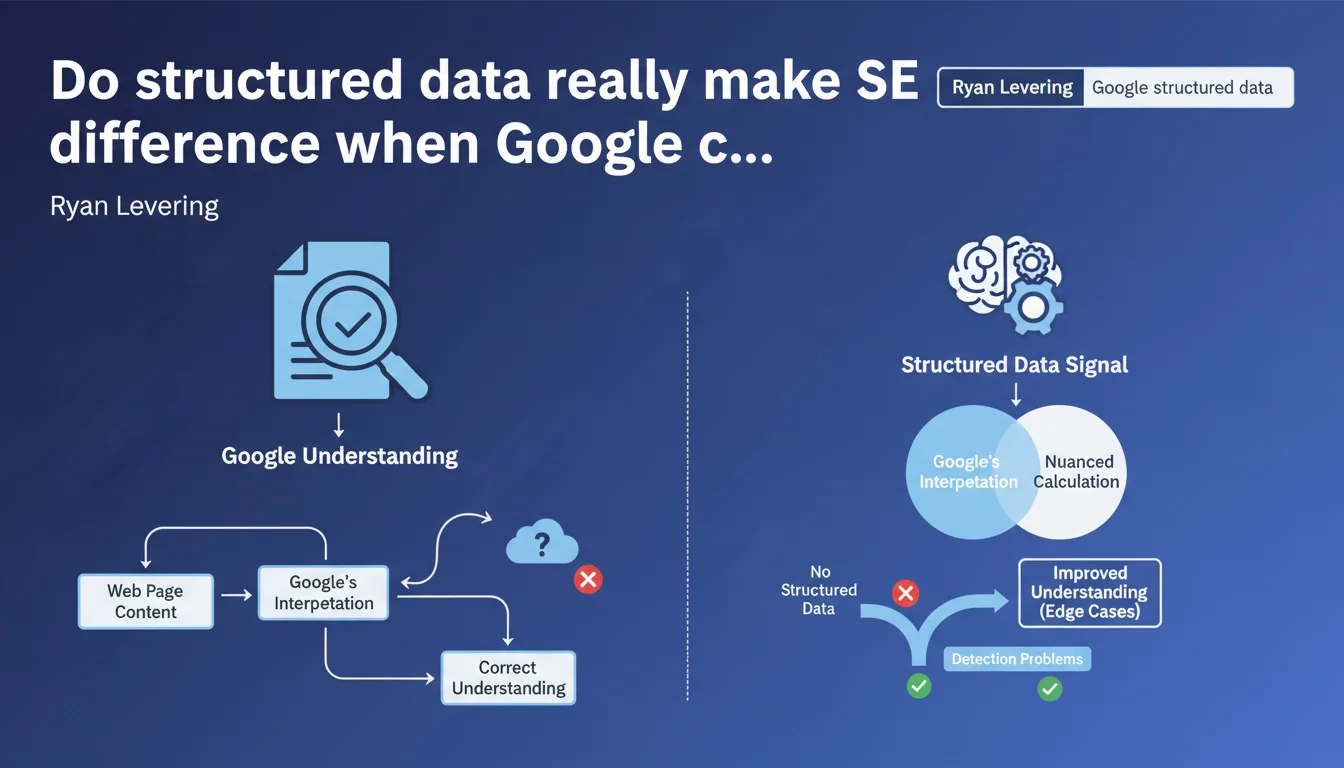
Google can understand a page without structured data, but these become decisive in edge cases with detection problems. They serve as a supporting signal in a nuanced calculation, not as a universal miracle solution.
What you need to understand
What exactly does an "edge case" mean according to Google?
Google talks about edge cases without really specifying what it means by that. We can interpret this as situations where the algorithm hesitates between multiple interpretations of a page — ambiguous content, complex HTML structure, or overlapping multiple elements.
Concretely, if your page presents an article with multiple dates (publication, modification, mentioned event), structured data will remove the ambiguity. Same thing for products with price variations depending on options.
Why does Ryan Levering insist on the term "additional signal"?
The choice of words is revealing. An additional signal is not a direct ranking factor or a guarantee of rich snippet display. It's data that adds to a set of signals in what Google calls a "nuanced calculation".
Translation: structured data don't compensate for weak content or poor user experience. They help Google better categorize and display your content when everything else is already solid.
In what contexts do structured data really make a difference?
The cases where we observe the most real-world impact: cooking recipes (with preparation time, ingredients), events (dates, multiple locations), e-commerce products (availability, variations), news articles (author, date, organization).
For a classic corporate blog with simple articles? The impact will be marginal if your HTML is clean and your content well structured. It's really on pages rich in metadata that it matters.
- Structured data do not replace good semantic HTML architecture
- They intervene as arbiters when Google must choose between multiple possible interpretations
- The impact is maximum on content rich in metadata (products, recipes, events)
- A "nuanced calculation" means that structured data are one signal among others, not an isolated lever
SEO Expert opinion
Is this statement consistent with what we observe in the field?
Generally yes, but with a caveat. We do see that sites with clean structured data have better rates of obtaining rich snippets — but the correlation is not as clear-cut as Google wants us to believe. I've seen sites without Schema.org get featured snippets, and perfectly marked-up sites ignored.
The problem is that Google never precisely defines what a "detection problem" is. [To verify]: does a simple lack of semantic HTML5 tags count as a detection problem? Or does there need to be truly major structural ambiguity?
What nuances should be added to this statement?
First nuance: Ryan Levering doesn't say that structured data improve ranking. He says they help understanding. That's not the same thing. You can rank on the first page without Schema.org if everything else is solid.
Second nuance: certain types of structured data are almost mandatory for certain sectors. Try ranking in e-commerce without Product Schema on competitive queries — good luck. In this context, we're no longer in the "additional signal" territory, we're in the bare minimum.
In what cases does this rule not really apply?
On news sites and media outlets, Article and NewsArticle structured data have become almost mandatory to appear in Google News and Top Stories. Saying they are "particularly useful on edge cases" is diplomatic understatement.
Same for recipe sites: without Recipe Schema, you'll never get the recipe carousel in SERP. It's not an "additional signal", it's a prerequisite. Let's be honest.
Practical impact and recommendations
What should you do concretely with this information?
Don't assume that structured data are optional. Audit your site to identify pages where Google might hesitate over interpreting the content — that's where Schema.org will save you.
Prioritize types of structured data based on your sector: Product for e-commerce, Recipe for food, Event for ticketing, Article for media. No need to implement everything if 80% of your content doesn't fit into any specific category.
What mistakes should you avoid when implementing?
Classic mistake: marking up invisible content for users. Google penalizes structured data that don't match displayed content. If your Schema says "price: 49€" but the page displays 59€, you risk a manual penalty.
Another trap: using multiple contradictory Schema types on the same page. Google will have to decide, and guess what — you just recreated the "detection problem" you wanted to solve.
- Validate your structured data with Google's Rich Results Test in Search Console
- Check consistency between the Schema and visible page content
- Monitor structured data errors in Search Console
- Prioritize strategic pages: flagship products, high-traffic articles, conversion pages
- Implement at minimum Organization, WebSite and Breadcrumb on all pages
- Test SERP display after implementation (rich snippets are never guaranteed)
Structured data are not a miracle lever, but their absence can handicap you on competitive queries where your competitors implement them. The pragmatic approach: start with Schema types directly linked to your business, test, measure, then expand.
The technical implementation of structured data and their strategic alignment with your SEO objectives can quickly become complex — especially on large-scale sites or restrictive CMS platforms. If you want to maximize their impact without risking costly errors, support from a specialized SEO agency may be worth considering to audit your situation and deploy a tailored strategy.
❓ Frequently Asked Questions
Les données structurées améliorent-elles directement le positionnement dans Google ?
Est-il obligatoire d'implémenter des données structurées sur toutes les pages ?
Pourquoi mes données structurées sont validées mais je n'ai pas de rich snippet ?
Quel format de données structurées privilégier : JSON-LD, Microdata ou RDFa ?
Les données structurées peuvent-elles pénaliser mon site si mal implémentées ?
🎥 From the same video 13
Other SEO insights extracted from this same Google Search Central video · published on 07/04/2022
🎥 Watch the full video on YouTube →
💬 Comments (0)
Be the first to comment.