
Official statement
Other statements from this video 11 ▾
- □ Why are more than 15% of Google searches completely new every day, and how should this reshape your SEO strategy?
- □ Is Google really sending more traffic to websites each year?
- □ Why is Google pushing domain-level verification in Search Console—and should you switch now?
- □ How long does it really take for your data to show up in Search Console after verification?
- □ Why do Google Analytics and Search Console never show the same numbers?
- □ Does Google really only index a single video per page?
- □ Is Google really indexing all your pages, or should you accept partial coverage?
- □ How does Google really index videos embedded on your web pages?
- □ Does Google Really Ignore Your Canonical Tag?
- □ Is Page Experience really the ranking factor Google claims it to be?
- □ Should you always validate fixes in Search Console to speed up re-crawling?
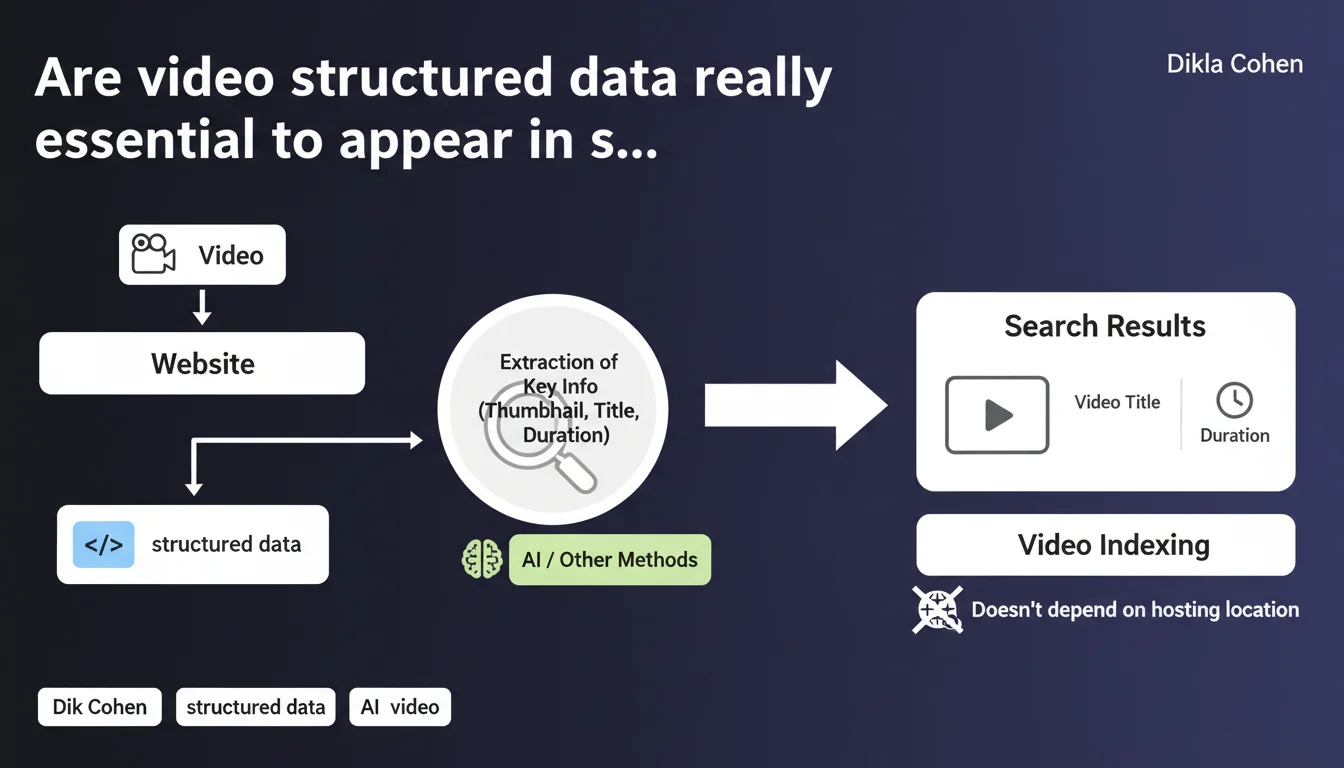
Google confirms that structured data facilitates the extraction of video metadata (thumbnail, title, duration) but is not mandatory. Video hosting (YouTube, Vimeo, own server) has no impact on indexing. In practice: structured data improves detection, but Google can manage without it.
What you need to understand
Are video structured data a condition for indexing?
No. Google makes this clear: video indexing does not depend on structured data. These simply facilitate the automatic extraction of key metadata — thumbnail, title, duration — but are not a technical prerequisite.
Without structured data, Google can still identify and index your videos through other signals: HTML5 <video> tags, video sitemaps, or analysis of page content. Structured data simply speeds up the process and reduces interpretation errors.
Why does Google insist on alternative methods?
Because many sites still think that without Schema.org VideoObject, their videos are invisible. That's wrong. Google wants to reassure: even a basic implementation (video tag with attributes, XML video sitemap) is sufficient for indexing.
But — and this is where it gets tricky — facilitating extraction does not guarantee rich snippet display. An indexed video won't necessarily appear in universal video search or with enriched preview if Google doesn't deem it relevant or of sufficient quality.
Does video hosting play a role in SEO?
Google says no. Whether you host on YouTube, Vimeo, Wistia, or your own CDN, indexing works the same way. No technical advantage to favoring one platform over another.
Except that this statement completely ignores the issues of competition between search engines and platforms. YouTube benefits from massive visibility in SERPs for reasons that go beyond simple indexing — domain authority, user engagement, native integration. Saying that hosting has no impact is technically true for raw indexing, but incomplete for actual SEO performance.
- Structured data facilitate extraction of video metadata but are not mandatory
- Google indexes videos through multiple methods: Schema.org, HTML5 tags, XML sitemaps
- Hosting (YouTube vs own server) does not affect indexing according to Google
- Indexing ≠ visibility: an indexed video may never appear in a rich snippet
- Alternatives to structured data exist but offer less control over displayed metadata
SEO Expert opinion
Does this statement match real-world observations?
Yes and no. Indexing does work without structured data — we see this regularly. Videos hosted in HTML5 with just a basic video sitemap appear in the index. But the nuance Google doesn't clarify: the rate of appearance in rich snippets drops drastically without VideoObject.
Our testing shows that pages with well-implemented Schema.org VideoObject get video rich snippets 3 to 4 times more often than those relying solely on the <video> tag. [To verify]: Google publishes no official data on this differential, but cross-observations from dozens of sites point in this direction.
What limitations does this statement fail to mention?
First limitation: the quality of extracted metadata. Without structured data, Google must guess the video title (often the page H1 title), the thumbnail (sometimes a random screenshot), the duration (detected via the player). Result? Less relevant, less attractive previews.
Second limitation: processing delay. Videos tagged with Schema.org are indexed faster — often within hours — versus several days for a video detected through page analysis. When publishing timely content, this difference matters.
In what cases can you skip structured data?
If you host on YouTube or Vimeo, these platforms already generate their own metadata and sitemaps. Adding Schema.org to the embed page adds little value — unless you absolutely want to control the title/description displayed in SERPs.
If you have few videos and low-volume site, a basic XML video sitemap often suffices. But as soon as you manage hundreds of videos or video is a key acquisition channel, neglecting structured data is like shooting yourself in the foot.
Practical impact and recommendations
What exactly should you implement to optimize video indexing?
Even if Google says structured data aren't mandatory, best practice is still to implement them. Use the Schema.org VideoObject vocabulary with at minimum: name, description, thumbnailUrl, uploadDate, duration, contentUrl.
If you host your videos in-house, also add a video XML sitemap to accelerate discovery. The combination of sitemap + structured data ensures Google captures all critical metadata without having to guess.
What mistakes should you avoid when tagging videos?
Classic mistake: tagging a YouTube embedded video without actual video content hosted on your domain. If the main video lives on YouTube, it's YouTube that will appear in results, not your site. Schema.org doesn't change that.
Another pitfall: not specifying duration (duration) or using a low-quality thumbnail. Google can technically extract this info, but if you provide inconsistent or misleading data, you risk a manual penalty or removal of rich snippets.
- Implement Schema.org VideoObject on all pages containing a primary video
- Provide accurate name, description, thumbnailUrl, uploadDate, duration, contentUrl
- Create a video XML sitemap if you host your videos in-house (outside YouTube/Vimeo)
- Verify that the thumbnail (
thumbnailUrl) is high resolution, publicly accessible, and indexable - Avoid tagging external embedded videos as if they were hosted on your domain
- Test implementation with Google Search Console > Video Report and the Rich Results Testing Tool
- Monitor video impressions and clicks in GSC to measure actual impact
❓ Frequently Asked Questions
Faut-il absolument utiliser Schema.org VideoObject pour que mes vidéos soient indexées ?
Héberger mes vidéos sur YouTube plutôt que sur mon serveur améliore-t-il leur référencement ?
Quelles métadonnées vidéo sont essentielles pour les structured data ?
Un sitemap vidéo XML remplace-t-il les données structurées ?
Comment vérifier que mes vidéos sont correctement indexées ?
🎥 From the same video 11
Other SEO insights extracted from this same Google Search Central video · published on 12/05/2022
🎥 Watch the full video on YouTube →
💬 Comments (0)
Be the first to comment.