
Official statement
Other statements from this video 7 ▾
- □ Is semantic HTML really decisive for your search rankings?
- □ Is semantic HTML really useless for SEO?
- □ Should you really use Hn tags instead of styling your headings visually with CSS?
- □ Does placing images near relevant text really boost your SEO and visibility in Google Images?
- □ Should you really ban HTML tables for page layouts?
- □ Why does Google still insist on anchor tags instead of JavaScript for your links?
- □ Should you prioritize semantic <section> and <article> tags over <div> for SEO?
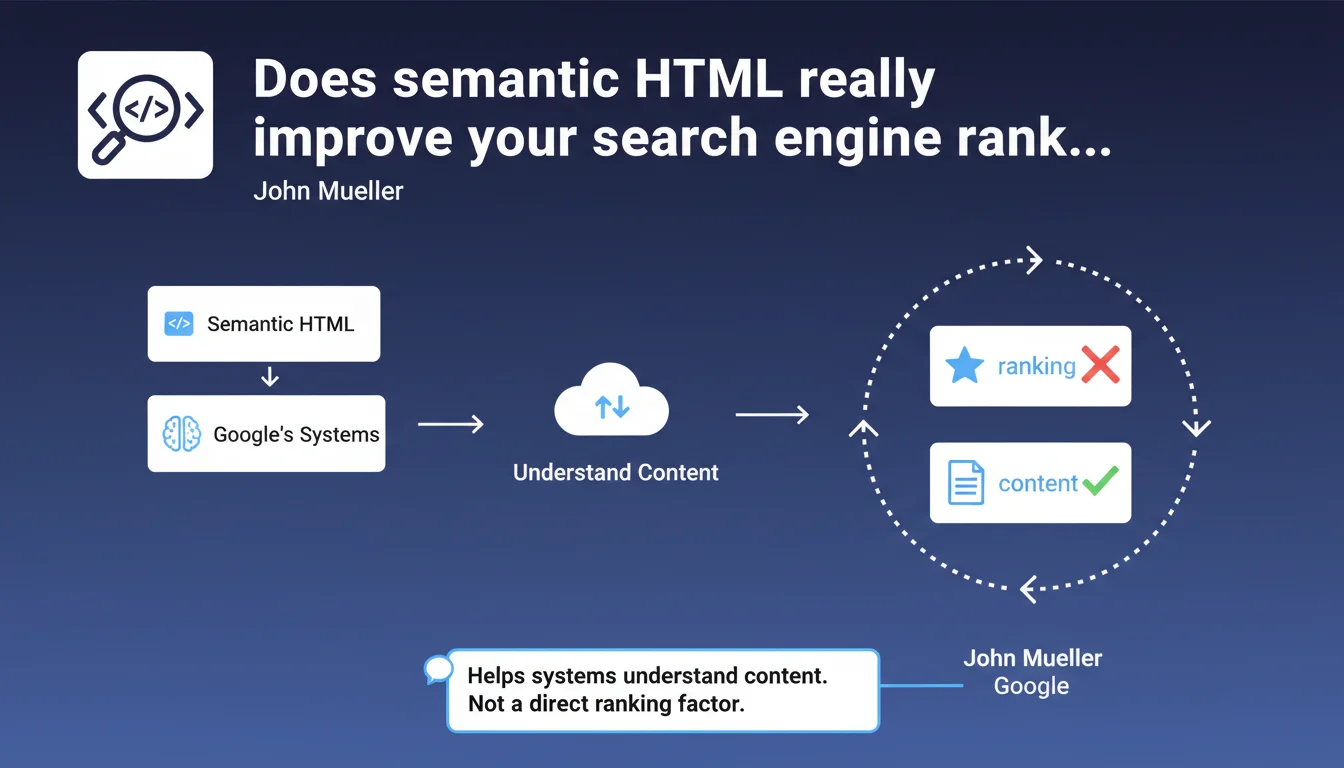
Google states that semantic HTML facilitates content understanding on a page, but it is not a direct ranking factor. In practical terms: properly structuring your tags helps algorithms better interpret your pages, but it doesn't guarantee measurable position gains. The impact remains indirect and difficult to quantify.
What you need to understand
What does "understanding content" mean for Google?
When Mueller talks about content understanding, he's referring to the algorithms' ability to identify the semantic role of each HTML element. A <nav> signals navigation, an <article> signals main content, an <aside> signals supplementary information.
This hierarchy allows Google to distinguish what really matters on your page — the body text — from what's part of the peripheral structure (menu, footer, widgets). Without semantic markup, the algorithm has to guess, with less certainty.
Why does this statement emphasize "not a direct ranking factor"?
Because Google wants to prevent SEOs from expecting a magic boost by replacing their <div> tags with <section> tags. The message is clear: semantic HTML doesn't trigger an algorithmic bonus comparable to a quality link or comprehensive content.
The effect is indirect: better content understanding can improve the relevance of featured snippets, the detection of key passages (Passage Ranking), or Google's ability to answer complex queries. But no KPI will measure "+ X positions thanks to my <main> tags".
Which HTML elements are really taken into account?
Structural tags like <header>, <nav>, <main>, <article>, <aside>, <footer> help delimit functional zones. Content tags like <h1>-<h6>, <p>, <ul>, <blockquote> structure information.
Google also uses microdata (Schema.org) to extract specific entities — recipes, events, products. But be careful: Schema.org and semantic HTML are not synonymous. The former enriches data, the latter organizes presentation.
- Semantic HTML helps Google prioritize information without directly modifying ranking
- Measurable impact remains difficult to isolate from other on-page optimizations
- Structural tags (
<main>,<article>) are more useful than generic tags (<div>,<span>) - Schema.org and semantic HTML are complementary, not interchangeable
- Accessibility (ARIA, landmarks) can indirectly benefit SEO by clarifying structure
SEO Expert opinion
Is this statement consistent with field observations?
Yes, to the extent that no one has ever demonstrated that a poorly tagged site with good copy ranks worse than a semantically flawless competitor. A/B tests on semantic HTML alone never show statistically significant effects on rankings.
However, we observe that well-structured sites more often obtain featured snippets and rich results. Correlation, not causation: these sites also take care of their content, their linking, their technical aspects. Semantic HTML is part of a coherent whole, not a magic wand.
What nuances should be added to this statement?
Mueller doesn't say semantic HTML is useless. He says it's not a direct ranking lever. A crucial distinction: a technically clean site makes the crawler's job easier, reduces interpretation ambiguities, and can indirectly improve user experience (accessibility, loading time if the DOM is better structured).
The trap would be concluding "since it's not a direct factor, I'll ignore it." Wrong. A well-tagged site is easier to maintain, audit, and evolve. And if Google ever becomes better at exploiting this structure to refine its extracts, you'll be ahead. [To verify]: Google remains vague about the precise way this "better understanding" translates into measurable benefits.
In which cases does this rule not apply?
If your site is a mess of JavaScript without server-side rendering and your HTML looks like a field of <div> tags without hierarchy, even the best content in the world will be harder to crawl and index. Here, semantic HTML is no longer optional, it's a technical survival condition.
Similarly, for news sites or content rich in featured snippets, properly structuring your <article>, <time>, and data schemas can make the difference between appearing in position 0 or staying in the top 5. The indirect effect becomes very concrete.
<section> tags everywhere without logic adds nothing. Consistency trumps quantity.Practical impact and recommendations
What should you concretely do on your existing pages?
Start with a structure audit: identify pages that use exclusively <div> and <span> without semantic tags. Replace them progressively with <header>, <nav>, <main>, <article>, <aside>, <footer> according to their actual function.
Focus first on strategic pages: homepage, main categories, featured articles. The ROI will be more visible than revamping your entire site at once. Also remember to verify that your heading hierarchies (<h1>-<h6>) are logical and have no skipped levels.
What errors should you avoid when refactoring HTML?
Don't fall into the "semantic keyword stuffing" trap: multiplying <article> or <section> tags without structural reason. Google detects inconsistencies, and you're complicating code maintenance for nothing.
Also avoid neglecting accessibility: good semantic HTML goes hand-in-hand with ARIA attributes, landmarks, and smooth keyboard navigation. If you optimize for Google without thinking about users with disabilities, you're missing the main goal.
How do you verify that your site respects best practices?
Use your browser's inspection tools to visualize HTML structure. Extensions like HeadingsMap or Landmark Navigation allow you to quickly verify hierarchy. On the SEO side, Google Search Console won't tell you anything about your semantic HTML, but tools like Screaming Frog or Sitebulk can audit the presence and consistency of your tags.
Also test your pages with a screen reader (NVDA, JAWS): if navigation is confusing for a blind user, it's probably also confusing for a crawler. Accessibility and SEO share more common ground than you might think.
- Replace generic
<div>tags with structural tags (<main>,<article>,<aside>) - Verify heading hierarchy: only one
<h1>, no skipped levels - Add ARIA attributes and landmarks for accessibility
- Audit strategic pages first (homepage, categories, featured articles)
- Test with HeadingsMap, Screaming Frog, Sitebulk to validate structure
- Avoid tag overload without real semantic logic
❓ Frequently Asked Questions
Le HTML sémantique améliore-t-il mon classement dans Google ?
Dois-je refondre tout mon site pour utiliser des balises sémantiques ?
Quelle différence entre HTML sémantique et Schema.org ?
Comment vérifier si mon HTML est bien structuré ?
Le HTML sémantique suffit-il pour obtenir des featured snippets ?
🎥 From the same video 7
Other SEO insights extracted from this same Google Search Central video · published on 29/06/2023
🎥 Watch the full video on YouTube →
💬 Comments (0)
Be the first to comment.