
Official statement
Other statements from this video 7 ▾
- □ Is semantic HTML really decisive for your search rankings?
- □ Is semantic HTML really useless for SEO?
- □ Should you really use Hn tags instead of styling your headings visually with CSS?
- □ Does placing images near relevant text really boost your SEO and visibility in Google Images?
- □ Should you really ban HTML tables for page layouts?
- □ Why does Google still insist on anchor tags instead of JavaScript for your links?
- □ Does semantic HTML really improve your search engine rankings?
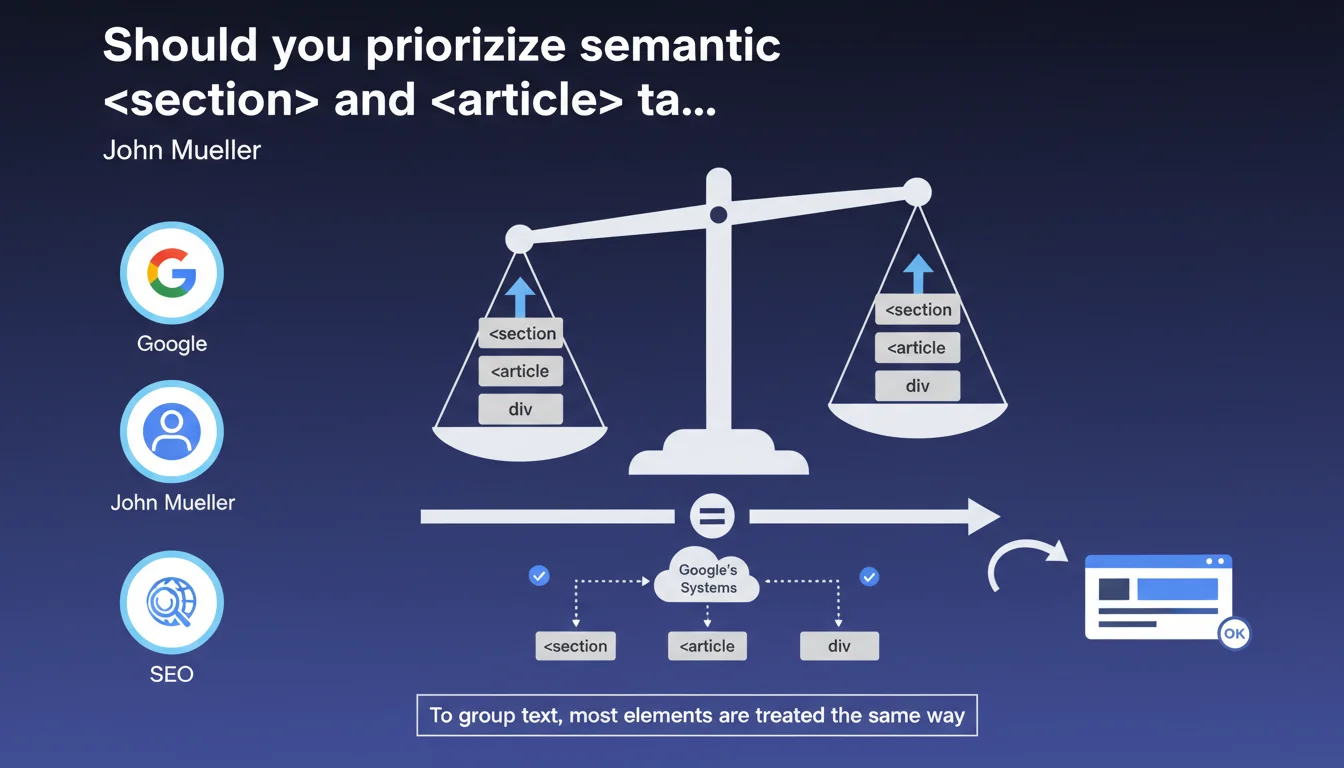
Google makes no distinction between HTML5 grouping elements such as <section>, <article> or plain <div>. All are treated identically by crawling and content understanding systems. HTML semantic optimization therefore provides no direct SEO advantage.
What you need to understand
Why does Google claim to make no difference between these tags?
Search engines historically operated before the arrival of HTML5 and its semantic tags. Google relies primarily on text content, heading structure (h1, h2, h3), links and other signals to understand a page's hierarchy.
Tags like <section>, <article> or <aside> were designed to improve accessibility and code semantic structure on the developer side. They help browsers and assistive technologies — not necessarily crawlers.
Does this statement contradict HTML structuring best practices?
No. Using semantic tags remains an excellent practice for code maintenance, accessibility and future compatibility.
But from a pure SEO perspective, it changes nothing. Google reads the DOM, extracts text and relevant signals, whether it's in a <div class="content"> or an <article>.
Which structural elements actually impact crawling and indexation?
The real SEO levers remain unchanged: heading hierarchy, keyword presence in key zones, internal linking, page load speed, Schema.org markup.
HTML5 semantics have never been confirmed as a ranking factor. Mueller's statement reaffirms this explicitly.
- Google's systems treat
<div>,<section>and<article>identically - No direct SEO advantage to using semantic HTML5 tags
- Content structuring relies on heading hierarchy (h1-h6), not containers
- Code accessibility and maintainability remain good reasons to use HTML5
SEO Expert opinion
Is this statement consistent with field observations?
Yes, completely. A/B tests conducted on thousands of pages show no correlation between semantic tag usage and ranking improvement. Sites using only <div> can rank as well as those with a flawless HTML5 structure.
What matters is how content is hierarchized with heading tags and how it answers search intent.
What nuances should be applied to this claim?
Mueller is talking about "text grouping" here. He's not saying that all HTML tags are equivalent — obviously an <h1> doesn't carry the same weight as a <p>.
The nuance is important: structural tags (div, section, article, aside) are interchangeable for Google. Content semantic tags (h1, strong, em, a) retain their importance.
[To verify]: Google could exploit HTML5 semantics more in the future, particularly with evolving toward finer context understanding. But for now, nothing indicates this.
Should semantic HTML5 be abandoned?
No. And that would be a mistake.
First, web accessibility (WCAG, RGAA) relies on proper semantic structure. Screen readers, browser reading modes and other technologies benefit directly.
Second, clean, semantic code facilitates team collaboration and maintenance. While it doesn't boost SEO, it improves overall site technical quality — which can indirectly impact performance.
Practical impact and recommendations
What should you do concretely on your SEO projects?
Stop wasting time "optimizing" HTML5 semantics hoping for SEO gains. Focus on real levers: heading hierarchy, semantic density, semantic silo, page load speed, internal linking.
If you already have clean HTML5 structure, keep it. If you use <div> everywhere, it's not an SEO problem — but consider accessibility.
What errors should you avoid when structuring a page?
Don't sacrifice heading hierarchy under the pretense of using semantic tags. An <article> without <h2> or <h3> is worthless to Google.
Also avoid overly complex structures that slow down rendering. Google favors DOM simplicity and fast content extraction.
How should you prioritize your technical restructuring efforts?
If you have limited budget or constrained dev resources, here's the priority order:
- Verify each page has a unique, descriptive
<h1> - Check heading hierarchy (h2, h3, h4) — no level jumps
- Ensure main content is quickly accessible in the DOM
- Implement Schema.org on strategic page types (Product, Article, FAQPage, etc.)
- Optimize render time and LCP (Largest Contentful Paint)
- Improve accessibility (alt text on images, labels on forms, contrast)
❓ Frequently Asked Questions
Utiliser des balises <section> et <article> améliore-t-il mon référencement Google ?
Faut-il remplacer tous mes <div> par des balises HTML5 sémantiques pour le SEO ?
Quelle est la différence entre balisage HTML5 et Schema.org ?
Les balises sémantiques peuvent-elles avoir un impact SEO à l'avenir ?
La hiérarchie des titres (h1, h2, h3) est-elle toujours importante malgré cette déclaration ?
🎥 From the same video 7
Other SEO insights extracted from this same Google Search Central video · published on 29/06/2023
🎥 Watch the full video on YouTube →
💬 Comments (0)
Be the first to comment.