
Official statement
Other statements from this video 7 ▾
- □ Le HTML sémantique est-il vraiment déterminant pour le référencement naturel ?
- □ Faut-il vraiment utiliser des balises Hn plutôt que styler visuellement ses titres ?
- □ Faut-il vraiment placer les images près du texte pour améliorer leur référencement ?
- □ Faut-il vraiment bannir les tableaux HTML pour la mise en page ?
- □ Pourquoi Google insiste-t-il encore sur les balises <a> plutôt que sur JavaScript pour vos liens ?
- □ Faut-il privilégier les balises sémantiques <section> et <article> plutôt que les <div> pour le SEO ?
- □ Le HTML sémantique améliore-t-il vraiment votre référencement ?
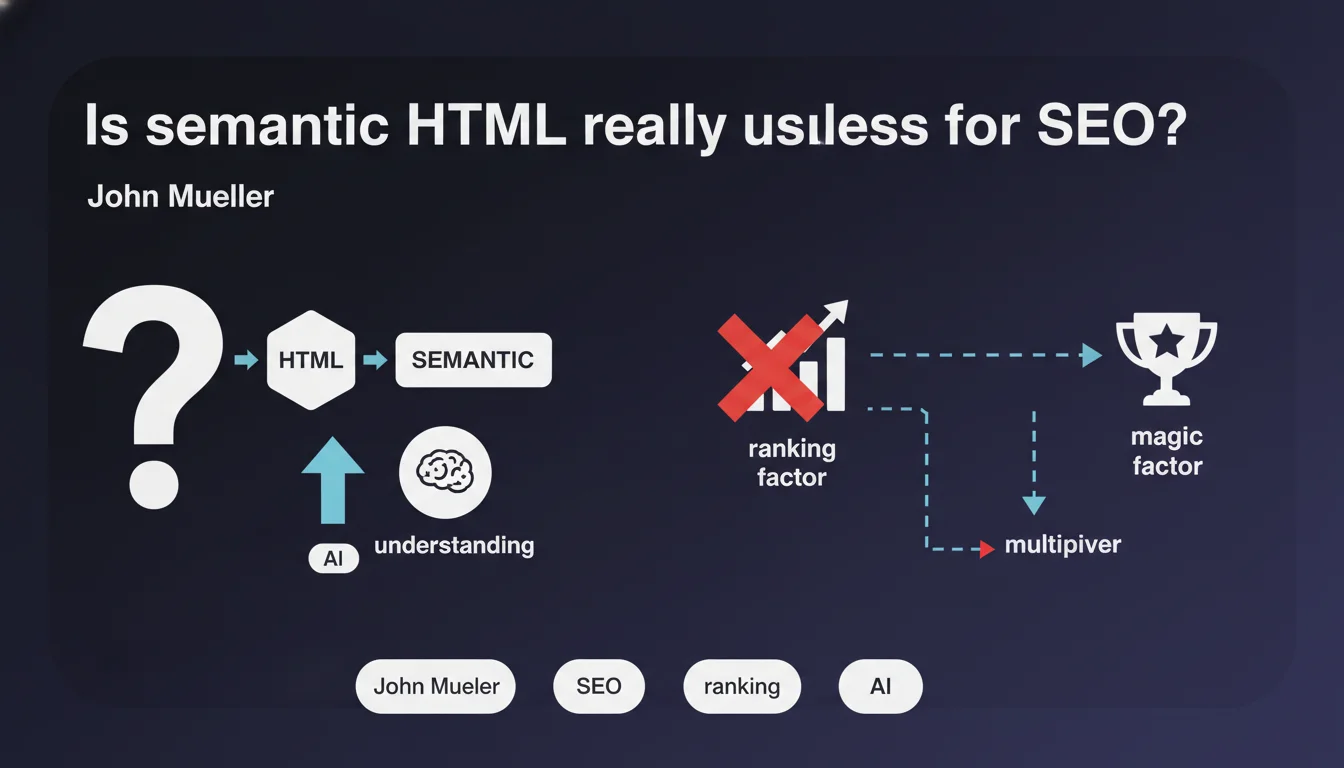
John Mueller states that semantic HTML is not a direct ranking factor and does not mechanically improve positioning. It helps Google better understand a page's structure, but this understanding does not automatically translate into a boost in the SERPs. In other words: proper markup, yes — expecting an immediate ranking gain, no.
What you need to understand
Does Google really disregard semantic HTML?
No, and that's where Mueller's statement deserves nuance. Mueller doesn't say Google ignores semantic HTML, but that it doesn't function as a ranking multiplier. Practically speaking, using <article>, <section>, <header>, or <time> tags helps algorithms identify the logical structure of content.
But this improved understanding doesn't translate into bonus points in the ranking algorithm. Google relies first on the content itself, relevance signals, domain authority, and user experience. Semantic HTML remains a technical facilitator, not a performance lever.
Why does this confusion persist in the SEO community?
Because for years, we conflated "best practice" with "ranking factor." Many SEOs observed visibility improvements after restructuring their HTML — but correlation is not causation. If a site gains performance after a semantic overhaul, it's often because other optimizations happened in parallel: page speed, duplicate content removal, internal linking improvements.
Semantic HTML can indirectly promote rich snippet extraction or facilitate crawling, but it doesn't boost ranking on its own.
What does "aids understanding" concretely mean?
Google uses HTML to identify key page sections: where the main article begins, where navigation is located, which elements are supplementary content. Semantic tags allow robots to contextualize information more quickly, which can improve indexing accuracy.
But this contextualization guarantees nothing. If content is weak or the page has no authority, flawless markup won't change Google's verdict.
- Semantic HTML facilitates robot reading, but doesn't replace content quality
- It can improve eligibility for rich snippets (but without guarantee)
- It has no direct weight in the ranking algorithm
- Google adapts very well to poorly marked sites if content is relevant
SEO Expert opinion
Does this statement align with field observations?
Yes, and it's even a welcome confirmation. We regularly see sites with chaotic — even broken — HTML ranking on the first page because they better answer search intent than better-structured competitors. Conversely, technically impeccable sites stagnate because their content lacks depth or they have zero link equity.
Let's be honest: semantic HTML is often a marker of technical rigor, and rigorous sites generally have other assets (speed, content, UX). That's why we sometimes confuse cause and effect.
Should we neglect semantic HTML then?
No. And that's where nuance becomes crucial. Just because a practice isn't a ranking factor doesn't mean it's useless. Well-structured HTML facilitates maintenance, improves accessibility (WCAG), and can promote featured snippets or enriched structured data display. It also makes the site more interoperable with assistive technologies and automatic reading tools.
But don't expect miracles. If your content is mediocre, a clean <article> won't save it. [To verify]: it would be interesting to measure whether Google actually uses semantic HTML to better identify "evergreen" versus ephemeral content — Mueller remains vague on this point.
In what cases does this rule not apply?
There's one notable exception: Schema.org structured data. While technically not "pure" semantic HTML, it uses specific markup to communicate directly with Google. And there, yes, it can impact SERP display (stars, price, FAQ, etc.).
But be careful: Schema.org doesn't boost organic ranking either. It improves CTR by making the result more attractive, which can indirectly influence positioning if Google measures user engagement. But it's not a direct factor.
Practical impact and recommendations
Should we still invest time in semantic HTML?
Yes, but with the right priorities. If your site has content, speed, or internal linking issues, start there. Semantic HTML will come after, as a finishing layer, not a strategic pillar. It won't gain you 10 positions overnight, but it contributes to clean, maintainable architecture.
Concretely, focus on tags with measurable indirect impact: <nav> for menus, <main> for main content, <aside> for sidebars. This helps Google ignore the noise and focus on what matters.
What mistakes should you avoid with semantic HTML?
The most common: believing perfect markup compensates for weak content. Some SEOs spend hours cleaning their HTML when their page adds no value whatsoever. That's a waste of time. Another mistake: overusing semantic tags without logic. Using 5 nested <article> tags on a single page helps no one, neither Google nor the user.
Finally, don't confuse HTML semantics with accessibility. The two are related, but accessibility also requires ARIA attributes, explicit labels, and functional keyboard navigation. Semantic HTML alone isn't enough.
How do you verify your HTML is well-structured?
- Use a W3C validator to detect syntax errors
- Verify each page has a single
<main>and main content is properly isolated - Test accessibility with WAVE or Axe DevTools
- Inspect Google's rendering via Search Console (live URL test)
- Compare your HTML to well-ranked competitors' — not to blindly copy, but to identify effective patterns
❓ Frequently Asked Questions
Le HTML sémantique peut-il quand même aider pour les featured snippets ?
Si Google dit que ce n'est pas un facteur de classement, pourquoi des concurrents bien balisés rankent mieux ?
Dois-je refondre tout mon HTML si mon site rank déjà bien ?
Les balises Schema.org sont-elles concernées par cette déclaration ?
Un site mal balisé peut-il quand même être crawlé efficacement par Google ?
🎥 From the same video 7
Other SEO insights extracted from this same Google Search Central video · published on 29/06/2023
🎥 Watch the full video on YouTube →
💬 Comments (0)
Be the first to comment.