
Official statement
Other statements from this video 6 ▾
- □ Could Google Search Console be the missing key to unlock your hidden ranking opportunities?
- □ Are your high-visibility pages silently losing clicks in Search Console?
- □ Should you really be reformulating your content based on what users actually search for?
- □ Do you really need to request reindexing every time you update your content?
- □ How can you accurately measure the real impact of your SEO optimizations in Search Console?
- □ How can you spot high-potential content opportunities by analyzing growing search demand?
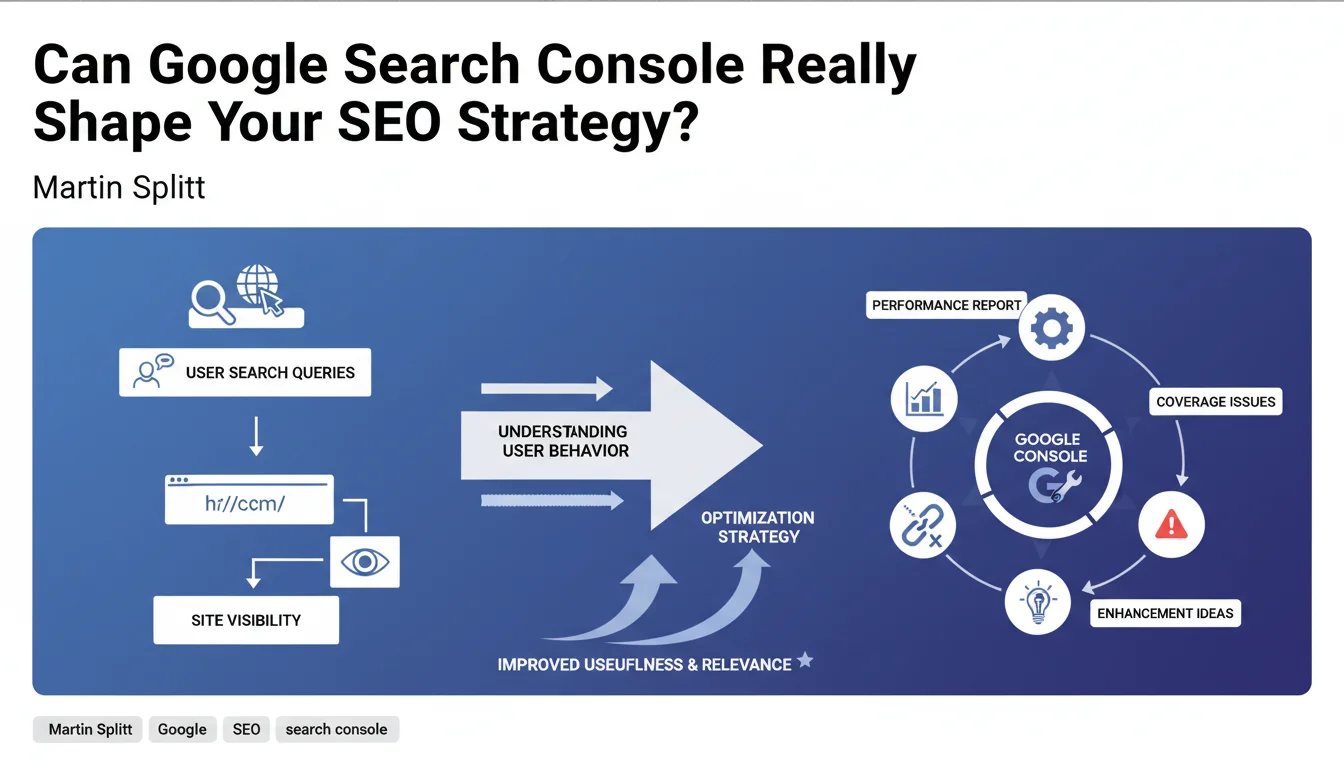
Martin Splitt positions Google Search Console as a strategic tool to improve your site's relevance in the eyes of users. The focus is on usefulness and relevance, not simply fixing technical errors. This signals that Google wants SEOs to use GSC as a strategic compass, not just as a reactive dashboard.
What you need to understand
What does "strategic tool" really mean in this context?
When Google calls Search Console a strategic tool, it's a notable shift in messaging. For years, GSC has been perceived—rightly so—as a technical diagnostic tool: indexation errors, coverage, crawl issues.
Here, Splitt moves the needle. He's not talking about errors to fix, but about relevance to build. The idea: GSC should guide your editorial and strategic decisions, not just your technical maintenance.
Why does Google emphasize "useful and relevant" rather than "optimized"?
Language is never incidental at Google. "Useful" and "relevant" are two pillars of the Helpful Content Update and Google's product philosophy for years now.
By steering the conversation toward these terms, Splitt sends a message: stop hunting for algorithmic loopholes, focus on what users actually want. GSC becomes a mirror of that intent—queries, CTR, performing pages reveal what resonates with real needs.
Which GSC data points concretely improve relevance?
Splitt stays deliberately vague on the "how." But we can infer that several GSC reports play this strategic role: Performance (queries, impressions, CTR), Page Experience, Core Web Vitals, and even the Coverage tab which reveals what Google deems worthy of being served.
- Queries with no clicks reveal unmet expectations or weak meta descriptions
- Pages with high CTR but low ranking indicate content with untapped potential
- Indexed pages never shown in results signal a relevance or semantic targeting issue
- Core Web Vitals influence experience, hence perceived usefulness
SEO Expert opinion
Is this statement consistent with what we see in the field?
Yes and no. In principle, no one disputes that GSC provides valuable data to understand how Google sees your site. It's often the first source of truth in SEO audits.
Where it gets tricky: GSC suffers from well-documented limitations. Query data is sampled beyond a certain volume, APIs are throttled, and some reports lack granularity. Saying it's enough to drive a complete strategy is somewhat short-sighted. [To verify]: is Google planning to enrich GSC to truly make it a strategic hub, or is this just marketing repositioning?
What nuances should we add to this idealized vision?
GSC only shows what Google allows you to see. It doesn't replace comprehensive crawl tools (Screaming Frog, Botify), ranking trackers (SEMrush, Ahrefs), or advanced behavioral analytics (GA4, Matomo).
Splitt points toward relevance, but GSC will never tell you why a page lacks relevance. It won't reveal hidden intentions behind queries, or competitive gaps. It shows symptoms, rarely root causes.
In what cases does this rule not apply?
For high-volume sites (e-commerce, media), GSC quickly becomes insufficient in granularity. Aggregated data masks fine patterns you need to find in log analysis tools or enterprise platforms.
For sites in testing or redesign phases, GSC is behind the curve—it reflects current indexation, not potential. You'll need A/B testing, preventive crawls, simulations before Google even sees your changes.
Practical impact and recommendations
What should you do concretely to use GSC strategically?
Move beyond reactive usage. Don't log in only when there's a problem. Integrate GSC into your weekly routine: monitor emerging queries, track CTR evolution, detect pages losing impressions.
Cross Performance data with your business objectives. A high-volume query with low conversion might signal a mismatch between search intent and your actual offering. Adjust the page or content accordingly.
Which mistakes should you avoid when interpreting GSC data?
Don't draw hasty conclusions from short timeframes. 7-day fluctuations may be noise. Look at trends over at least 28 days, and compare year-over-year to neutralize seasonality.
Don't confuse impressions with real visibility. A page may have thousands of impressions in positions 15-20 without generating clicks. That's not useful visibility, that's noise.
- Set up automatic alerts for sharp drops in impressions or CTR (via API or third-party tools)
- Regularly export your data to maintain history beyond GSC's 16-month window
- Segment reports by page type (categories, products, articles) for actionable insights
- Compare branded vs non-branded queries to assess your reliance on brand awareness
- Use query filters to identify underexploited long-tail intent opportunities
- Cross GSC data with GA4 to understand post-click behavior
How do you measure if your GSC usage is becoming truly strategic?
Ask yourself: are your future content decisions influenced by GSC data? If you're still creating content purely on intuition or competitive benchmarking, you're not tapping the strategic potential.
Mature GSC usage translates to regular editorial adjustments: semantic enrichment on high-potential pages, removal or consolidation of zombie pages, CTA reorientation based on detected intent.
❓ Frequently Asked Questions
La Search Console remplace-t-elle d'autres outils SEO ?
Quelles données de la GSC sont les plus utiles pour la pertinence ?
Pourquoi Google insiste-t-il sur la pertinence plutôt que sur l'optimisation technique ?
Les données GSC sont-elles fiables à 100% ?
À quelle fréquence faut-il consulter la Search Console pour un usage stratégique ?
🎥 From the same video 6
Other SEO insights extracted from this same Google Search Central video · published on 02/11/2023
🎥 Watch the full video on YouTube →
💬 Comments (0)
Be the first to comment.