
Official statement
Other statements from this video 6 ▾
- □ Comment exploiter Google Search Console pour détecter vos pages à fort potentiel inexploité ?
- □ Faut-il vraiment reformuler son contenu en fonction des requêtes des utilisateurs ?
- □ Faut-il vraiment demander une réindexation après chaque mise à jour de contenu ?
- □ Comment mesurer efficacement l'impact réel de vos optimisations SEO dans Search Console ?
- □ Comment identifier les opportunités de contenu à fort potentiel grâce à la demande croissante ?
- □ La Search Console peut-elle vraiment orienter votre stratégie SEO ?
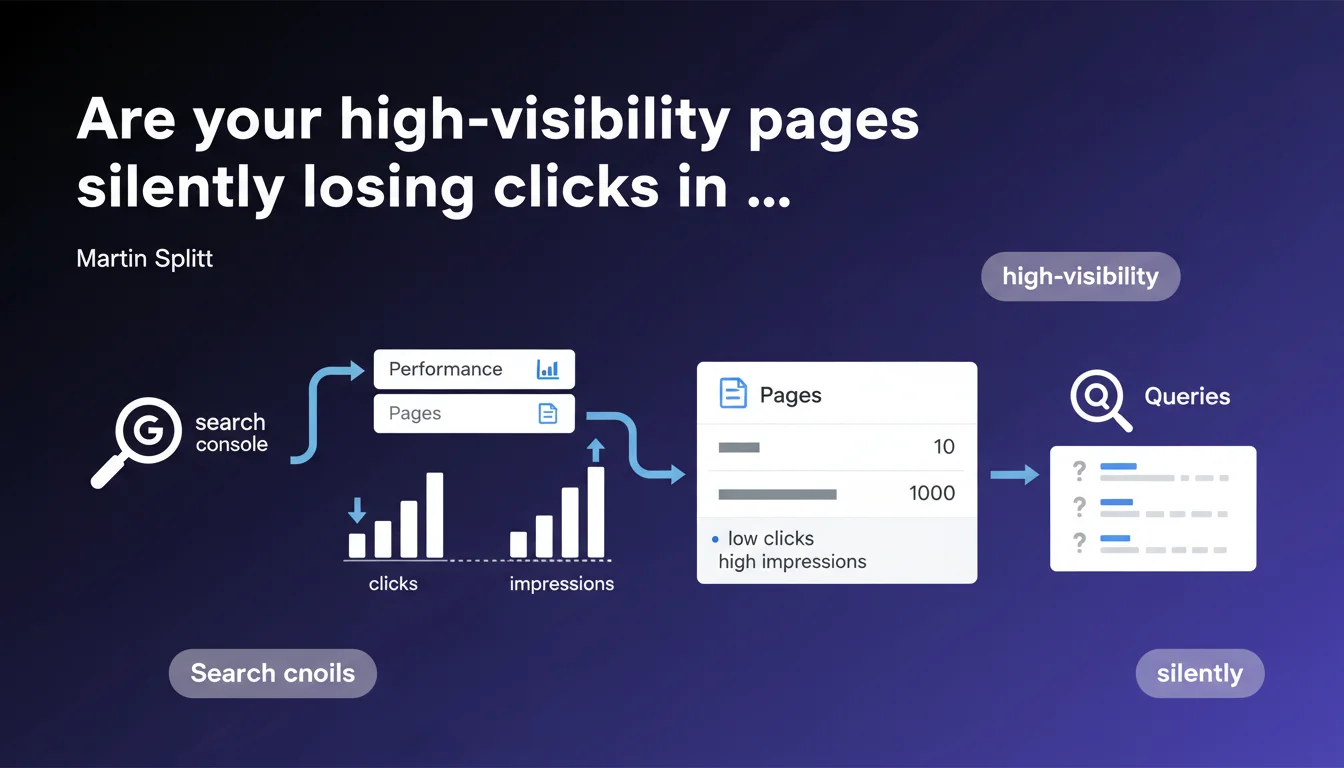
Martin Splitt recommends targeting pages with many impressions but few clicks in Search Console. The workflow: Pages tab > sort by clicks > spot the unfavorable impression/click ratio > analyze related queries. The goal: detect quick wins for organic CTR optimization.
What you need to understand
This Google statement lays out the foundation for a simple yet often overlooked audit methodology: detect pages that show up regularly in SERPs without actually driving traffic. It's a clear signal that something is wrong — either your title/meta description, your actual ranking position, or the alignment between search intent and content.
Let's be honest: many SEOs focus on pages with zero impressions, when the real goldmines are pages that are seen but ignored. That's where the potential for quick wins hides.
Why is this impression/click ratio so revealing?
When a page racks up thousands of impressions with an organic CTR of 0.3%, two scenarios emerge. Either you're consistently positioned at the bottom of page 1 or on page 2 — visible in the count but never clicked. Or your title/meta tags are bland or misaligned with intent, and nobody finds it worth clicking even though you show up.
In both cases, you have an exploitable problem: improve your ranking or rewrite your snippets. Unlike an invisible page, you've already covered half the distance — Google is showing you, now you just need to convince the user to click.
What concrete workflow does Google suggest?
The process is straightforward. In Search Console, Performance > Pages section, sort by number of clicks in descending order. Scroll down to identify anomalies: pages with 5,000 impressions but only 20 clicks, for example.
Click on the URL in question, then switch to the Queries tab. There you see what people are actually searching for when your page appears. If the queries are completely off-topic compared to your content, you have a targeting problem. If they're aligned but nobody clicks, the issue is in how you appear in the SERPs.
How is this different from a simple average CTR analysis?
Average CTR is a lazy metric. It mixes well-ranked pages with high CTR and poorly-ranked pages with low CTR, diluting the signal. By specifically targeting pages with high impression volume + low CTR, you isolate concrete opportunities.
It's a surgical approach. You don't waste time on pages with zero visibility — you optimize those that have already proven they can land in SERPs but fail at the final step: getting clicked.
- Pages with high impressions + low clicks are quick-win CTR optimization opportunities
- The recommended workflow: Pages > sort by clicks > identify anomalies > analyze associated queries
- Two main causes: insufficient ranking position (bottom of page 1, page 2) or unattractive snippets
- This method isolates pages that have already cleared the indexation and ranking hurdle — so the action lever is simpler
- Query analysis lets you diagnose whether the problem is poor targeting or a presentation defect
SEO Expert opinion
Is this recommendation deep enough to diagnose the real problem?
Splitt's method is a good starting point, but it stays surface-level. Identifying a page with 10,000 impressions and 50 clicks is useful — but it won't tell you whether the problem stems from average ranking position or snippets. Search Console doesn't provide precise position distribution: you see an "average position," which can mask heterogeneous reality (some queries ranking position 3, others at 15).
Concretely, if your average position is 8-12, the low CTR is logical and expected. The real lever isn't optimizing the snippet, but strengthening content and internal linking to climb to positions 3-5. Conversely, if you're averaging position 4 with a 2% CTR, your snippets clearly need rework. [To verify]: Splitt's method doesn't provide tools to make this distinction quickly.
What interpretation mistakes should you avoid?
First trap: confusing "low clicks" with "low actual CTR." A page may have few clicks simply because it targets niche queries with low search volume. If it shows a 15% CTR on 100 impressions, it's performing well — no need to touch it.
Second trap: optimizing the snippet without checking intent. Imagine a product page appearing on informational queries ("how does X work"). Even with a perfect snippet, CTR stays low because the user isn't trying to buy. The problem isn't cosmetic, it's structural: poor semantic targeting.
Third trap: overlooking featured snippets and other SERP features. If your page shows 5,000 times but 80% of impressions are on queries where Google displays a competing optimized extract, your CTR will be mechanically crushed. The solution isn't rewriting your meta description, it's restructuring content to capture the featured snippet.
When is this method particularly effective?
It shines on editorial sites and e-commerce with large page volumes. When you have 500 product pages or 200 blog articles, manually auditing each is impossible. This method lets you prioritize interventions: you target the 10-15 pages already getting visibility but squandering their potential.
It's also powerful for sites with solid internal linking and decent authority. If you're regularly on page 1 but nobody clicks, it means your value proposition in the SERPs is unclear. A site struggling to rank has other priorities — but a site ranking without driving traffic has every reason to follow this workflow.
Practical impact and recommendations
What should you do concretely after identifying these pages?
First step: retrieve the average position and position distribution for each identified query. If you're averaging beyond position 7-8, the problem isn't cosmetic — you need to strengthen content, work on internal linking, or build targeted backlinks. Rewriting the snippet changes nothing if you're invisibly ranked low.
If you're well-positioned (top 5) with abnormally low CTR, move to snippet optimization. Analyze competitor results on these queries: what catches the eye in their titles? Do they use power words, numbers, brackets? Does your meta description clearly answer search intent, or is it generic and flat?
Test multiple title/meta description variants. Wait 2-3 weeks, measure impact in Search Console. If no improvement, the problem may be elsewhere: too much competition, SERP features cannibalizing CTR, misunderstood intent.
What execution mistakes should you avoid?
Don't modify 50 pages at once. You won't know what worked or what didn't. Target 5 to 10 priority pages (those with the biggest volume of wasted impressions), test your optimizations, measure results, then iterate.
Don't just cosmetically rewrite title/meta description. If your page doesn't truly answer the dominant search intent, rework the content itself before polishing tags. An attractive snippet leading to disappointing content will degrade bounce rate and send a negative signal to Google.
Don't ignore SERP structure analysis. If 80% of visible space is taken by ads, featured snippets, or PAA (People Also Ask), your leverage on organic CTR is limited. In this case, the strategy isn't optimizing your regular snippet, but targeting position zero or adjusting semantic focus.
How do you verify your optimizations are working?
Create a custom segment in Search Console with the pages you've optimized. Track CTR average, click count, and impressions over a 28-day before/after interval. If CTR improves without impressions dropping, you're on the right track.
Also measure engagement metrics: bounce rate, time on page, pages per session. Rising CTR but exploding bounce rate means your snippet oversells the actual content — you're attracting wrong-fit traffic, which can harm you long-term.
Finally, watch ranking position fluctuations. Sometimes a high-performing snippet optimization boosts CTR, signaling to Google and slightly improving rank. This is a virtuous circle — but you need to measure it to validate it.
- Identify pages with high impressions + low clicks in Search Console (Pages > sort by clicks)
- Verify average position and real position distribution via a third-party tool
- If position > 7-8, prioritize content improvement and internal linking over snippet optimization
- If position top 5, analyze competitor snippets and rewrite title/meta description with attractive elements (numbers, power words, clear intent response)
- Test modifications on 5-10 priority pages, measure impact over 2-3 weeks
- Verify content actually answers search intent before optimizing tags
- Create a Search Console segment to track CTR, clicks, impressions evolution on optimized pages
- Monitor engagement metrics (bounce, time spent) to detect potential intent/content mismatch
- Analyze SERP structure: if dominated by features, adjust strategy (target position zero, rethink targeting)
❓ Frequently Asked Questions
Quel CTR organique doit-on considérer comme "faible" pour une page en position 5-7 ?
Faut-il optimiser en priorité les pages avec le plus d'impressions ou celles avec le pire ratio ?
Est-ce que modifier le title peut impacter négativement le ranking ?
Combien de temps faut-il attendre après une modification de snippet pour mesurer l'impact ?
Cette méthode fonctionne-t-elle aussi bien pour l'e-commerce que pour l'éditorial ?
🎥 From the same video 6
Other SEO insights extracted from this same Google Search Central video · published on 02/11/2023
🎥 Watch the full video on YouTube →
💬 Comments (0)
Be the first to comment.