
Official statement
Other statements from this video 3 ▾
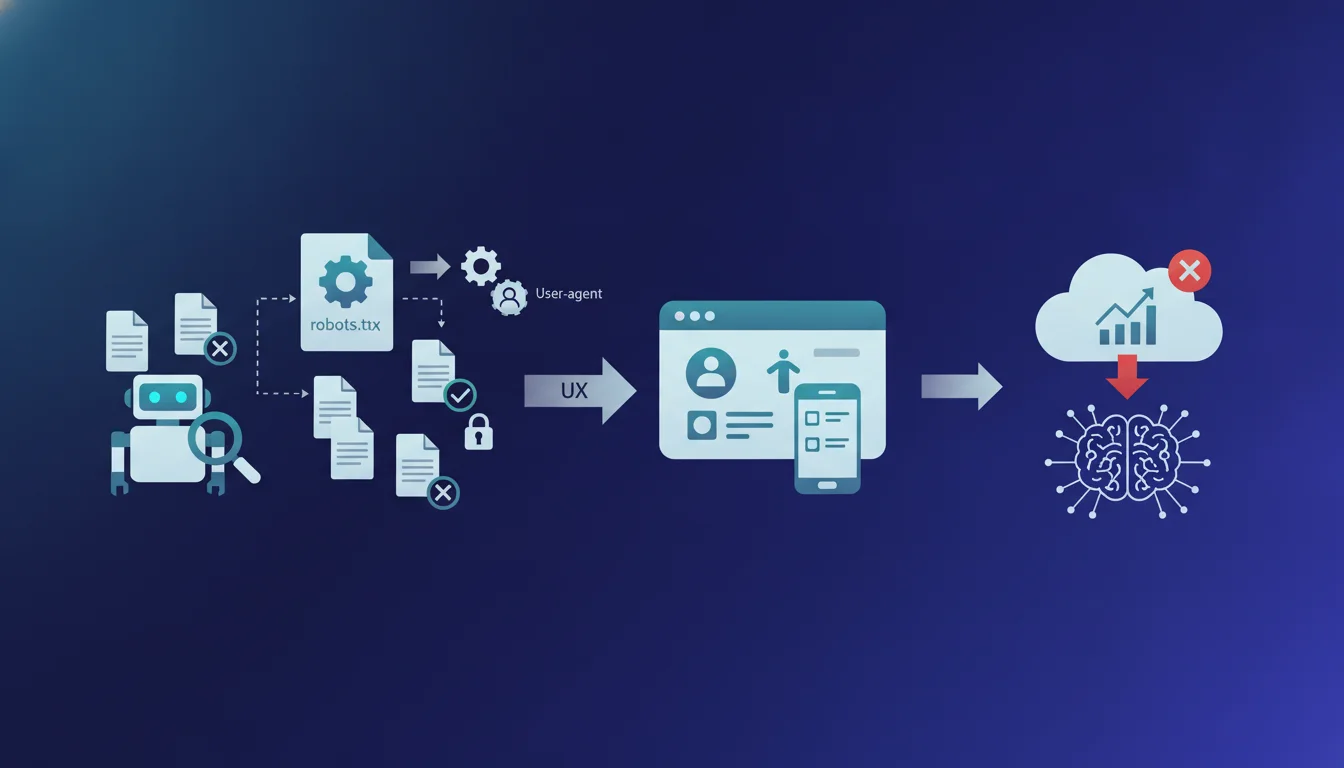
Google reminds us that robots.txt only indicates if a crawler can explore a page, not how the data will be used after collection. To block a specific AI bot, you need to explicitly target its User-agent in the file. It's a preference protocol, not a technical lock: a malicious crawler can ignore it without facing direct legal consequences.
What you need to understand
What is the difference between crawling block and usage control?
The robots.txt acts like a 'no entry' sign that any crawler can choose to ignore. Google clarifies here that this file only controls access to content, not what happens next with the retrieved data.
A respectful bot will read the file and stop if you block its User-agent. However, nothing technically prevents an AI crawler from bypassing this rule, exploring your pages anyway, and using the content to train its models. The robots.txt is a convention, not a firewall.
How can you target a specific AI crawler in robots.txt?
Each bot has an identifiable User-agent that you can block individually. For example: GPTBot for OpenAI, Google-Extended for Bard/Gemini models, CCBot for Common Crawl, ClaudeBot for Anthropic.
The syntax is simple: User-agent: GPTBot followed by Disallow: / blocks the entire site for that specific crawler. But beware: some bots regularly change names or use multiple User-agents to bypass blocks.
Does blocking in robots.txt impact natural SEO?
Blocking the standard Googlebot (for organic search) certainly penalizes your SEO since your pages will no longer be indexed. On the other hand, blocking Google-Extended does not affect your ranking in traditional search results.
Google now clearly separates its crawlers: Googlebot for search indexing, Google-Extended for AI training. You can allow one and block the other without affecting your organic visibility. This is a crucial nuance that many SEO professionals still overlook.
- The robots.txt is a preference protocol, not a technical security mechanism.
- Each AI crawler has a User-agent that must be explicitly targeted to be blocked.
- Blocking Google-Extended does not impact indexing in traditional search.
- A malicious bot can ignore robots.txt without automatic sanction.
- Real protection requires additional measures: authentication, rate limiting, anomaly detection.
SEO Expert opinion
Is this distinction between access and usage really new?
No. SEO practitioners have known for years that robots.txt has no technical enforcement power. What Google is formalizing here is mainly the clear separation between crawling for indexing and crawling for generative AI.
The timing of this statement is not arbitrary: it comes at a moment when publishers are discovering that their content feeds AI models without compensation. Google legally protects itself by reminding us that robots.txt does not guarantee anything about data usage. [To be verified]: no court ruling has yet determined if violating robots.txt for AI training constitutes a copyright infringement.
Do AI crawlers really respect these rules in practice?
The major players (Google, OpenAI, Anthropic) generally respect robots.txt... when caught. Log analyses regularly show bots changing User-agent to bypass blocks.
More problematic: the dozens of AI startups scraping the web via residential proxies, using spoofed User-agents imitating standard browsers. For these actors, robots.txt is completely invisible. The only real defense comes from application rate limiting and behavioral detection.
Should you systematically block all AI crawlers?
It depends on your business model. If you monetize through advertising, blocking AI reduces your future visibility in generative responses (SGE, Perplexity, etc.). This is a risky bet in the medium term.
On the other hand, if your content is your product (training, premium analysis, proprietary databases), blocking becomes essential. But let's be honest: robots.txt alone will never be enough. You must combine authentication, CAPTCHA on forms, scraping pattern detection, and for sensitive content, detectable watermarking in AI outputs.
Practical impact and recommendations
Which User-agents should you prioritize blocking in robots.txt?
Start with the official AI crawlers from major players: GPTBot (OpenAI), Google-Extended (Gemini/Bard), CCBot (Common Crawl widely used by many models), ClaudeBot (Anthropic), cohere-ai, Omgilibot, FacebookBot.
But be cautious: this list evolves every month. A crawler blocked today might reappear under a new name tomorrow. Maintaining the robots.txt becomes a continuous task, not a one-time action. Some sites now automate updates using scripts that aggregate community lists of known AI User-agents.
How can you verify that the block is actually working?
Analyze your raw server logs, not just Google Analytics. Look for the User-agents you have blocked and verify that they no longer generate requests. A good pattern: compare hit volumes before/after modifying robots.txt over a 7-14 day window.
Also, use tools like Screaming Frog or OnCrawl to simulate the behavior of different bots and confirm that your rules apply correctly. And test manually via curl with a specific User-agent to validate that your server adheres to the robots.txt directives.
What additional measures should you implement beyond robots.txt?
The robots.txt is your first line of defense, not the only one. Implement rate limiting at the server level (nginx limit_req, Apache mod_ratelimit) to block abnormal request spikes. Add CAPTCHAs on sensitive pages accessible via forms.
For premium content, consider a light authentication (even free) that requires identification before access. And for high-stakes sites, Web Application Firewall (WAF) solutions like Cloudflare or Imperva detect industrial scraping patterns that robots.txt cannot manage.
These technical optimizations can quickly become complex, especially on large infrastructures or custom CMSs. If you manage an e-commerce catalog of thousands of pages or a content platform with sensitive material, consulting a specialized SEO agency can help implement these protections without compromising legitimate indexing or penalizing your loading time.
- List all AI User-agents to block in robots.txt (minimum GPTBot, Google-Extended, CCBot, ClaudeBot).
- Test the robots.txt file via Google Search Console and curl to verify syntax.
- Monitor the server logs for 14 days to validate the blocking effectiveness.
- Implement server rate limiting to curb aggressive crawls.
- Add CAPTCHA on critical endpoints (forms, downloads, public APIs).
- Automate the monthly update of the list of emerging AI User-agents.
❓ Frequently Asked Questions
Bloquer Google-Extended impacte-t-il mon référencement dans Google Search ?
Un crawler IA peut-il légalement ignorer mon robots.txt ?
Comment savoir quels bots IA crawlent actuellement mon site ?
Faut-il bloquer CCBot alors qu'il alimente Common Crawl, une archive publique ?
Puis-je bloquer tous les bots sauf Googlebot et Bingbot dans robots.txt ?
🎥 From the same video 3
Other SEO insights extracted from this same Google Search Central video · duration 9 min · published on 21/10/2026
🎥 Watch the full video on YouTube →
💬 Comments (0)
Be the first to comment.