
Official statement
Other statements from this video 4 ▾
- □ Should you deploy return policy markup at the organization level instead of the product level?
- □ Does product variant markup really change the game for e-commerce SEO?
- □ How can you leverage merchant listing tracking in Google Images through Search Console to boost your e-commerce visibility?
- □ How can you optimize Sitemaps for large e-commerce sites according to Google's latest guidance?
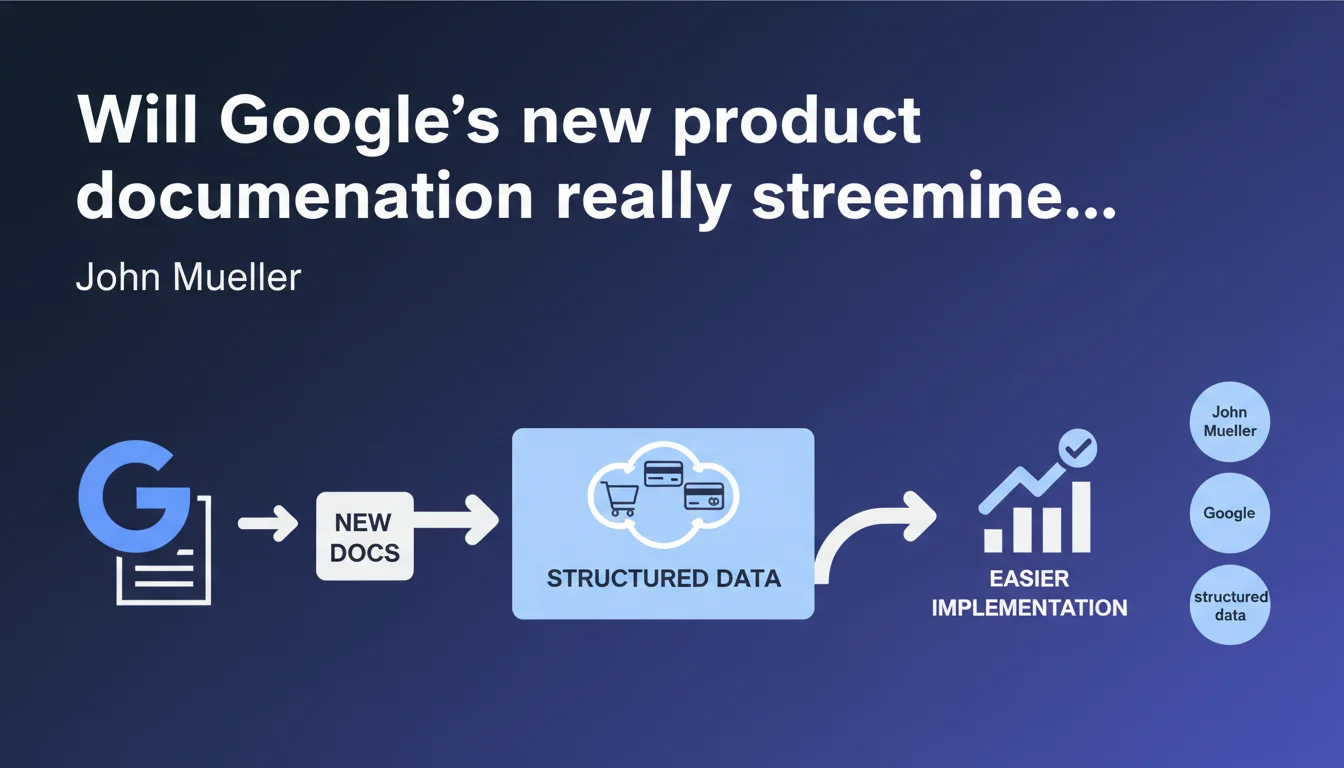
Google has restructured its documentation on product structured data to make implementation easier. The stated goal: to make it more accessible for e-commerce sites to add schema.org Product markup. The question remains whether this overhaul truly makes a difference in the field or if it's just a cosmetic refresh of documentation that already existed.
What you need to understand
Why is Google restructuring this documentation now?
Documentation on product structured data already existed, but it was scattered across multiple pages, sometimes redundant, with examples that were outdated. Google is consolidating everything to offer a more cohesive path for developers and SEOs implementing Product markup.
This restructuring aligns with Google's increasing push toward rich results in e-commerce SERPs. The better the documentation is organized, the more sites will implement it correctly, and the more Google can display rich information (price, availability, reviews) directly in search results.
What concrete changes have been made?
Google has grouped guidelines together, clarified which properties are mandatory versus recommended, and added more complete code examples. Navigation between different sections (Product, Review, Offer, AggregateRating) is now more intuitive.
Common errors are better documented, with specific use cases (out-of-stock products, variants, multiple offers). Fewer gray areas, more clarity on what triggers or doesn't trigger a rich result.
- Consolidation of scattered pages into a single hub
- Updated examples using JSON-LD (Google's preferred format)
- Clarification of mandatory properties: name, image, offers
- Detailed use cases for product variants and bundled offers
- Dedicated section for common errors detected in Search Console
Does this restructuring change how the markup itself functions?
No. The schema.org Product specification remains identical; Google hasn't modified the technical specifications. What's changing is only how the information is presented and organized in the official documentation.
If your markup was correct before, it still is. If you had errors, this improved documentation should help you identify and correct them more easily through the recommendations and examples provided.
SEO Expert opinion
Does this initiative really change the game for e-commerce sites?
Let's be honest: better documentation doesn't compensate for 15 years of technical fragmentation in the e-commerce ecosystem. Between proprietary CMS platforms, poorly coded third-party modules, and haphazard migrations, many sites are stuck with sloppy Product markup.
This restructuring does help — especially for developers implementing manually or via flexible systems like Shopify or well-configured WooCommerce. But for large catalogs running on custom platforms, the problem often remains structural: missing data in the database, poorly managed variants, dynamic prices not reflected in the markup.
What gray areas still remain?
Google clarifies mandatory properties, but remains vague about quality criteria that actually trigger rich results in production. [To verify]: the documentation states that "compliance doesn't guarantee display," without specifying the thresholds or additional signals being considered.
Another gray area: managing multiple offers for the same product (third-party sellers, price variations by size/color). The examples provided remain simplistic, yet this is where errors accumulate in large catalogs with multi-vendor marketplace logic.
In what cases won't this documentation help you?
If your problem is upstream of the markup — incomplete product feeds, poor image quality, generic descriptions — redoing schema.org won't change anything. Structured data amplifies what already exists; it doesn't create value where there is none.
Similarly, if you operate in an ultra-competitive niche (tech, fashion), having perfect markup is a prerequisite, not a differentiator. All your serious competitors already have it; the competitive advantage lies elsewhere: site speed, UX, content strategy.
Practical impact and recommendations
What should you audit as a priority on your site?
Start with Search Console, "Enhancements" section, "Products" tab. Google lists errors detected in your markup there: missing properties, invalid values, inconsistencies. Cross-reference this data with the Rich Results Test on a few representative catalog URLs.
Then verify consistency between your markup and visible content: price, availability, images. A frequent misalignment occurs during promotions or stock-outs if the markup isn't updated dynamically.
What recurring errors should you absolutely avoid?
The most common: omitting the "offers" property or filling it with empty/generic values. Google requires a valid price and currency, as well as an offer URL pointing to a purchasable page.
Another trap: using AggregateRating without actual review data. Google detects fake or artificially generated ratings and can remove stars from your results if the signal isn't credible (too few reviews, suspicious ratings).
- Audit Search Console to identify existing Product markup errors
- Test 10-15 representative URLs with Google's Rich Results Test
- Verify price/availability consistency between DOM and JSON-LD
- Ensure each product has a quality image (minimum 800px wide)
- Don't use AggregateRating without significant volume of authentic reviews
- Implement product variants with distinct URLs if possible
- Monitor the appearance of rich results in target SERPs using a tracking tool
How do you ensure sustainable implementation?
Automate as much as possible. If you're manually updating product markup product-by-product, you're not scalable. Integrate JSON-LD generation directly into your templates or via your PIM/ERP to guarantee real-time updates.
Set up automated monitoring: scripts that regularly test a sample of URLs and alert you to any regressions (missing property, validation error). Large sites with dynamic catalogs experience silent regressions after every deployment.
❓ Frequently Asked Questions
Le balisage Product est-il obligatoire pour apparaître dans Google Shopping ?
Dois-je baliser chaque variante d'un produit séparément ?
Mon balisage est valide dans le Rich Results Test mais je n'ai pas de résultats enrichis, pourquoi ?
Faut-il utiliser JSON-LD ou peut-on garder les microdonnées HTML ?
Combien de temps après correction des erreurs voit-on l'impact dans les SERP ?
🎥 From the same video 4
Other SEO insights extracted from this same Google Search Central video · published on 07/08/2024
🎥 Watch the full video on YouTube →
💬 Comments (0)
Be the first to comment.