
Official statement
Other statements from this video 11 ▾
- □ Why are more than 15% of Google searches completely new every day, and how should this reshape your SEO strategy?
- □ Is Google really sending more traffic to websites each year?
- □ Why is Google pushing domain-level verification in Search Console—and should you switch now?
- □ How long does it really take for your data to show up in Search Console after verification?
- □ Why do Google Analytics and Search Console never show the same numbers?
- □ Does Google really only index a single video per page?
- □ Is Google really indexing all your pages, or should you accept partial coverage?
- □ How does Google really index videos embedded on your web pages?
- □ Are video structured data really essential to appear in search results?
- □ Does Google Really Ignore Your Canonical Tag?
- □ Should you always validate fixes in Search Console to speed up re-crawling?
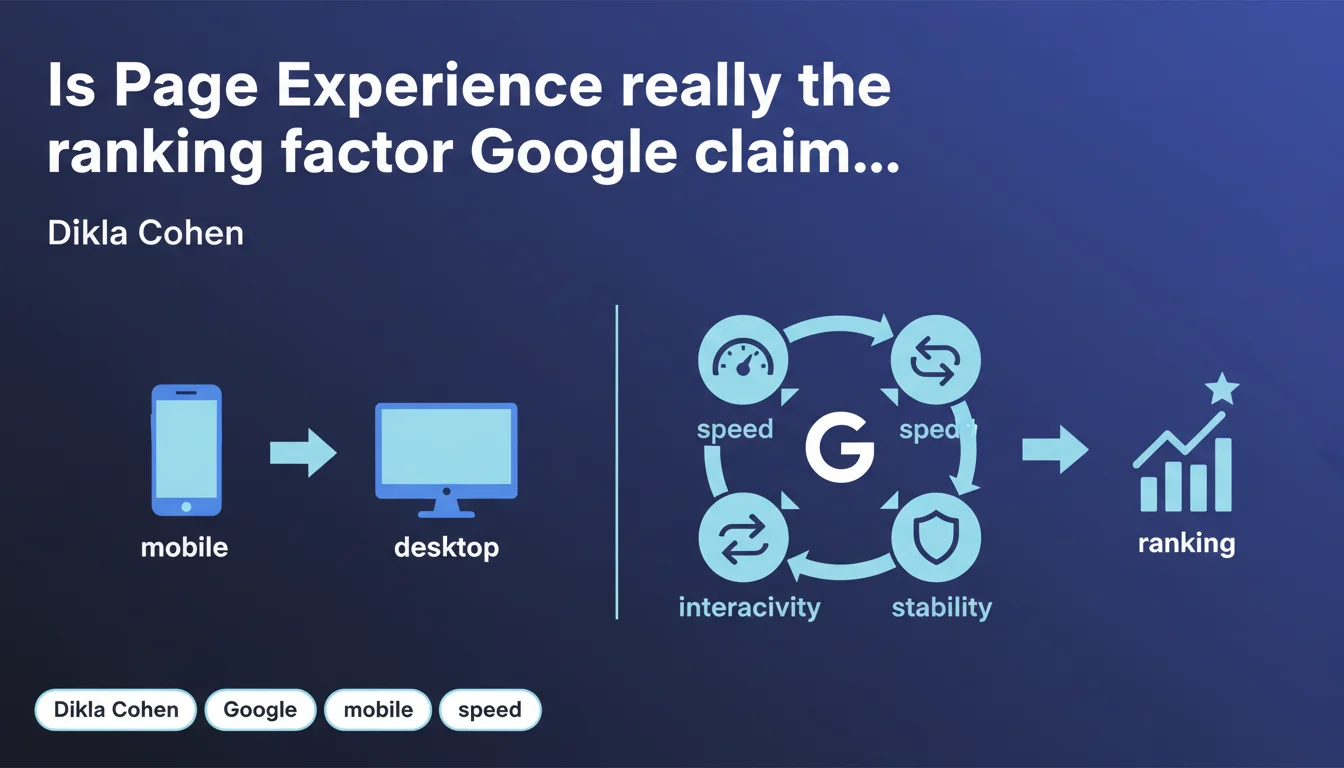
Google rolled out the Page Experience update first on mobile, then on desktop. It combines Core Web Vitals (speed, interactivity, visual stability) as user experience signals. The ranking impact remains moderate, but these criteria are becoming a quality standard.
What you need to understand
What exactly is the Page Experience update?
This update transforms user experience into a measurable ranking factor. Google compiles multiple signals: the Core Web Vitals (LCP, FID/INP, CLS), mobile-friendliness, HTTPS, absence of intrusive interstitials.
The rollout happened in two phases: mobile first, desktop second. This "mobile-first" approach reflects Google's overall strategy, which prioritizes the smartphone experience above all else.
Why does Google emphasize these technical metrics so much?
Because user experience directly impacts bounce rate, session duration, and conversions. A slow or unstable site generates frustration — and Google knows it.
Core Web Vitals translate this frustration into numbers: an LCP above 2.5 seconds, a CLS above 0.1, an FID exceeding 100 ms. These thresholds may seem arbitrary, but they correspond to tipping points in user behavior.
Does this update radically change the SEO game?
No. And that's where many get it wrong.
Google has repeated it: Page Experience is one signal among many. Mediocre content with perfect Core Web Vitals will never outrank excellent content with average metrics. Content remains king — but experience becomes the quality surrounding it.
- Page Experience combines speed, interactivity, visual stability (Core Web Vitals)
- Gradual rollout: mobile first, desktop second
- Moderate ranking signal, not a radical shift
- Quality content remains the dominant factor
- These metrics are becoming an expected quality standard for users
SEO Expert opinion
Is this statement consistent with what we observe in the field?
Yes and no. The direct ranking impact remains difficult to isolate. We observe correlations, not obvious causality. Sites with terrible Core Web Vitals continue to rank in first position on competitive queries — simply because their content, backlinks, and authority more than compensate.
Where it really shows is on undifferentiated queries: when multiple pages offer equivalent content, Core Web Vitals can tip the scales. But how often does this situation actually occur?
What nuances should be added to this announcement?
Google provides no figures on the relative weight of Page Experience. "Ranking signal" could mean 1% or 15% — we simply don't know. [To be verified] on your own sites through rigorous A/B testing.
Another point: Core Web Vitals thresholds evolve. What passes today may turn red tomorrow. INP (Interaction to Next Paint) replaced FID — proof that Google adjusts its criteria as the web evolves.
Let's be honest: this update also serves Google's commercial interests. Faster sites = more pages crawled, more satisfied users, less server load. It's win-win, but altruism isn't the only force at play.
In what cases doesn't this rule really apply?
On high-authority sites with ultra-specialized content. A flagship media outlet, a government site, a SaaS platform in a monopoly position — they can afford average Core Web Vitals without losing their positions.
Same for branded queries: if someone types your name, they'll click your site even if it loads in 5 seconds. SEO urgency concentrates on generic queries where competition is fierce.
Practical impact and recommendations
What should you do concretely to optimize Page Experience?
Start by measuring: Google Search Console, PageSpeed Insights, Lighthouse. Identify pages exceeding thresholds. Focus first on recurring templates (product sheets, articles, category pages) rather than individual URLs.
On the technical side: optimize lazy loading of images, reduce unnecessary JavaScript, use a CDN, minimize third-party requests. CLS is often fixed by reserving space for images and ads before they load.
What mistakes must you absolutely avoid?
Don't fall into the obsession with perfect scores. A site scoring 95/100 in PageSpeed Insights that converts at 2% beats a 100/100 site that converts at 0.5%. Core Web Vitals are a means, not an end.
Another trap: neglecting mobile experience for desktop. Google indexes mobile first — an impeccable desktop site but a catastrophic mobile experience loses the battle before it even starts.
Also avoid over-optimizing to the point of breaking navigation or making the site austere. An image carousel may degrade CLS, but if your users love this feature and it boosts engagement, keep it and optimize elsewhere.
How do you verify your site meets these criteria?
- Check the Core Web Vitals report in Google Search Console — group URLs by issue
- Test your key pages with PageSpeed Insights and note top priorities
- Use Lighthouse in Chrome DevTools for detailed audits under real-world conditions
- Compare your metrics with those of your direct competitors on the same target queries
- Set up continuous monitoring (CrUX, WebPageTest) to detect regressions after each deployment
- Prioritize pages with high organic traffic: 20% of URLs often generate 80% of traffic
❓ Frequently Asked Questions
Les Core Web Vitals sont-ils aussi importants que le contenu pour le classement ?
Un site desktop rapide mais mobile lent sera-t-il pénalisé ?
Quel seuil viser pour les Core Web Vitals : bon ou parfait ?
Faut-il optimiser toutes les pages du site ou seulement certaines ?
Un mauvais score PageSpeed Insights signifie-t-il forcément un mauvais classement ?
🎥 From the same video 11
Other SEO insights extracted from this same Google Search Central video · published on 12/05/2022
🎥 Watch the full video on YouTube →
💬 Comments (0)
Be the first to comment.