
Official statement
Other statements from this video 11 ▾
- □ Is Google really replacing traditional blue links with enriched features—and what does that mean for your organic visibility?
- □ Does Google really remove search features based on clicks alone?
- □ Should you really optimize invisible or rarely-clicked elements on a page?
- □ Does Google really prioritize user satisfaction, or is maximizing ad revenue the hidden agenda?
- □ Does Google really measure your page's satisfaction through repeated searches?
- □ How does Google decide which features are worth evaluating in its algorithm?
- □ Does Google really sacrifice SEO features just to cut infrastructure costs?
- □ Is Google really demanding more and more work from website owners indefinitely?
- □ Should you really be happy when Google removes SEO features?
- □ Does Google really roll out algorithm changes all at once, or are they tested gradually on live traffic?
- □ Does Google really have to publicly announce every SEO feature it removes?
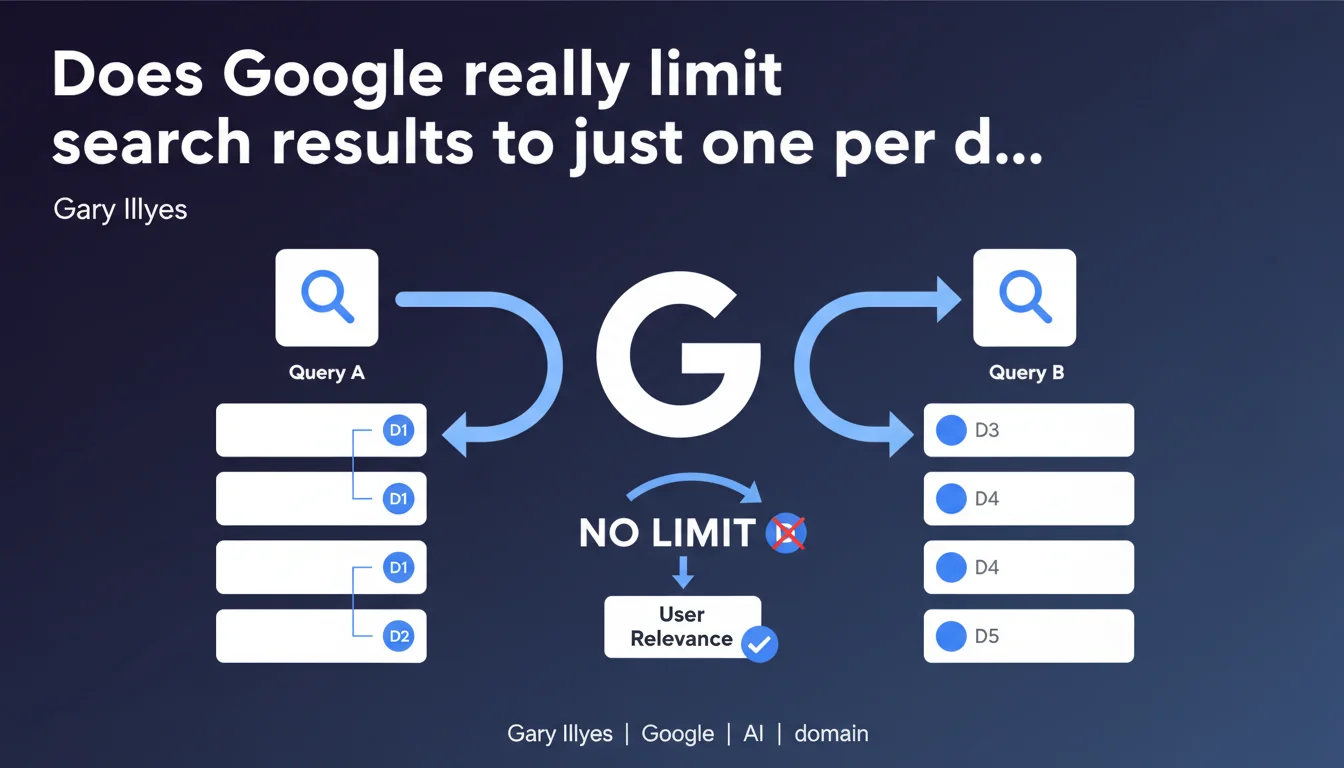
Google does not limit search results to one per domain in the SERPs. For certain queries, displaying multiple pages from the same site provides a better user experience. This official confirmation invalidates a widespread belief and directly impacts keyword targeting strategies.
What you need to understand
Why does this statement contradict a common misconception?
Many SEO practitioners still believe that Google applies a strict rule limiting each domain to just one organic search result per results page. This belief stems from partial observations and from an era when Google was indeed testing this type of limitation.
The reality is more nuanced. Gary Illyes confirms that no automatic rule caps results per domain. Google prioritizes relevance and search intent — if multiple pages from the same site answer the query better, they can all appear.
In which cases do we see multiple results from the same domain?
This phenomenon is most commonly observed for navigational or specific informational queries. Typically: brand searches, technical queries, detailed tutorials where one site has authority.
Concrete example: a query "wordpress site redesign migration" can display 3-4 articles from the same specialized blog if it covers different angles (plugins, database, redirects, SEO). Google considers that the user benefits from this concentration of expertise.
Does this lack of limit apply to all queries?
No. For generic or commercial queries, Google favors diversity of sources. A search for "buy iPhone" won't show 10 Amazon pages — the algorithm seeks to present different retailers, reviews, comparisons.
The key lies in user intent. If it's broad, Google diversifies. If it's specific and one domain clearly dominates the topic, it can occupy multiple positions.
- No strict rule limits organic SERP results to 1 per domain
- Relevance and intent take priority over systematic diversification
- Navigational or niche queries favor multiple results from the same site
- For generic queries, Google naturally favors variety of sources
- This policy encourages thematic authority and exhaustive topic coverage
SEO Expert opinion
Is this statement consistent with real-world observations?
Generally yes, but with significant variations depending on sectors. In technical niches (development, SEO, SaaS B2B), we regularly observe 2 to 4 results from the same authoritative domain. In mainstream e-commerce? Much rarer, except for brand searches.
The problem: Google does not specify the thresholds or exact criteria that trigger this concentration of results. Is it purely based on relevance? Is there a minimum authority score? What role does user engagement play in this decision? [To verify]
What nuances should be added to this claim?
First nuance: the absence of a strict limit does not mean it's frequent. On the majority of competitive queries, you'll see only one or two results maximum per domain on the first page. Cases of 4-5 results remain exceptional.
Second nuance: this rule concerns standard organic results. Featured snippets, PAA (People Also Ask), images or videos can add to and create an even stronger presence from one domain. A site can thus occupy 6-7 visual spaces with technically only 2 organic results.
Should you reconsider your cannibalization strategy?
Yes and no. This statement changes nothing about the fact that internal cannibalization remains a real problem: two pages competing for the same keyword dilute their signals and confuse Google.
But it means that having multiple pieces of content on different angles of the same topic is not penalizing — quite the opposite. If each page targets a distinct facet ("WordPress migration" vs "WordPress migration plugins" vs "common WordPress migration errors"), they can coexist in the SERPs.
Practical impact and recommendations
What should you concretely do with this information?
First action: audit your content clusters. Identify queries where you already have multiple pages ranking simultaneously. Analyze whether it's intentional (complementary angles) or accidental (cannibalization). Strengthen positive cases, merge or redirect negative cases.
Second action: develop a thematic authority strategy. If you dominate a niche, create an exhaustive hub with content covering all facets of a topic. Google can reward this depth by displaying multiple of your pages for related queries.
What mistakes should you avoid after this announcement?
Classic mistake: believing you can "spam" the SERPs by creating 15 variations of the same content. Google speaks of increased relevance, not strategic duplication. Each page must bring distinct value.
Another pitfall: neglecting diversification of traffic sources on the assumption that you can monopolize certain queries. This possibility remains the exception, not the rule. Your strategy should remain balanced.
How can you verify that your site benefits from this?
- Analyze your multiple positions in Search Console: which queries display 2+ URLs from your domain?
- Identify the query patterns: are they navigational, informational, brand?
- Verify the real differentiation between your multi-ranking pages: distinct angles or cannibalization?
- Test satellite content around your pillars: detailed guides, specific FAQs, case studies
- Track evolution: is Google adjusting in favor or against your multi-presence over time?
- Compare with competitors: are other domains benefiting from the same treatment on your target queries?
❓ Frequently Asked Questions
Combien de résultats d'un même domaine peut-on voir au maximum dans une SERP ?
Cette règle s'applique-t-elle aussi aux sous-domaines ?
Faut-il créer plusieurs pages sur un même sujet pour profiter de cette règle ?
Les featured snippets comptent-ils dans cette absence de limite ?
Cette politique favorise-t-elle les gros sites au détriment des petits ?
🎥 From the same video 11
Other SEO insights extracted from this same Google Search Central video · published on 07/11/2023
🎥 Watch the full video on YouTube →
💬 Comments (0)
Be the first to comment.