
Official statement
Other statements from this video 11 ▾
- □ Is Google really replacing traditional blue links with enriched features—and what does that mean for your organic visibility?
- □ Does Google really remove search features based on clicks alone?
- □ Should you really optimize invisible or rarely-clicked elements on a page?
- □ Does Google really prioritize user satisfaction, or is maximizing ad revenue the hidden agenda?
- □ Does Google really measure your page's satisfaction through repeated searches?
- □ How does Google decide which features are worth evaluating in its algorithm?
- □ Does Google really sacrifice SEO features just to cut infrastructure costs?
- □ Is Google really demanding more and more work from website owners indefinitely?
- □ Should you really be happy when Google removes SEO features?
- □ Does Google really roll out algorithm changes all at once, or are they tested gradually on live traffic?
- □ Does Google really limit search results to just one per domain?
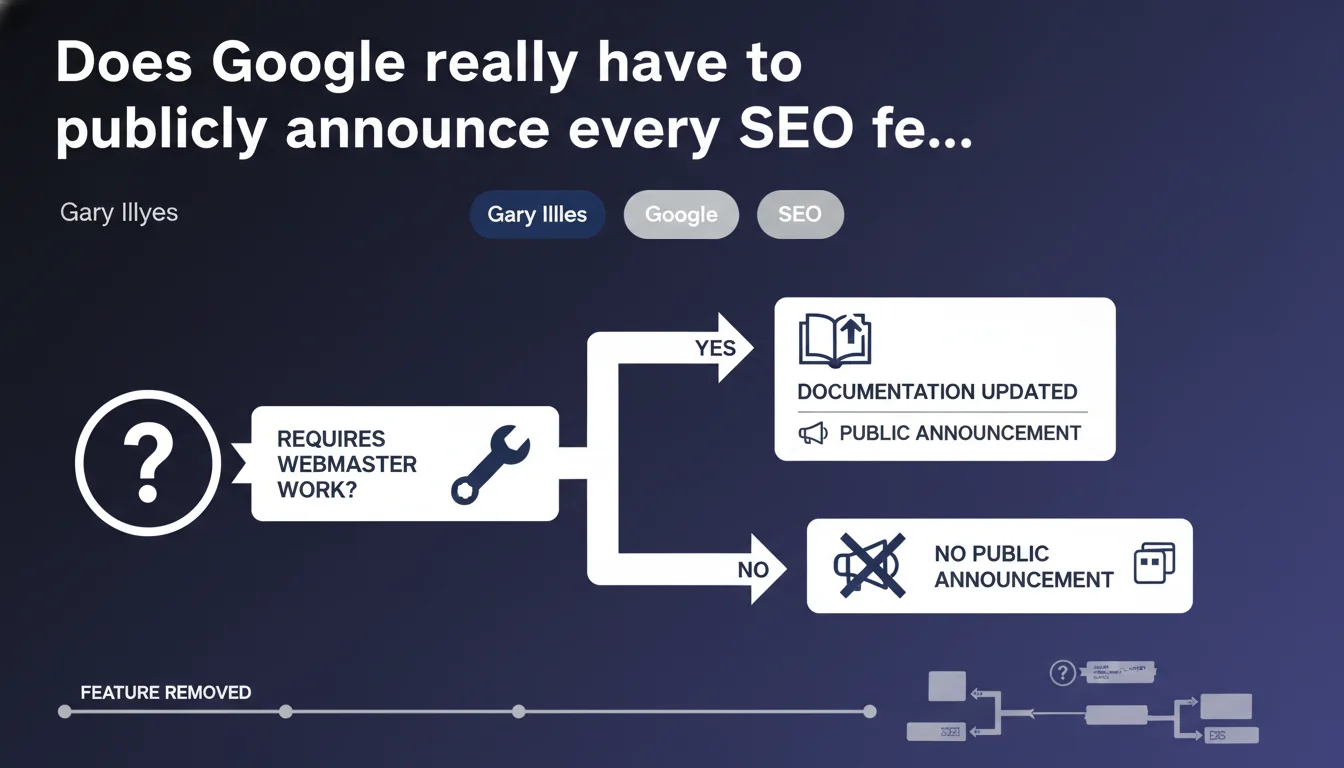
Google doesn't systematically communicate feature removals. Public announcements only happen if the feature required webmaster-side implementation — in that case, documentation must be updated to prevent unnecessary effort. Removals that don't impact site work often go unannounced.
What you need to understand
Why does Google distinguish between two types of feature removals?
The logic is pragmatic: Google only announces what directly impacts webmaster work. If a feature disappears without requiring site-side modifications, the company believes public communication isn't essential.
This approach is based on a simple calculation: a removal invisible to webmasters doesn't deserve to create noise. Conversely, if sites have invested time implementing a feature (structured markup, specific tags, technical optimizations), it becomes critical to update official documentation.
What are the concrete implications for SEO professionals?
First point: Google documentation becomes the absolute reference. If a feature disappears from official guides without fanfare, that's a strong signal. Monitoring documentation updates is as critical as following the Search team's Twitter announcements.
Second point: some removals go completely unnoticed. Algorithm adjustments, internal filter removals, weighting modifications — all of this can disappear without public trace. The field remains the only reliable indicator.
How do you know if a feature is still supported?
The safest method: check for presence in official documentation. If a markup, tag, or technical recommendation no longer appears in Google Search Central guides, consider it obsolete.
However, be careful: some features remain documented but are no longer actively developed. The distinction is subtle. The absence of updates or mentions in recent communications may indicate gradual disengagement.
- Selective communication: Google only announces removals requiring webmaster action
- Documentation priority: official guides are updated even without public announcement
- Invisible removals: some algorithm modifications never get communicated
- Webmaster responsibility: actively monitor documentation to avoid unnecessary effort
SEO Expert opinion
Is this communication policy consistent with observed practices?
Yes, and it's actually a confirmation of what we've seen for years. Google has always been selective in its announcements. Features like authorship markup, recurring events in structured data, or certain types of rich snippets disappeared with minimal communication.
The problem? This approach creates information asymmetry. Professionals who don't scrutinize documentation daily may continue implementing obsolete features for months. I've seen sites add abandoned markup simply because a three-year-old guide hadn't been removed from the web.
What nuances should be added to this statement?
Gary Illyes says documentation "must be updated" — but timelines remain unclear. [To verify]: no commitment to a specific update timeline. In practice, I've observed delays of several weeks, even months, between an actual removal and deletion of corresponding documentation.
Another point: what exactly is a "feature requiring implementation"? Canonical tags? Clearly. But a change in how Google interprets an existing signal? The boundary becomes blurry. The definition remains subjective and lets Google decide case by case.
In what cases doesn't this rule really apply?
"Silent" removals mainly concern internal algorithm adjustments. But when a visible feature disappears (featured snippets of a certain type, specific SERP display), the absence of official communication doesn't prevent the SEO community from noticing immediately.
And that's where it gets tricky: Google may not announce, but SERP tracking tools, field analysis, and community discussions partially compensate for this silence. Official communication is no longer the only information channel — it's sometimes even the last one.
Practical impact and recommendations
What should you do concretely to avoid wasted effort?
Regularly audit existing implementations by cross-referencing with official documentation. Markup that hasn't generated rich results for six months deserves questioning, even if still mentioned in a Google guide.
Set up active monitoring of Google Search Central documentation updates. RSS feeds, GitHub notifications on documentation repositories, or simply a monthly check of key pages allow you to detect discreet removals.
What mistakes should you avoid when implementing new features?
Never implement a feature just because it's documented. Verify it produces concrete results in SERPs before investing development time. Test with the rich results testing tool, observe competitors, validate on a sample of pages.
Avoid relying on undated third-party guides or tutorials. Information freshness is critical in technical SEO — an 18-month-old article may recommend already obsolete practices.
How do you verify that a feature is still active and relevant?
First method: use official Google tools (Search Console, rich results testing tool, PageSpeed Insights). If markup is no longer recognized or no longer generates a preview, that's a warning signal.
Second method: analyze competitor SERPs. If no sites in your sector display a type of rich result despite correct implementation, the feature is probably deprecated or disabled.
- Quarterly audit of structured markup and technical tags implemented
- Monitor Google Search Central documentation updates via RSS feeds or notifications
- Systematically test with official Google tools before any implementation
- Analyze competitor SERPs to validate actual display of rich results
- Document implementation dates internally to facilitate future audits
- Prioritize features actively promoted by Google in recent communications
❓ Frequently Asked Questions
Google est-il obligé de prévenir avant de retirer une fonctionnalité SEO ?
Comment savoir si une fonctionnalité documentée par Google est toujours active ?
Pourquoi certains balisages structurés ne produisent-ils plus de résultats enrichis ?
À quelle fréquence faut-il auditer les implémentations techniques SEO ?
Existe-t-il une liste officielle des fonctionnalités retirées par Google ?
🎥 From the same video 11
Other SEO insights extracted from this same Google Search Central video · published on 07/11/2023
🎥 Watch the full video on YouTube →
💬 Comments (0)
Be the first to comment.