
Official statement
Other statements from this video 11 ▾
- □ Is Google really replacing traditional blue links with enriched features—and what does that mean for your organic visibility?
- □ Should you really optimize invisible or rarely-clicked elements on a page?
- □ Does Google really prioritize user satisfaction, or is maximizing ad revenue the hidden agenda?
- □ Does Google really measure your page's satisfaction through repeated searches?
- □ How does Google decide which features are worth evaluating in its algorithm?
- □ Does Google really sacrifice SEO features just to cut infrastructure costs?
- □ Is Google really demanding more and more work from website owners indefinitely?
- □ Should you really be happy when Google removes SEO features?
- □ Does Google really roll out algorithm changes all at once, or are they tested gradually on live traffic?
- □ Does Google really have to publicly announce every SEO feature it removes?
- □ Does Google really limit search results to just one per domain?
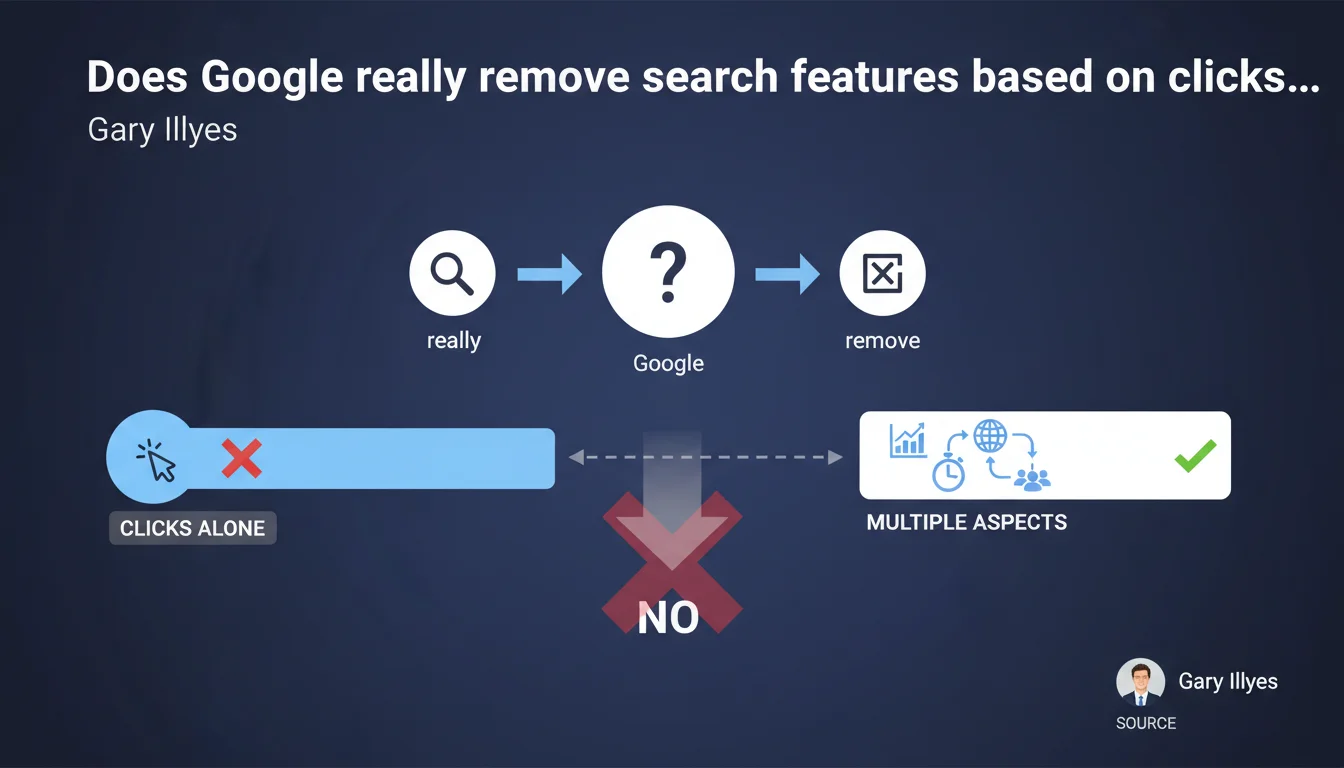
Google dismantles the myth that interaction rates are the sole criterion for keeping or removing a SERP feature. Gary Illyes confirms that multi-criteria evaluation is at play — a strong signal that user engagement is just one piece of the puzzle, and probably not the most decisive one.
What you need to understand
Why does this statement change the game for SEOs?
Many SEO practitioners have adopted the following assumption: if a SERP feature generates few clicks, Google removes it. This logic relies on observed cases like People Also Ask or Featured Snippets that vary by query.
Gary Illyes just shattered this simplistic view. The decision to keep or remove a feature is not based on a single KPI (CTR), but on a bundle of criteria whose exact composition remains unknown.
What other criteria are likely at play?
Google doesn't detail the algorithm, but we can infer several dimensions: technical maintenance cost, editorial relevance relative to search intent, user satisfaction (not just the click, but what happens after), mobile compatibility, legal or reputational risks.
A concrete example: AMP Stories disappeared despite respectable engagement. Why? Maintenance cost, fragmentation of standards, low adoption by publishers. CTR doesn't explain everything.
Is this multi-criteria approach documented elsewhere?
No, and that's the problem. Google communicates little about the exact decision framework. We know that Quality Raters evaluate the relevance of SERP features, but their actual influence remains unclear.
The E-E-A-T guidelines mention overall user experience, but no public matrix details the respective weight of each criterion. We're working in the fog, as usual.
- No single metric: CTR alone does not determine the survival of a SERP feature
- Multidimensional evaluation: technical, editorial, legal, mobile UX
- Assumed opacity: Google will never publish the complete decision matrix
- Case studies: AMP Stories, Quick Answers removed despite solid engagement
SEO Expert opinion
Is this statement consistent with observed practices?
Yes and no. In the field, we indeed observe that certain low-CTR features persist (Knowledge Panels for unpopular entities, for example), while others disappear despite solid engagement. Consistency exists if we accept the existence of hidden criteria.
But — let's be honest — this statement remains extremely vague. Gary Illyes specifies neither the nature nor the weight of these so-called criteria. We're told "it's complex," without actionable leverage. [To verify]: to what extent do Quality Raters actually influence these decisions?
What nuances should we add to this official position?
First nuance: CTR probably remains a major criterion, even if it's not exclusive. Google wouldn't remove a feature that's massively clicked, except in exceptional cases (legal issue, excessive cost).
Second nuance: criteria vary by feature. A Featured Snippet and a video carousel are not evaluated with the same framework. Context matters as much as raw metrics.
What are the implications for SERP visibility strategies?
Concretely? You can no longer optimize for SERP features based solely on observed click-through rates. You must integrate editorial and technical logic: content quality, mobile relevance, post-click satisfaction.
And that's where it gets tricky: how do you measure post-click satisfaction without access to Google's data? We return to basics: time on page, bounce rate, scroll depth, real engagement. Proxies, not certainties.
Practical impact and recommendations
What should you do concretely to secure your SERP visibility?
Stop chasing only Featured Snippets or People Also Ask. Work on the intrinsic quality of your content: if Google removes a feature, your page must stand on its own as a standard organic result.
Invest in post-click signals: Core Web Vitals, real engagement, smooth navigation architecture. Google doesn't say it explicitly, but these dimensions probably influence decisions to keep or remove features.
What mistakes should you avoid when optimizing for rich positions?
Mistake #1: over-optimizing for an unstable SERP feature. If your traffic depends 40% on a Featured Snippet, you're in danger. Diversify your entry points.
Mistake #2: ignoring mobile experience. Google frequently removes features that perform poorly on mobile (heavy carousels, non-responsive formats). Test your content on mobile as a priority.
How can you verify that your strategy remains viable despite these uncertainties?
Regularly audit your traffic sources in Search Console. If a query generates 80% of its traffic through a specific feature (FAQ, How-to), create an editorial backup plan: complementary content, query variations, improvement of pure organic ranking.
Monitor SERP evolution for your key queries with tracking tools (SEMrush, Ahrefs, or even custom scripts). Feature removal can be progressive — detect weak signals before traffic collapse.
- Diversify SERP entry points: never depend on a single feature
- Optimize post-click signals: CWV, time spent, scroll depth
- Prioritize mobile experience for all targeted SERP features
- Audit monthly traffic distribution by position type (pure organic vs. enriched)
- Create content that "stands on its own" even without a rich position
- Monitor SERP evolution with automated tracking tools
❓ Frequently Asked Questions
Google retire-t-il vraiment des fonctionnalités SERP uniquement à cause du faible CTR ?
Quels autres critères Google utilise-t-il pour décider du retrait d'une fonctionnalité ?
Comment protéger mon trafic si Google retire une fonctionnalité SERP dont je dépends ?
Les Featured Snippets sont-ils menacés par cette logique multi-critères ?
Faut-il arrêter d'optimiser pour les positions riches après cette déclaration ?
🎥 From the same video 11
Other SEO insights extracted from this same Google Search Central video · published on 07/11/2023
🎥 Watch the full video on YouTube →
💬 Comments (0)
Be the first to comment.