
Official statement
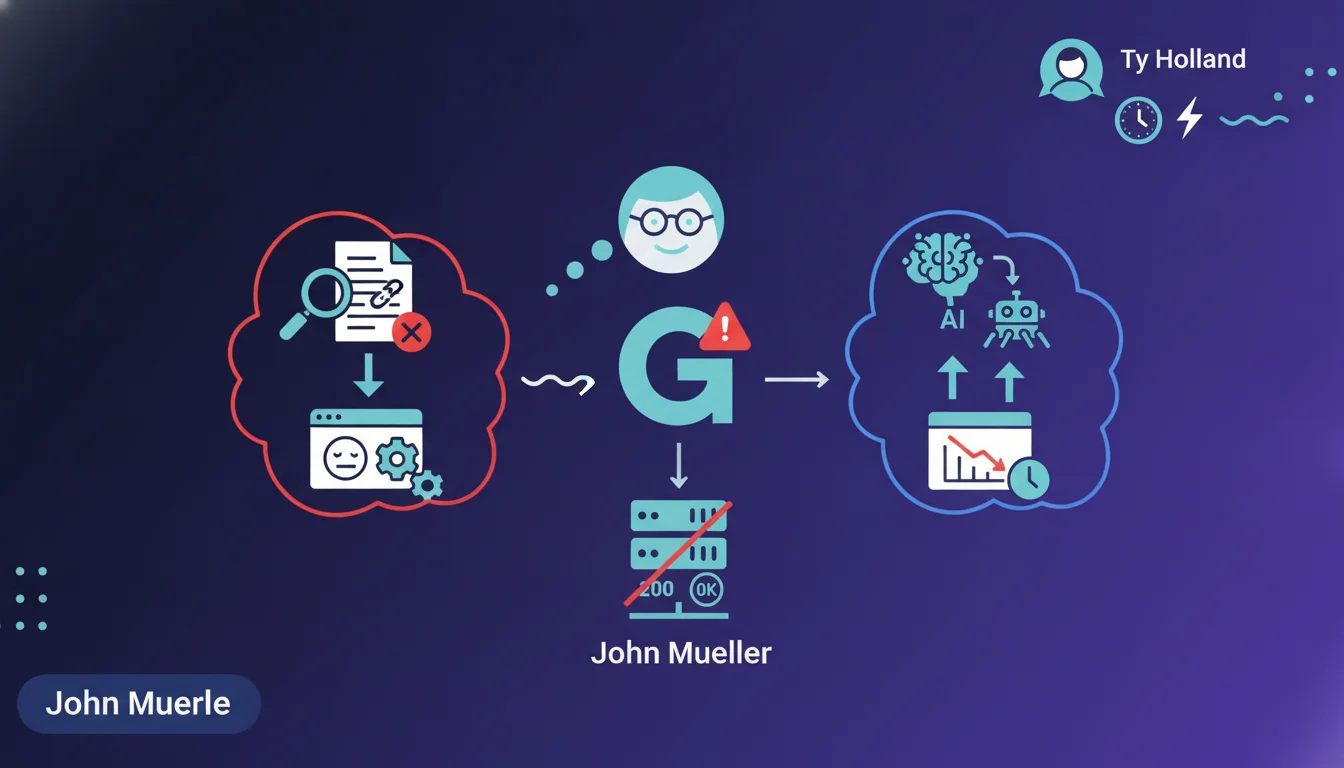
For John Mueller, there are two risks: The indexing of the error message: Google may index the page with the visible text, such as 'try again later'. This text then appears in the search results. This issue resolves itself once the actual content comes back.
Deduplication: If the same message appears on all pages, Google may consider them duplicates and remove them from the index. This second problem is more severe and longer-lasting: deduplicated pages are crawled less frequently, meaning it may take a long time to regain their positions.
Returning an HTTP 200 code during an outage with a 'back soon' message poses two risks: temporary indexing of the error message in the SERPs, and especially massive deduplication if all pages show the same content. The second issue can lead to permanent deindexing of the deduplicated pages, with crawling slowdowns that significantly delay their reappearance.
What you need to understand
Why is a 200 code problematic during an outage?
When a site goes down, many CMSs or maintenance systems display a 'we'll be back soon' page while returning a HTTP 200 code. For the server, everything is fine. For Google, this signal means that the page is functioning normally and that its current content is valid.
The bot crawls this page, sees the error message as legitimate content, and may decide to index it. The result: your URLs appear in the SERPs with a snippet like 'Site maintenance, please try again later'. Not great for brand image, but this issue corrects itself as soon as the real content returns.
What is deduplication and why is it more serious?
The real danger is when all pages on the site return the same maintenance message with a 200 code. Google detects that hundreds or thousands of URLs are serving exactly the same content.
Its algorithm then considers these pages as duplicates. To avoid polluting the index with duplicated content, it may decide to mass-remove URLs from the index. Unlike the temporary indexing of an error message, this deduplication has lasting effects: deduplicated pages are crawled less often, which significantly prolongs the time before they reappear in the results.
How long does it take to recover after deduplication?
Once the pages are removed from the index due to duplication, the crawl budget allocated to these URLs decreases. Google spaces out the bot's visits, considering these pages do not provide value.
When the original content returns, you have to wait for Googlebot to revisit, notice the change, reassess the quality and uniqueness of each page, and then reindex them. This process can take weeks, or even months for sites with a low crawl budget or thousands of affected pages.
- A 200 code with an error message signals to Google that the content is valid and indexable
- The temporary indexing of the message quickly resolves upon the return of the real content
- Mass deduplication leads to lasting deindexing and crawling slowdowns
- Sites with a low crawl budget are particularly vulnerable
- Recovery can take several weeks or months depending on the size of the site
SEO Expert opinion
Is this recommendation consistent with field observations?
Yes, absolutely. Field reports confirm that prolonged outages with a 200 code cause measurable damage. I've seen sites lose 60 to 80% of their indexed pages after poorly managed maintenance lasting 48 hours, with recovery times exceeding two months.
What's interesting is that severity also depends on the site's usual crawl frequency. A highly authoritative media site with daily crawling recovers faster than a small e-commerce site crawled once a week. The crawl budget plays a major role in the speed of recovery post-deduplication.
What nuances should be added to this rule?
Mueller clarifies that the issue mainly arises for long outages, but does not clearly define this threshold. In practice, outages of less than 2-3 hours rarely cause visible damage, especially if they occur outside peak crawl times.
The risk also depends on the number of pages crawled during the outage. If Googlebot only visits 5% of your URLs before the site returns, the impact will be limited. But if an outage occurs just after a major update that triggers mass recrawling, the damage can be considerable.
Another rarely mentioned point: some sites use dynamic maintenance pages that display different content based on the URL. Technically, this avoids strict deduplication, but Google might still detect patterns of partial duplication. [To verify]: The actual effectiveness of this approach lacks consolidated public data.
In which cases is a 200 code still acceptable?
There are situations where a 200 code with alternative content does not pose a problem. For instance, a well-designed soft 404 that displays true contextual replacement content, with functioning navigation links and a coherent design.
Some large sites also use maintenance pages by section: only part of the site shows a 200 status with an error message, while the rest functions normally. This limits the scope of deduplication. But let's be honest: this approach requires complex infrastructure that few sites can afford.
Practical impact and recommendations
What should be done concretely during an outage?
The basic rule: always return an appropriate HTTP code when the site is unavailable. For a short outage (less than a few hours), use a 503 Service Unavailable code with a Retry-After header indicating when the bot should revisit.
For planned maintenance lasting several hours or days, 503 remains the best option. Google understands that it is temporary and keeps the pages in the index. The bot will naturally return without penalizing the site.
If the outage exceeds 48-72 hours, some recommend a 410 Gone code for truly removed pages, but this is risky: if misused, the 410 can lead to permanent deindexing hard to reverse. The 503 is safer for even long outages, as long as you are certain the content will return.
How to avoid deduplication in case of issues?
The ideal is to configure your server or CDN to return a 503 at the server level, before the maintenance page even loads. Many CMSs (WordPress, Shopify, Magento) offer plugins or maintenance modes that do this correctly.
If you absolutely must display a maintenance page, ensure it is served with a 503 code and contains a realistic Retry-After header. Googlebot usually respects this indication and spaces out its attempts accordingly.
Avoid JavaScript solutions that show a 'site maintenance' message client-side while the server returns a 200. Google crawls the raw HTML and will see a 200 code even if the user sees the error message.
How to check if my site is correctly configured?
Test your maintenance page with a tool like curl or the browser's DevTools. Ensure that the HTTP code returned is indeed 503 (or 500/502 as appropriate), not 200. Conduct this test before the outage, in a staging environment.
After an outage, monitor the Search Console: Coverage section, 'Excluded' tab. If you see a sharp increase in pages marked 'Duplicated', that's a bad sign. Request a manual reindexing of the main pages via the URL inspection tool.
For large sites, monitoring server logs allows for quick detection if Googlebot is massively crawling error pages. A spike in bot requests showing 200 during an outage should trigger an alert.
- Configure the server to return a 503 code in case of an outage, never a 200
- Add a realistic Retry-After header to guide Googlebot
- Test the configuration in a staging environment before any maintenance
- Monitor the Search Console after an outage to detect deduplication
- Request manual reindexing of the main pages if necessary
- Implement log monitoring to alert in case of massive crawling during an outage
💬 Comments (0)
Be the first to comment.