
Official statement
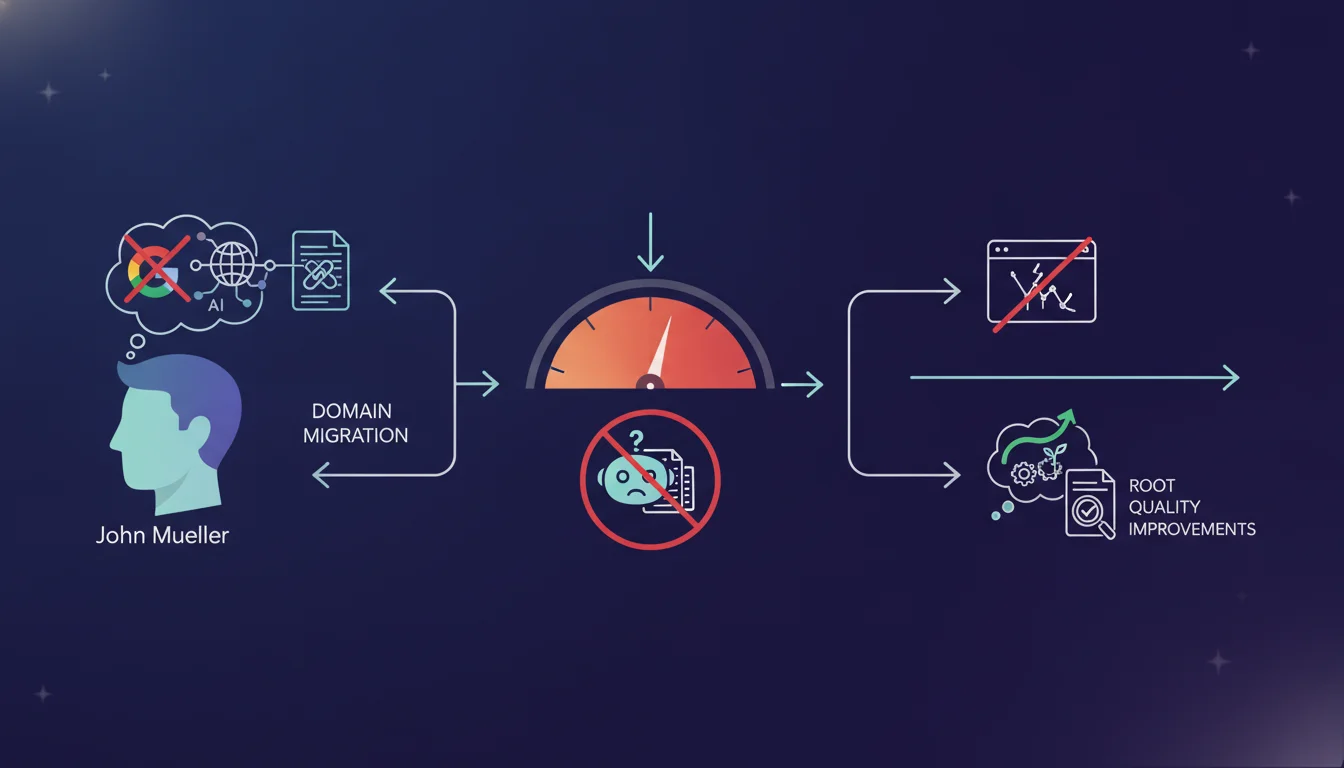
According to John Mueller, the problem likely stems less from the migration itself than from Google's quality systems, which are 'not convinced' by the site.
Changing the domain does not resolve a quality issue. He advises taking a step back and asking what actual value the site brings to the web.
John Mueller is clear: migrating to a new domain does not solve any existing quality issues. If a site remains poorly indexed 10 months after migration, it means Google's quality systems do not find it robust enough. Before changing the domain, ask yourself the real question: what new value do you bring to the web?
What you need to understand
Why doesn't a domain migration improve perceived quality?
A domain name change is a neutral technical operation for Google. Crawlers transfer signals (backlinks, history, authority) from one address to another via 301 redirects. But they do not alter the content or the perceived value of the pages.
If your site had weaknesses before the migration—duplicate content, low-value pages, poor user experience—these problems travel with you. Google reevaluates the site based on its real substance, not its address. A superficial change does not convince anyone.
What does 'not convinced by the site' really mean?
Mueller uses a vague phrase: the quality systems are 'not convinced'. In practice, this encompasses several algorithmic filters: Helpful Content, Product Reviews, E-E-A-T signals, and anti-spam mechanisms. These systems assess the perceived added value of the content.
In concrete terms, an 'unconvincing' site often has generic pages that rephrase what already exists elsewhere. Or promotional content disguised as information. Google looks for differentiation signals: demonstrated expertise, cited sources, original angles, real user feedback.
Can a site remain poorly indexed for several months after migration?
Absolutely. A successful technical migration (clean redirects, updated sitemap) does not guarantee any visibility gain if the content is problematic. Google may crawl and index quickly but not assign decent positions if quality algorithms are blocking.
In the reported case, 10 months is a long time. But this delay does not indicate a migration failure: it reveals a structural underlying issue. The new domain inherits the flaws of the old one, and Google confirms its initial verdict.
- A domain migration transfers signals (authority, backlinks, history) but does not correct any quality shortcomings.
- Google's quality systems evaluate the real content and added value, not the site address.
- A site can remain poorly indexed long after migration if the algorithms do not judge it strong enough.
- The real question to ask is: what unique offering do you have that other sites in your sector do not provide?
- Before any major technical change, audit your content with a critical and external perspective.
SEO Expert opinion
Is Mueller's position consistent with what we observe in the field?
Yes. Empirical feedback aligns with this: a well-executed migration transfers positions within weeks, provided the site is already healthy. When a site stagnates after migration, it is rarely a technical issue (unless it's an obvious redirect error), but rather a matter of perceived quality.
We often see cases where a site changes domain hoping to 'start fresh' and escape a Penguin penalty or a historical disavowal. This does not work: Google quickly links identities through backlink patterns, identical content, servers. The new domain inherits the liabilities.
What should you do if Google finds your site 'unconvincing'?
Mueller remains vague about the specific criteria. [To verify]: what exactly does Google mean by 'added value to the web'? The guidelines mention E-E-A-T, but many sites conforming to these criteria remain invisible. There is a lack of clear quantitative thresholds.
In practice, start with a brutal audit: compare your pages to those ranking in the top 3 for your target queries. Are they more comprehensive? Clearer? Better documented? If the answer is no, you have your diagnosis. Then, remove or consolidate weak pages, and strengthen your demonstrations of expertise (identified authors, cited sources, real case studies).
Are there cases where a migration can help indirectly?
Yes, in very specific situations. If your old domain was manually penalized (an unresolved manual action), a clean new domain may unlock potential, provided you correct the issues that caused the sanction. But this is marginal.
Another case: a domain historically associated with a different sector (e.g., an old online betting site converted to e-commerce). Changing the domain helps to remove semantic confusion. But again, the content must be solid. A migration never rescues a mediocre site.
Practical impact and recommendations
How can you diagnose a quality problem rather than a technical migration issue?
Start by checking the basics: are all the 301 redirects in place and properly pointing to the right pages? Is the XML sitemap of the new domain submitted in Search Console? If so, and Google is crawling normally but not indexing, you are facing a content issue.
Use Search Console: compare the 'discovered but not indexed' pages before and after migration. If the same patterns repeat (thin pages, detected duplicates, insufficient quality), the diagnosis is clear. Google politely informs you that your content does not deserve to be shown.
What concrete actions should you take to convince the quality systems?
First, remove or consolidate your weak pages. A site with 500 pages, of which 300 are mediocre, sends an overall negative signal. It is better to have 150 solid pages. Next, strengthen the E-E-A-T signals: add identifiable authors with biographies and verifiable expertise, cite credible external sources, and incorporate real user feedback.
Also work on user engagement: time on page, bounce rate, clicks to other pages. Google does not publish these metrics as direct ranking factors, but they reflect real satisfaction. Content that retains and engages is more likely to rank. Test, iterate, measure.
When should you call in experts to secure a migration or a quality audit?
A domain migration remains a risky operation: a missing redirect, a canonicalization error, and you lose positions that are difficult to recover. If you are managing an e-commerce site or a media outlet with thousands of pages, the cost of an error can quickly reach tens of thousands of euros in lost traffic.
Similarly, accurately diagnosing a perceived quality issue requires experience: knowing how to read between the lines of Search Console reports, comparing competitors' ranking signals, identifying algorithmic penalty patterns without visible manual action. Facing these complex issues, surrounding yourself with a specialized SEO agency can avoid months of costly trial and error and ensure tailored support suited to your situation.
- Ensure that all 301 redirects are in place and pointing correctly to the right URLs.
- Analyze the Search Console reports: 'discovered but not indexed' pages and the reasons cited.
- Compare your content with that of the top 3 competitors on your target queries: are you more comprehensive, clearer, more useful?
- Remove or consolidate the weak pages (thin content, duplicates, pages with no added value).
- Strengthen the E-E-A-T signals: identified authors, cited sources, proof of expertise, real user feedback.
- Measure real engagement: time on page, bounce rate, internal clicks. Content that retains is better than content that drives visitors away.
💬 Comments (0)
Be the first to comment.