
Official statement
What you need to understand
What is Google's official position on the number of meta tags?
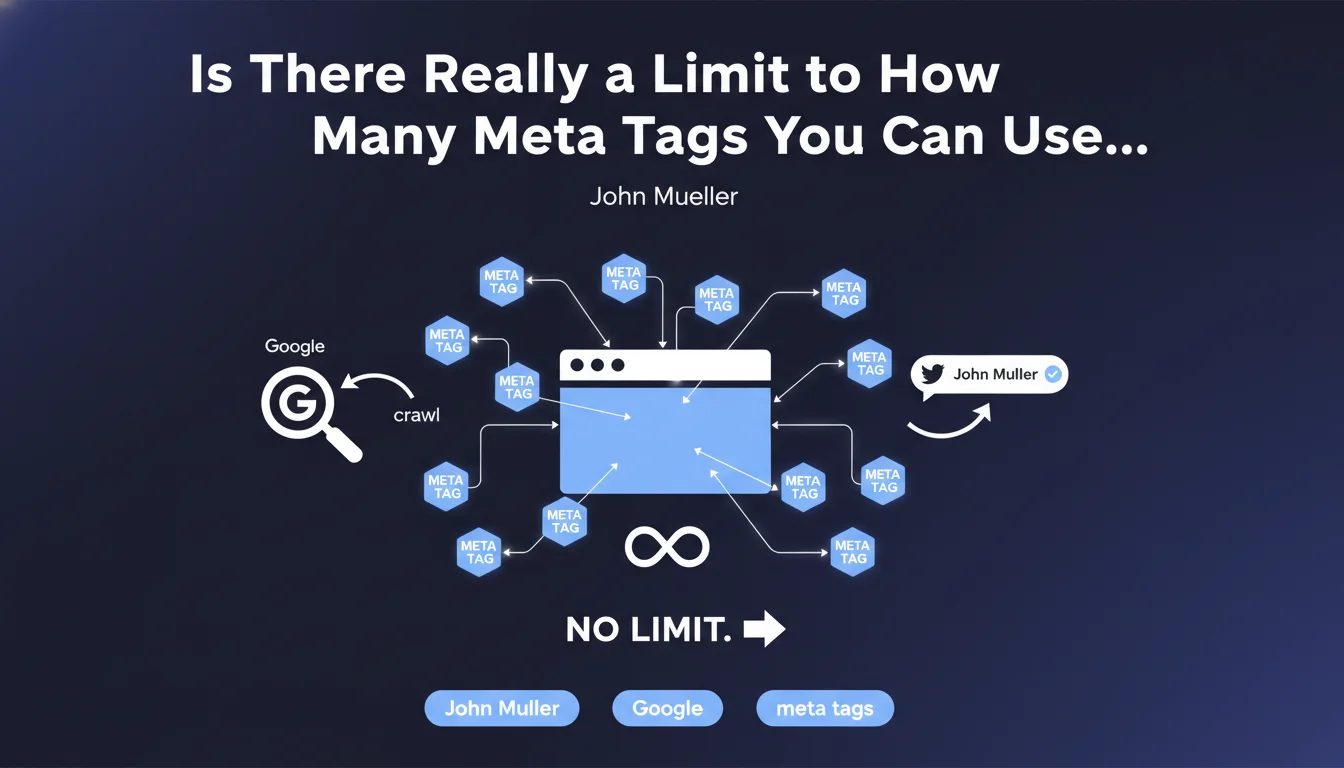
Google has clarified its position: there is no technical limit to the number of meta tags a page can contain. Google's crawler is capable of reading and analyzing all meta tags present in a page's HTML code.
This statement puts an end to speculation about potential restrictions. Contrary to certain misconceptions, you can multiply meta tags without fearing that some will be ignored for quantitative reasons.
Why does this clarification matter for SEO?
This information is essential because numerous meta tags play crucial technical roles. Beyond the famous meta description, there are dozens of tags that influence indexing, display, and your page's behavior.
Modern meta tags include: robots, viewport, charset, various tags for social networks (Open Graph, Twitter Cards), alternative structured data, and many other indispensable technical elements.
Which essential meta tags should you not confuse?
It's crucial to understand that the Title tag is not a meta tag. It's a distinct HTML tag that plays a major role in search engine optimization.
Here are the elements to clearly distinguish:
- Meta tags: description, robots, viewport, charset, http-equiv, etc.
- Title tag: separate HTML element, essential for ranking
- Meta keywords: historically abandoned by Google, no SEO impact
- Social tags: og:title, twitter:card, etc. (technically meta, but for specific use)
- No quantitative limit: only relevance and code validity matter
SEO Expert opinion
Is this statement consistent with practices observed in the field?
Absolutely. In my daily practice across thousands of audited sites, I have never observed a penalty related to the number of meta tags. Complex e-commerce sites or international platforms often integrate 15 to 30 different meta tags without issue.
The consistency is complete with field observations: Google does indeed analyze all present tags. What truly matters is the quality and relevance of each tag, not their quantity.
What important nuances should be considered regarding this statement?
Caution: no limit does not mean no consequences. While Google can technically crawl an unlimited number of meta tags, this doesn't mean all have a positive impact.
Several critical nuances deserve to be highlighted:
Moreover, certain obsolete or unrecognized meta tags provide no value and unnecessarily clutter the source code. The goal isn't to have as many as possible, but to have the right ones, properly configured.
In which cases can this freedom become problematic?
The freedom to multiply meta tags becomes risky in several situations. Contradictory tags (for example, multiple meta robots with opposing directives) create confusion and unpredictable behavior.
Pages overloaded with unnecessary or duplicate tags can suffer from performance issues. HTML artificially inflated by dozens of useless tags increases parsing time and degrades user experience, which indirectly impacts SEO.
Practical impact and recommendations
What should you actually do on your website?
Start by auditing existing meta tags on your main templates. Identify those that are actually used, those that are obsolete, and those missing to optimize your online presence.
Focus on implementing strategic meta tags: unique and engaging meta description, meta robots to control indexing, viewport for responsive design, charset for encoding, and Open Graph tags for social sharing.
Don't hesitate to add specific meta tags if they serve a precise technical purpose: geolocation, cache management, instructions for certain crawlers, metadata for mobile applications, etc.
What critical mistakes should you absolutely avoid?
Never create contradictory meta tags on the same page. For example, two meta robots with different directives (noindex vs index) will create indeterminate behavior.
Avoid integrating obsolete meta tags like meta keywords or abandoned proprietary tags. They pollute the code without adding value and can give a negative impression of the site's technical quality.
Don't overload your pages with useless tags simply because there's no limit. Each line of code must have a clear functional justification.
How can you verify and optimize meta tag configuration?
Use browser developer tools (F12) to inspect the <head> of your pages. Check the presence, uniqueness, and consistency of each strategic meta tag.
Complement with specialized SEO tools to identify missing or misconfigured tags site-wide. A comprehensive technical audit often reveals inconsistencies invisible to the naked eye.
- Audit all meta tags present in your main templates
- Remove obsolete tags (keywords) and unnecessary duplicates
- Implement essential tags: description, robots, viewport, charset
- Add Open Graph and Twitter Cards tags for social sharing
- Check for absence of contradictions between tags (especially meta robots)
- Test impact on loading time if numerous tags are added
- Document the purpose of each non-standard meta tag implemented
- Validate HTML code to avoid syntax errors
💬 Comments (0)
Be the first to comment.