
Official statement
What you need to understand
Why Does Google Recommend Using Only One Language Per Title Tag?
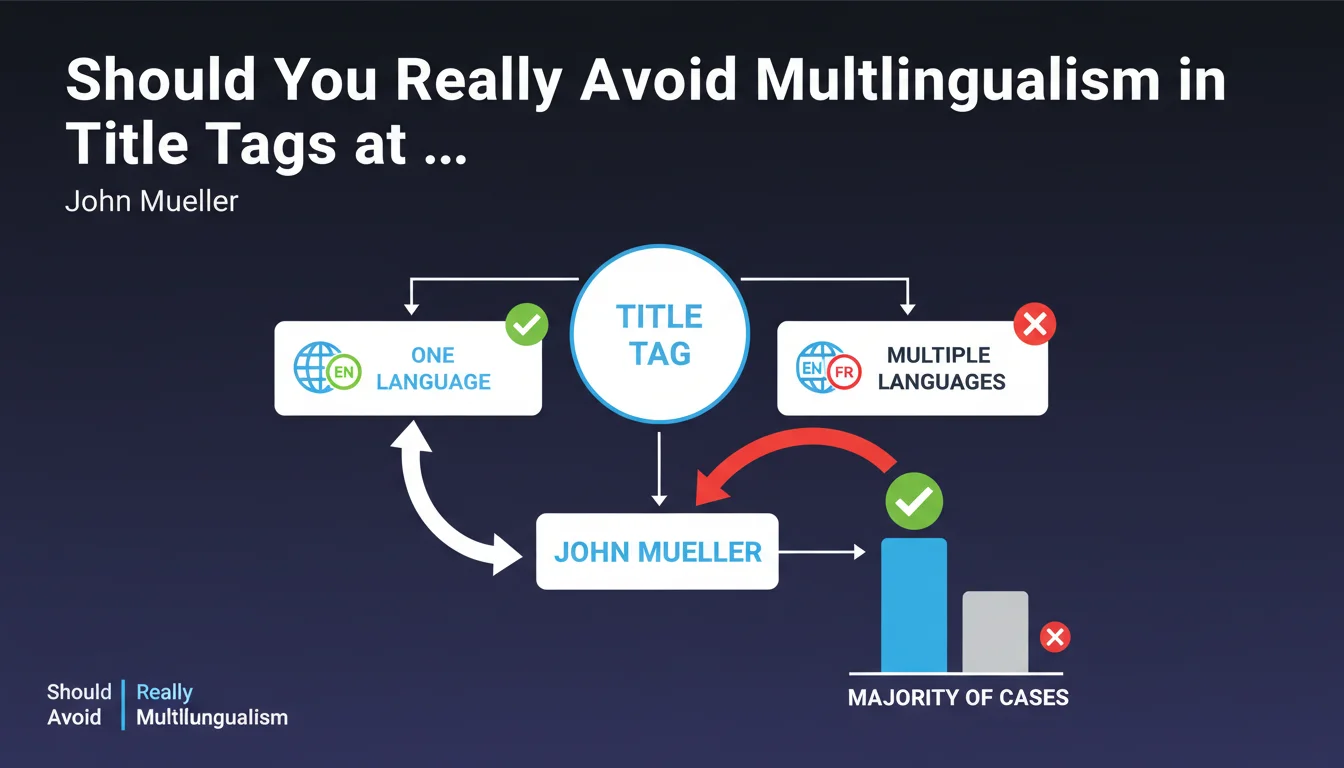
Google favors linguistic consistency to understand the context of a page. When a Title tag mixes multiple languages, it creates confusion for the algorithm that must determine the main language of the content.
This linguistic inconsistency can affect rankings in geolocalized search results. Google may miscategorize the page and present it to an inappropriate audience.
What Are the Consequences of a Multilingual Title Tag?
A Title tag in multiple languages sends contradictory signals to search engines. The click-through rate can also decrease because users don't immediately understand the relevance of the result.
The SEO performance is degraded: poor geographical positioning, loss of visibility in localized searches, and confusion for the end user in the SERPs.
Which Elements Need to Be Translated During Localization?
A complete translation is not limited to visible content. All technical elements must be consistent with the target language to guarantee an optimal user experience.
- Title tag: must be entirely in the language of the content
- Meta description: translated to improve CTR in the SERPs
- URL slug: ideally translated or transliterated depending on the strategy
- Image alt attributes: often forgotten but essential
- Hreflang tags: correctly configured to indicate language versions
- Structured content: schema.org and structured data in the appropriate language
SEO Expert opinion
Does This Recommendation Really Apply in All Contexts?
In 99% of cases, this rule is indeed relevant and should be followed. However, there are a few marginal exceptions where bilingualism might make sense.
For example, for international brands or universal technical terms (like "iPhone 15 Pro"), adding a term in a foreign language may be acceptable if it genuinely improves understanding. But these cases remain exceptional.
Do We Really Observe an Impact on Rankings?
My observations from multilingual site audits confirm the impact of this inconsistency. Pages with multilingual Titles systematically perform worse than their coherent monolingual versions.
The impact is particularly visible on geolocalized queries where Google clearly favors pages whose linguistic signals all converge. The difference can reach 20-30% of organic traffic.
What Are the Most Common Errors Observed?
Site migrations or poorly planned redesigns often generate these inconsistencies. Technical teams translate the visible content but neglect the less visible technical elements.
Another frequent case: international e-commerce sites that reuse the same templates without complete linguistic adaptation. The Title tags then contain a mix of the original template language and the new language.
Practical impact and recommendations
How Can You Audit Your Site's Linguistic Consistency?
Start with a complete crawl using Screaming Frog or Sitebulb by extracting all Title tags and meta descriptions. Export the data to Excel for analysis.
Use language detection tools (Google Cloud Translation API, Python libraries like langdetect) to automatically identify inconsistencies between the declared language (lang tag) and the actual language of the metadata.
What Corrective Actions Should Be Implemented Immediately?
Prioritize high-traffic pages and conversion pages. First correct the inconsistencies on these strategic URLs to obtain a rapid and measurable impact.
For large sites, create an automated process for linguistic verification before publication. Integrate these checks into your deployment workflow to avoid regressions.
- Verify that each page has a correctly defined lang tag in the HTML
- Ensure that the Title tag is 100% in the language of the main content
- Fully translate the meta description for each language version
- Adapt the URLs according to a coherent strategy (subdomain, subdirectory, or parameter)
- Correctly implement hreflang tags for all language variants
- Translate the alt attributes of images and internal link anchors
- Verify the consistency of structured content (JSON-LD, microdata) with the page language
- Configure Google Search Console by language version to monitor performance
- Establish a linguistic QA process before each deployment
How Can You Maintain This Consistency Over the Long Term?
Establish a mandatory deployment checklist including verification of all linguistic elements. Clearly document the rules to avoid errors during updates.
Train your editorial and technical teams in multilingual SEO best practices. Linguistic consistency must become a reflex, not a constraint imposed after the fact.
💬 Comments (0)
Be the first to comment.