
Official statement
What you need to understand
Why is the 70-character belief so widespread?
For years, the recommendation of 70 characters maximum for Title tags has established itself as a golden rule in the SEO community. This limit corresponded to the average number of characters displayed in Google search results.
The objective was to avoid title truncation in SERPs, considered a poor user experience. However, this approach confuses visual display and algorithmic understanding.
What does Google actually say about Title length?
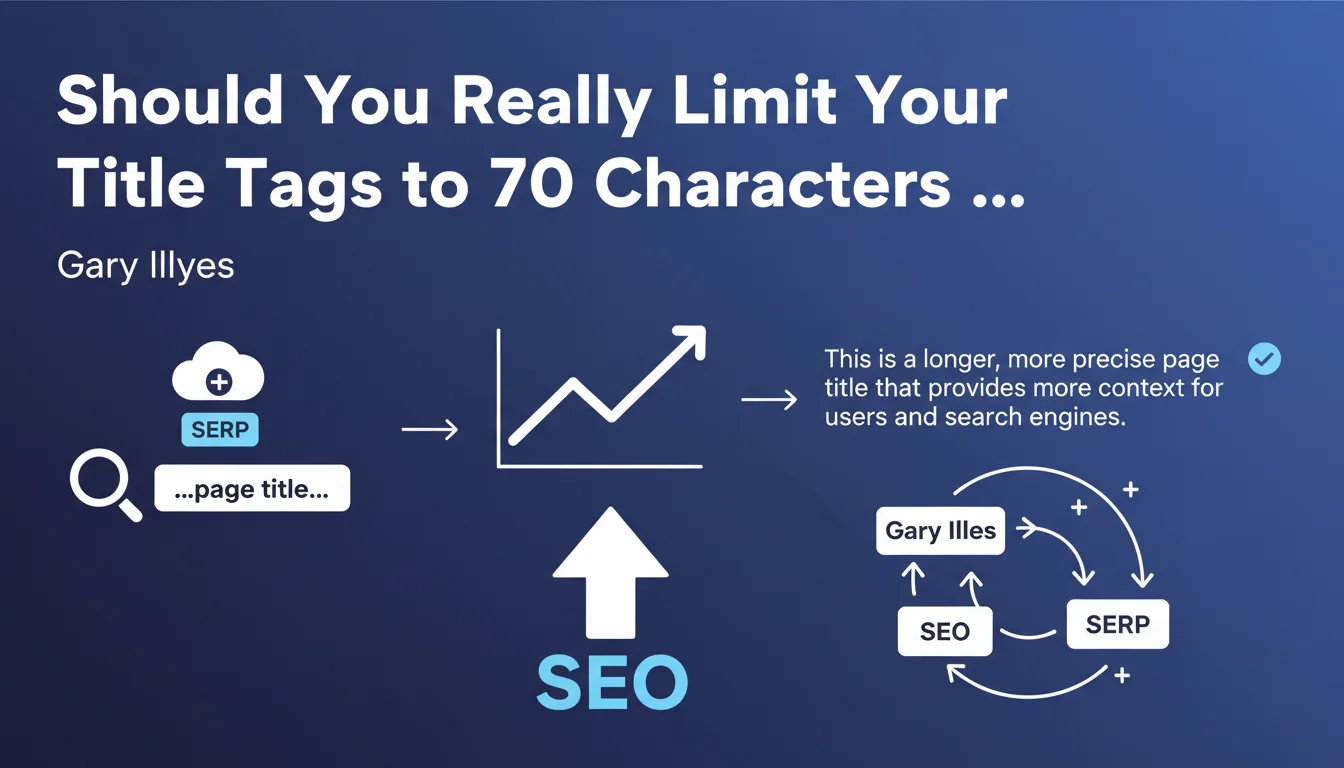
Gary Illyes from Google clarified the official position: Title tags longer than the display limit constitute a good SEO practice. The reason is simple: a longer title provides more context and precision to algorithms.
Google can thus better understand the page topic, even if all words are not visible in the results. The algorithm reads the entire Title, not just the displayed portion.
What's the difference between display length and optimal length?
Two concepts must be distinguished: the display length (approximately 60-70 characters depending on devices) and the optimal length for SEO (which can largely exceed this limit).
A Title of 100 to 150 characters can be perfectly suitable if it provides relevant complementary information. Google will use this data to better categorize your content, even if the display will be truncated.
- The 70-character limit is a display constraint, not an SEO limit
- Algorithms read the entire Title, beyond what is visible
- A longer Title offers more context and relevant keywords
- Precision and relevance take priority over artificial brevity
- Google can rewrite your Titles anyway, regardless of their length
SEO Expert opinion
Is this statement consistent with real-world observations?
My 15 years of experience completely confirms this position. I have observed across thousands of sites that pages with descriptive and detailed Titles often perform better than those with artificially shortened titles.
A/B tests show that Titles of 90-120 characters frequently generate better rankings for long-tail queries. The reason: they naturally contain more semantic variations and context.
However, be careful: length does not mean keyword stuffing. A long Title must remain natural, readable and provide real descriptive value.
What nuances should be applied to this recommendation?
The optimal length depends on the content type and search intent. For an e-commerce product page, a Title of 80-100 characters including brand, model and key attributes is often ideal.
For an informational blog article, you can go up to 120-150 characters to capture the full semantic richness. On the other hand, for a simple brand page, a short Title may suffice.
In what cases does the 70-character rule remain relevant?
For primary keywords, it remains crucial to place them in the first 60-70 characters. These words will be visible in SERPs and benefit from a psychological weight with users.
The ideal structure: primary keyword at the beginning of the Title (first 60 characters), followed by complementary and contextual information that enriches algorithmic understanding without harming user experience.
Practical impact and recommendations
How should you structure your Title tags concretely?
Adopt a two-part approach: the visible part (60-70 characters) contains your main message and your priority keyword. The extended part (up to 120-150 characters) adds context, secondary keywords and specifications.
Example: "Complete Technical SEO Guide 2024 [visible part] - Crawl, indexing, Core Web Vitals, structured data and crawl budget optimization [extended part]". The extended part enriches semantic understanding without overloading the display.
What mistakes should you avoid when lengthening Titles?
Don't fall into the trap of keyword stuffing under the pretext of lengthening your Titles. Each added word must provide real informational value, not simply repeat variations of the same keyword.
Also avoid Titles that exceed 200 characters: beyond that, you dilute the weight of each term. Stay within a range of 100-150 characters for an optimal balance between semantic richness and signal concentration.
Finally, ensure that your long Title remains grammatically correct and natural. An awkward Title will be counterproductive, even if it contains all the right keywords.
How do you audit and optimize your existing Titles?
Start by extracting all your Titles via a complete crawl of your site. Identify those that are artificially short (less than 60 characters) and those that lack contextual precision.
For each strategic page, ask yourself the question: "What complementary information would help Google better understand the content?". Add these elements after your main message.
- Place the primary keyword in the first 60 characters
- Extend the Title to 100-150 characters with relevant context
- Include natural semantic variations in the extended part
- Verify that each Title remains unique across the entire site
- Avoid excessive repetition and keyword stuffing
- Test display on mobile and desktop to validate the visible part
- Maintain complete consistency between Title and page content
- Monitor Title rewrites by Google in Search Console
- Prioritize pages with high traffic potential for optimization
💬 Comments (0)
Be the first to comment.