
Official statement
What you need to understand
What's the Real Difference Between a Manual Penalty and an Algorithmic Filter?
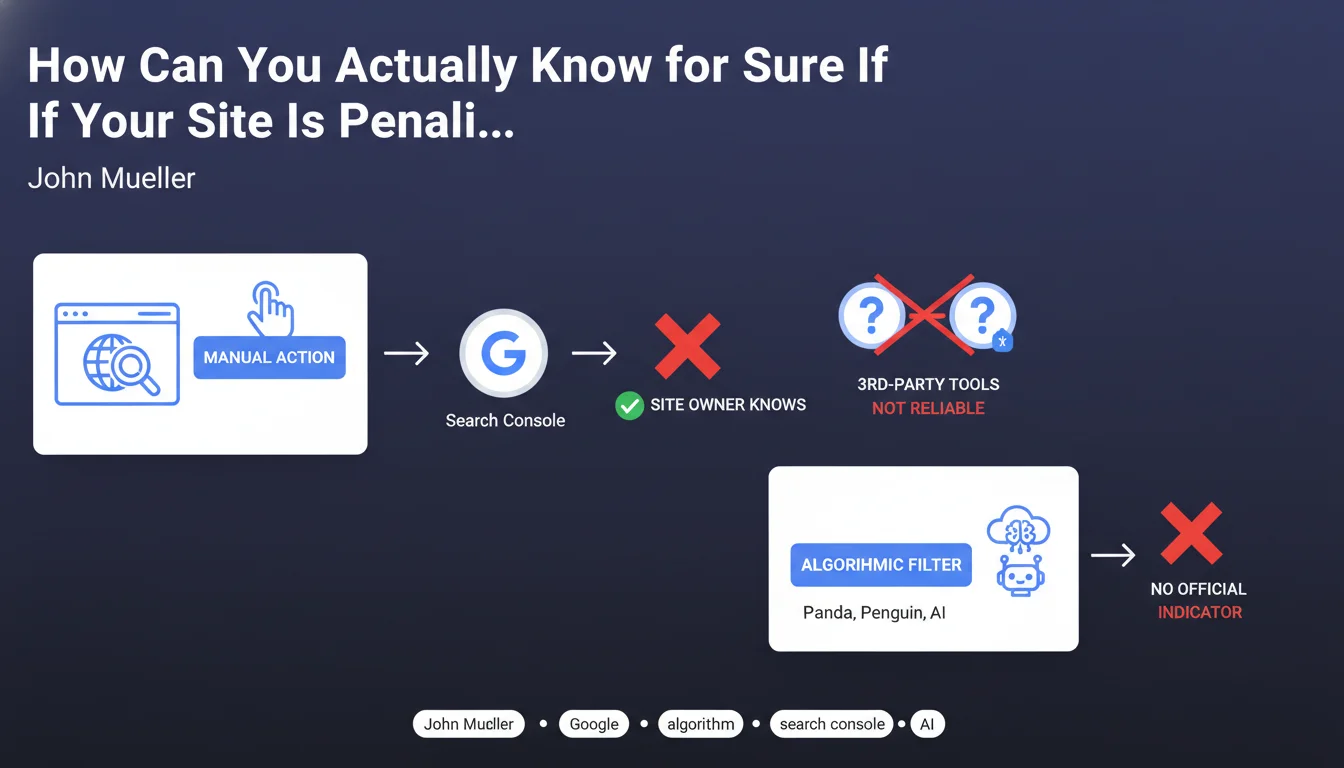
Google operates two distinct types of interventions on websites. Manual penalties are applied by human reviewers at Google and are always notified in Search Console.
Algorithmic filters like Panda or Penguin function automatically without human intervention. No notification is sent and no official indicator exists to confirm their triggering on your site.
Why Can't Third-Party Tools Actually Detect Penalties?
External tools to Google cannot access Google's internal data concerning manual actions. They are based solely on correlations and assumptions from public data such as traffic fluctuations.
Only Search Console provides reliable and official information about the existence of a manual penalty. Any other indicator coming from third-party tools remains speculative and potentially misleading.
How Do You Really Identify a Google Action on Your Site?
For manual penalties, the approach is simple: check the "Manual Actions" section of your Search Console. This is the only place where Google officially communicates these sanctions.
For algorithmic filters, the situation is more complex. You must analyze your traffic curves and correlate them with known algorithm update deployment dates, but this remains an interpretative approach without official confirmation.
- Search Console is the only reliable source for detecting a manual penalty
- Third-party tools claiming to detect penalties are not reliable according to Google
- No official indicator exists to confirm the impact of an algorithmic filter
- The distinction between manual penalty and algorithmic filter is crucial
SEO Expert opinion
Does This Statement Actually Match What We See in the Field?
After 15 years of experience, I confirm that Mueller's position is perfectly consistent with field reality. I've seen numerous clients panic because of third-party tool reports announcing "penalties" that didn't exist.
Traffic drops can have dozens of different causes: algorithmic changes, seasonality, technical issues, increased competition, or simple evolution of user behaviors. Automatically attributing these variations to a penalty is a frequent diagnostic error.
What Nuances Should We Add to This Statement?
While Google is right in principle, the reality is that algorithmic filters have a very concrete impact. The fact that there's no official notification doesn't mean we can't detect them indirectly.
With rigorous analysis of Analytics and Search Console data, combined with known update deployment dates, an expert can establish solid correlations. It's not absolute certainty, but it's a valid professional diagnostic approach.
Why Does Google Keep Emphasizing This Point So Much?
This communication aims to empower site owners and prevent them from blindly trusting unreliable paid tools. Google wants webmasters to consult Search Console directly rather than commercial intermediaries.
It's also a way to protect its intellectual property. By stating that no external tool can detect algorithmic actions, Google discourages reverse engineering of its algorithms and maintains its competitive advantage.
Practical impact and recommendations
What Should You Actually Do to Monitor Penalties?
The first action is to connect and regularly check your Search Console. Configure email notifications to be alerted immediately in case of manual action.
Set up weekly monitoring of your key metrics: organic traffic, positions on your strategic keywords, crawl rate. Document this data to be able to quickly identify any significant anomaly.
In case of sudden traffic drop, cross-reference dates with Google's algorithmic update calendar. Analyze which pages are affected and identify common patterns: content quality, link profile, user experience.
What Mistakes Should You Avoid When Diagnosing Penalties?
Don't rush to buy third-party tools promising to automatically detect penalties. These solutions are often more anxiety-inducing than useful and can make you waste time on false leads.
Avoid panicking at the first traffic fluctuation. Variations of 10-20% are normal and don't necessarily signal a serious problem. Wait a few days to confirm a trend before acting.
Don't confuse correlation with causation. Just because a drop occurs after an algorithmic update doesn't mean your site is necessarily targeted by that update. Other factors may be at play.
How Do You Build an Effective Prevention Strategy?
Adopt a proactive approach by scrupulously respecting Google's guidelines. The best protection against penalties remains quality: original and useful content, natural link profile, optimal user experience.
Conduct regular technical audits to identify and correct issues before they become critical. Maintain documentation of all your SEO actions to be able to connect them with potential performance variations.
- Check Search Console at least once a week
- Configure email alerts for manual actions
- Document your SEO metrics in a monthly dashboard
- Maintain a calendar of Google's algorithmic updates
- Never rely solely on third-party tools to diagnose a penalty
- Conduct a comprehensive SEO audit at least every 6 months
- Train your teams in best practices to avoid mistakes
💬 Comments (0)
Be the first to comment.