
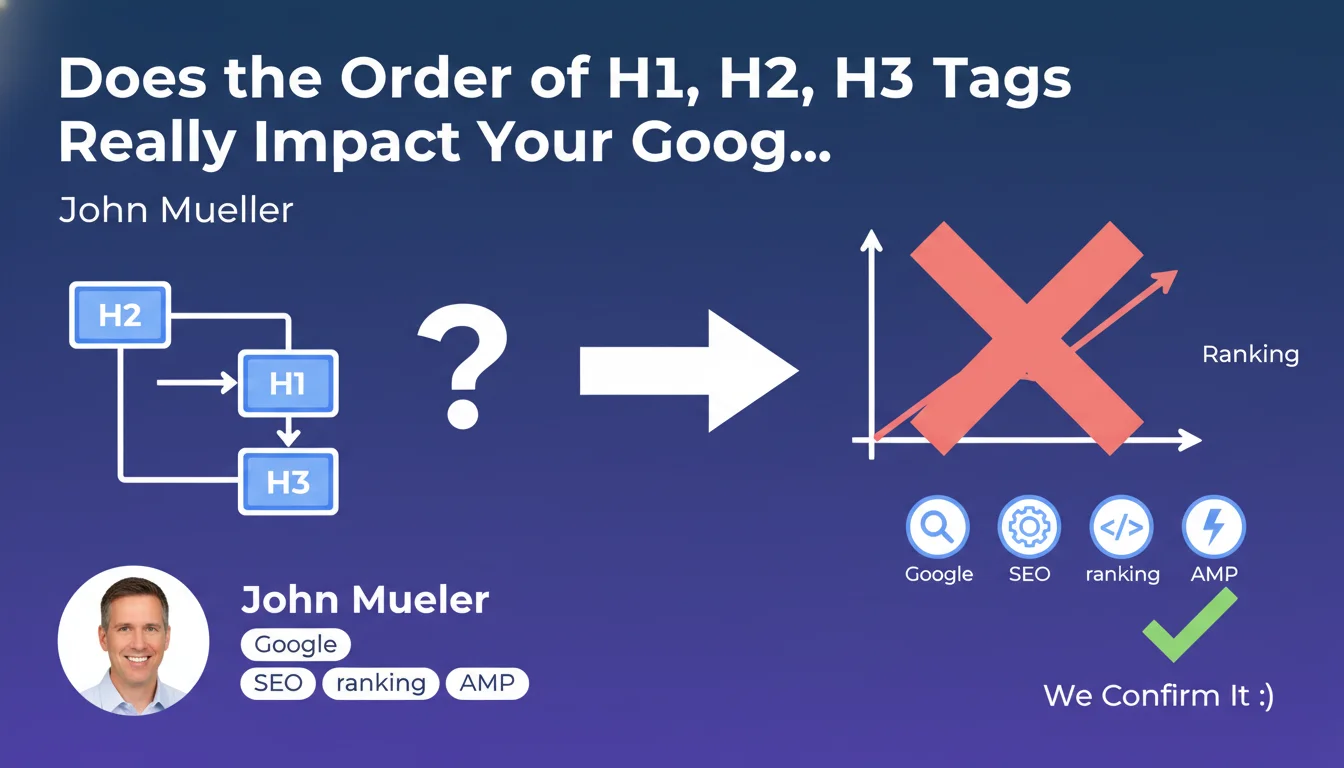
Official statement
What you need to understand
Google officially confirms that using Hn tags (H1 to H6) constitutes a fundamental SEO best practice. These tags are not merely formatting elements, but structural indicators that allow the search engine to understand the hierarchical organization of content.
Concretely, Hn tags function as a document outline for Google's algorithms. They signal which are the main headings, subheadings, and how the different sections articulate with each other. This architecture helps Google extract relevant information and better contextualize each part of the content.
Beyond the technical SEO aspect, this structuring also improves user experience. Well-hierarchized content is easier to scan visually, which increases time spent on the page and reduces bounce rate.
- Hn tags help Google understand the structure and hierarchy of content
- They facilitate the identification of relationships between information blocks
- They simultaneously improve SEO and user experience
- Good structure also helps writers organize their ideas
SEO Expert opinion
This statement is perfectly consistent with what we observe daily in analyses of high-performing sites. Well-structured pages with a logical Hn hierarchy tend to rank better, particularly on informational queries and long-form content.
Nevertheless, an important nuance: quality trumps quantity. Some sites abuse Hn tags by placing them everywhere without any real logic. Google is capable of detecting these over-optimizations. The essential thing is to create a natural and coherent structure that truly reflects the content organization.
In certain specific cases such as e-commerce product pages or highly visual landing pages, the Hn structure may be less developed. The important thing is to adapt the hierarchy to the type of content offered.
Practical impact and recommendations
- Audit the Hn structure of your main pages and identify those without clear hierarchy
- Ensure that each page has a single descriptive H1 that summarizes the main topic
- Create a logical hierarchy: H2 for main sections, H3 for subsections, etc.
- Avoid skipping levels (don't go directly from H2 to H4)
- Naturally integrate secondary keywords into H2 and H3 tags
- Verify that the Hn structure is consistent with the table of contents of the page if you have one
- Don't use Hn tags solely for formatting purposes (use CSS instead)
- Test the readability of your content by hiding all text except Hn headings
- Optimize the structure of blog articles and informational pages as a priority
💬 Comments (0)
Be the first to comment.