
Official statement
What you need to understand
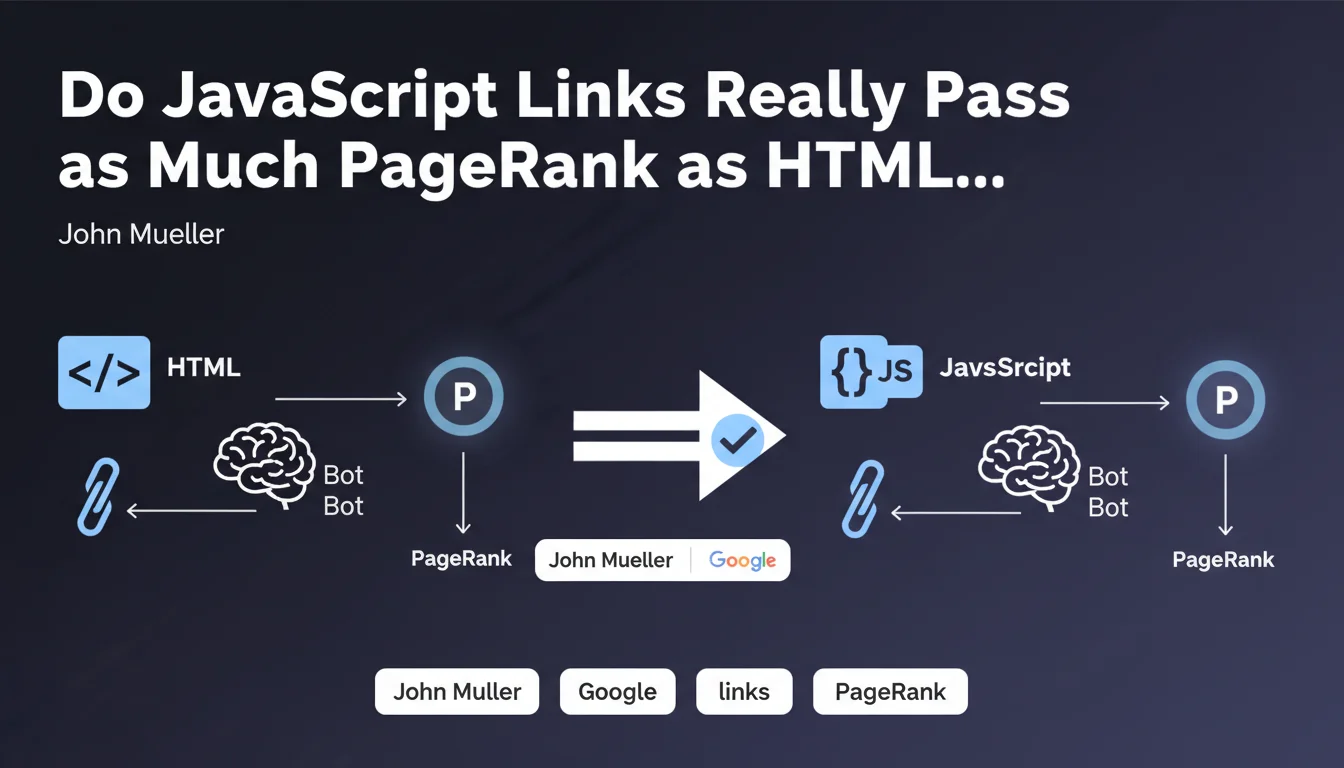
Google has clarified its position regarding links generated via JavaScript that don't use the standard HTML tag. Specifically, these are links created with elements like <div href> combined with JavaScript to handle navigation.
While Google can discover the URLs pointed to by these links during JavaScript execution, it does not treat them as real links in the SEO sense. This means they transmit neither PageRank, nor authority, nor anchor signals.
This distinction is crucial for understanding that URL discovery and SEO value transmission are two different concepts in Google's algorithm.
- Non-standard links (
<div href>+ JS) allow Google to find pages - These links transmit no PageRank or ranking signals
- The anchor text of these links is not analyzed for SEO purposes
- Only the
<a href>tag guarantees the transmission of SEO value - This rule applies to both internal linking and external links
SEO Expert opinion
This statement is perfectly consistent with what we've been observing in the field for years. Empirical tests consistently show that pages linked only via JavaScript without an <a href> tag receive significantly less authority and visibility.
However, we need to add nuance: Google does execute JavaScript and can follow these links for indexing purposes. But there's a fundamental difference between "being able to crawl a URL" and "transmitting SEO juice." This is where many developers and even some SEO professionals get it wrong.
In practice, we observe that sites heavily using these pseudo-links suffer from crawl budget issues and inefficient distribution of internal authority, even if their pages eventually get indexed.
Practical impact and recommendations
<a href> tag for all your links, whether internal or external. Audit your site to identify and fix JavaScript links that don't transmit SEO value.- Audit your HTML code to identify all non-standard links (div, span, button with JavaScript events)
- Systematically replace these elements with standard
<a href="URL">tags - Favor progressive enhancement: use real HTML links enhanced by JavaScript, rather than non-semantic elements
- Check your JavaScript frameworks (React Router, Vue Router, etc.) to ensure they generate real
<a>tags - Optimize your internal linking by ensuring all strategic links use the standard HTML format
- Test with tools like Screaming Frog in "Text Only" mode to see what Google actually sees
- Document best practices with your development teams to prevent these errors in the future
- Perform a complete crawl to measure the impact of the correction on internal PageRank distribution
The technical redesign of a site to fix these link issues can prove complex, particularly on modern JavaScript architectures or custom CMS platforms. These optimizations often require advanced technical expertise combining web development and advanced SEO. For large-scale projects or strategic sites, working with a specialized SEO agency provides accurate diagnosis, a personalized roadmap, and implementation monitoring that guarantee measurable results without risking your indexation.
💬 Comments (0)
Be the first to comment.