
Official statement
What you need to understand
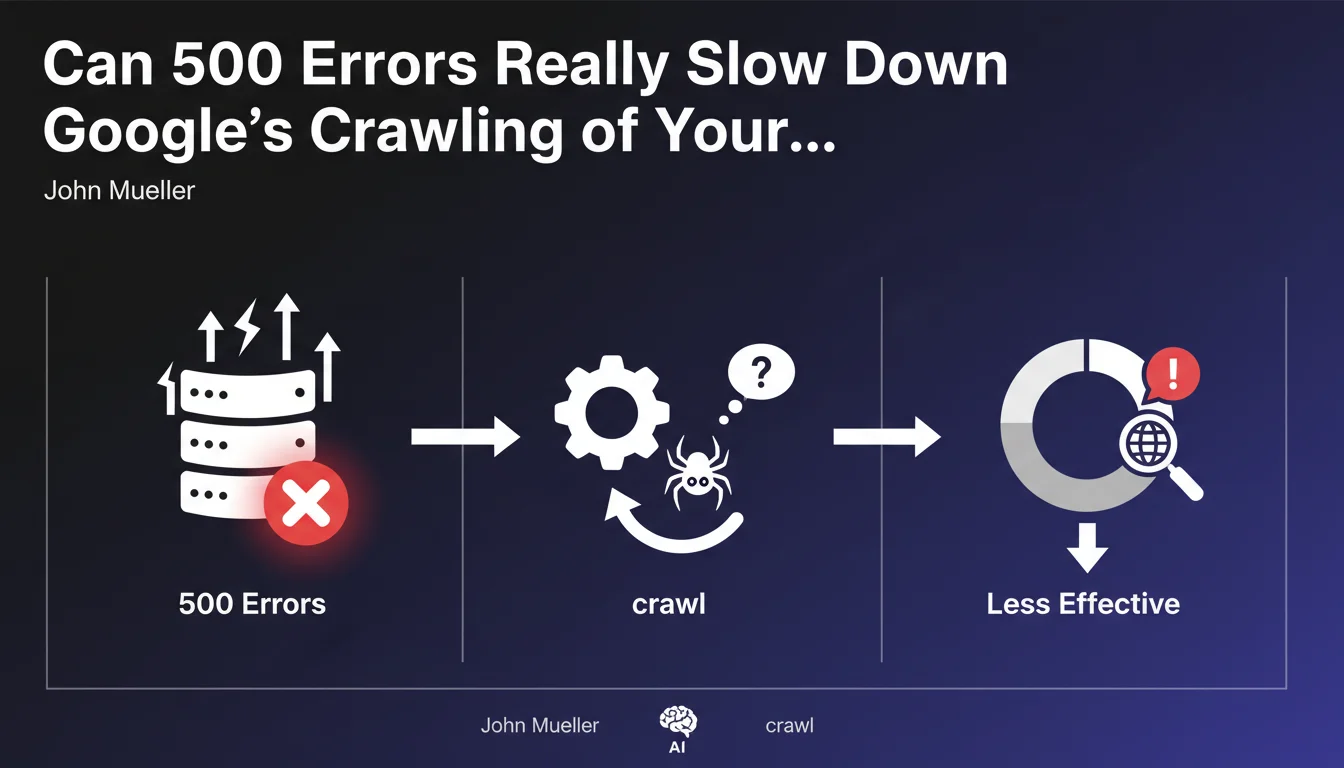
Google has confirmed that a high number of 5xx errors (server errors) directly impacts Googlebot's behavior when crawling your site. When the bot encounters these errors repeatedly, it interprets this as a signal that the server is experiencing difficulties.
In response to these errors, Googlebot automatically slows down its crawling speed. This protective measure is designed to avoid overloading a server that already appears to be in a critical situation. The bot assumes that its requests may be contributing to the overload.
The consequences for your SEO are direct: fewer pages crawled means fewer pages indexed and potentially updated in Google's index. Your new content will take longer to be discovered and your modifications will be taken into account more slowly.
- 5xx errors trigger a crawl slowdown as a protective measure
- Available crawl budget is wasted on inaccessible pages
- New pages and updates are discovered with delays
- The impact is proportional to the number and frequency of errors
- The phenomenon can become self-perpetuating if errors persist
SEO Expert opinion
This statement is perfectly consistent with field observations over many years. Server logs clearly show that Googlebot adjusts its crawl frequency based on server stability. It's an intelligent mechanism that protects both the infrastructure and avoids wasting resources on Google's side.
An important nuance: not all 500 errors are created equal. A one-time error on a secondary page will have no impact. However, repeated errors on strategic pages or massive error patterns (10-20% of requests) do indeed trigger this slowdown. The duration and intensity of the phenomenon depend on your reliability history.
It should also be noted that some 5xx errors can mask more serious problems: server configurations inadequate for traffic, database issues, or even DDoS attacks. The crawl slowdown is then just one symptom among others of an undersized infrastructure.
Practical impact and recommendations
- Implement permanent monitoring of HTTP codes returned by your server with tools like Google Search Console, Pingdom or UptimeRobot
- Configure automatic alerts to be notified as soon as a 5xx error threshold is exceeded (for example 5% of requests over 10 minutes)
- Perform regular crawls with Screaming Frog, Botify or OnCrawl to identify error patterns before Google encounters them massively
- Analyze your server logs to correlate 5xx errors with Googlebot visits and identify problematic pages
- Check your infrastructure: server capacity, PHP/Apache/Nginx configuration, database response time, available memory
- Prioritize fixing 5xx errors on strategic pages: homepage, main categories, conversion pages, recent content
- Avoid generic 500 errors: configure custom and informative error pages rather than raw server errors
- Load test your site to identify the thresholds at which errors appear and scale accordingly
Summary: 5xx errors are a critical signal that directly impacts your visibility on Google. Proactive monitoring and a solid infrastructure are essential to maintain optimal crawling.
The technical management of these issues requires cross-functional expertise between SEO, development and server infrastructure. Diagnostics can be complex, particularly to identify the root causes of errors and properly size your architecture. Engaging a specialized SEO agency with advanced technical skills can prove wise to implement effective monitoring and permanently correct these issues affecting your crawl budget.
💬 Comments (0)
Be the first to comment.