
Official statement
What you need to understand
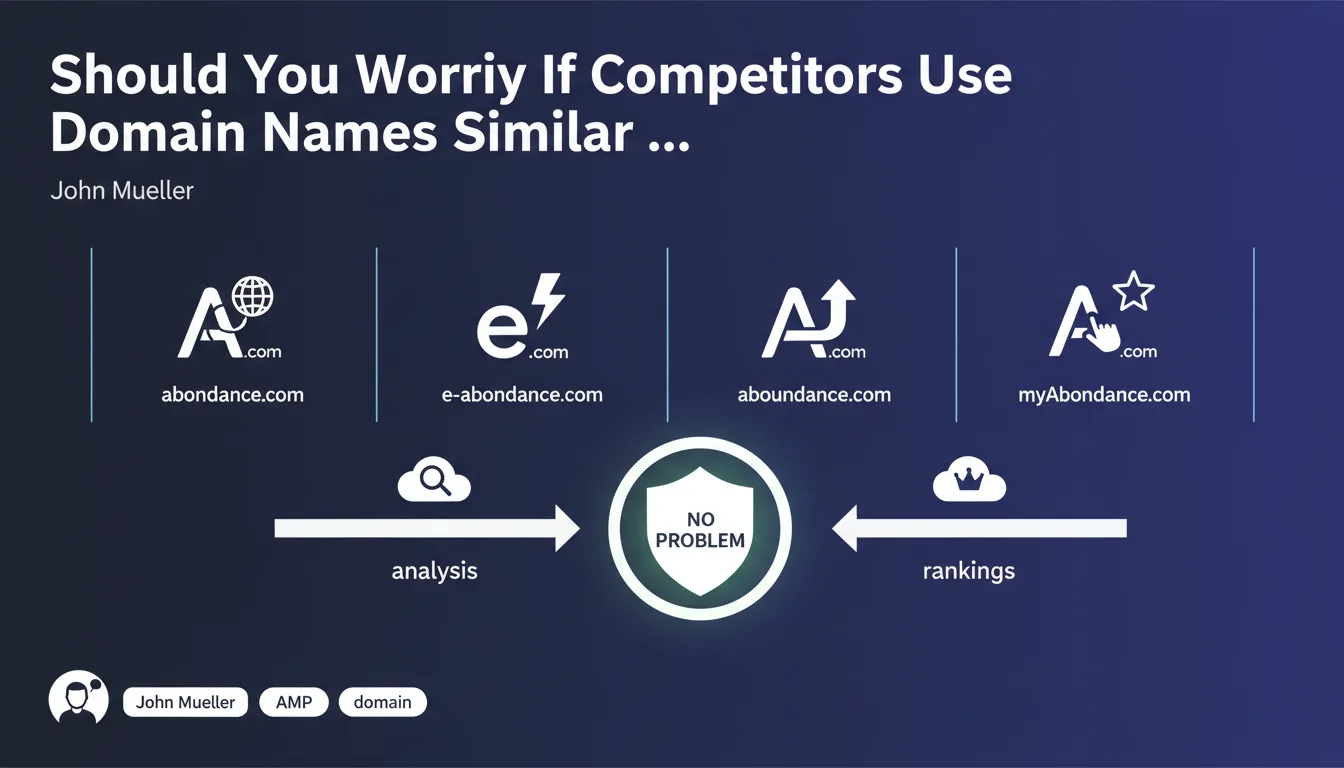
Google states that each website is evaluated completely independently, even if their domain names are very close. According to this statement, having domains like example.com, myexample.com, example-shop.com or e-example.com creates no algorithmic conflict.
Concretely, this means that Google's algorithm does not automatically penalize sites whose domain names are similar. Each domain is crawled, indexed and ranked according to its own merits: content quality, backlinks, user experience, etc.
However, this technical approach does not take into account certain realities of the digital market:
- User confusion who may end up on the wrong site when typing the URL
- Brand dilution and its online recognition
- The risk of cybersquatting and malicious practices (phishing, content copying)
- Competition on keywords present in the domain name (EMD - Exact Match Domain)
- Dispersion of traffic and brand signals across several similar domains
SEO Expert opinion
From a purely algorithmic point of view, Google's statement is consistent with what we observe in the field. Sites with similar names can indeed coexist in SERPs without direct penalty related to this similarity.
However, this technical vision ignores the strategic dimensions of modern SEO. Natural search optimization is no longer just about satisfying the algorithm: brand awareness, direct searches (branded searches), click-through rate in SERPs are increasingly important signals. A competitor using a similar name can capture part of your brand traffic.
Moreover, the presence of an exact keyword in the domain name retains a slight SEO advantage, even though its weight has considerably decreased since EMD updates. If a competitor creates a domain with your main keyword, they can effectively compete with you on that term.
Practical impact and recommendations
- Register strategic variants of your domain name (.com, .fr, .net, versions with hyphens) to protect your brand, even if you don't actively use them
- Regularly monitor new registrations of domains similar to yours via monitoring tools (DomainTools, Brand Monitor)
- Strengthen your brand signals: work on branded SEO, brand searches, social media presence to clearly differentiate yourself
- Set up 301 redirects from your defensive domains to your main site to centralize authority
- Register your trademark with INPI (or equivalent) to have solid legal recourse in case of cybersquatting or intentional confusion
- Prepare a DMCA procedure and familiarize yourself with Google's reporting tools in case of content copying on a similar domain
- Optimize your Knowledge Panel and your rich snippets to occupy more space in SERPs and reduce competitor visibility
- Don't create multiple sites yourself with similar names to "occupy the territory": this dilutes your resources without real algorithmic benefit
Strategic management of domain names and protection of your online presence require a comprehensive approach combining technical, legal and marketing aspects. These issues affect SEO, digital branding and the security of your online presence alike.
For companies whose brand represents a major strategic asset, support from an experienced SEO agency enables effective monitoring, development of a coherent defensive strategy and rapid response in case of infringement on your digital identity.
💬 Comments (0)
Be the first to comment.