
Official statement
Other statements from this video 5 ▾
- □ Does GDPR delisting really work completely, or is Google still hiding your URLs from some searches?
- □ Does Google's cache really update automatically when you change a page?
- □ Why does Google reject delisting requests submitted with search links instead of direct URLs?
- □ Can Google actually delete content directly from your website servers?
- □ Does Google really apply different delisting rules depending on where users are searching from?
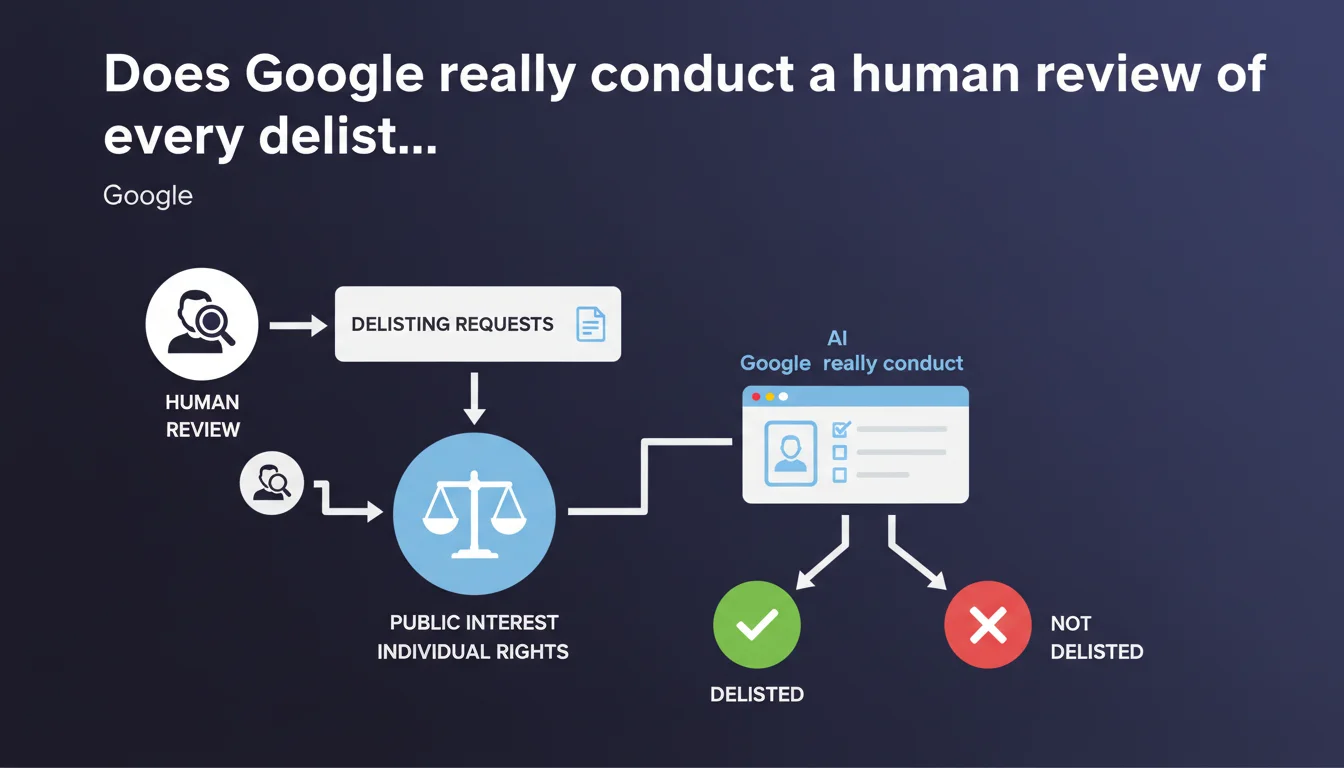
Google claims that a human reviewer manually examines all delisting requests, weighing public interest against individual rights under applicable law. This statement is crucial for understanding how GDPR and right to be forgotten requests are processed, but remains vague about the precise evaluation criteria and processing timelines.
What you need to understand
What is the legal context behind this statement?
Google's claim responds to strict legal obligations, primarily the European right to be forgotten established by the GDPR and similar legislation in other jurisdictions. Since 2014, Google has been required to allow individuals to request the removal of search results deemed obsolete, inadequate, or excessive.
The search engine insists on manual review to protect itself legally. An automated process could not assess the complexity of individual situations and the delicate balance between freedom of information and privacy. Let's be honest: it's also a way to slow down the flow of requests and justify refusals.
What does "public interest" actually mean according to Google?
Google provides no precise definition, and that's where it gets tricky. Public interest remains a fuzzy concept that each reviewer may interpret differently. Information concerning public figures, recent criminal convictions, or financial scandals is generally kept in the index.
For an SEO practitioner, this imprecision means it's virtually impossible to predict whether a delisting request will be approved. Each case is supposed to be unique, but the evaluation criteria remain opaque.
Is a single human reviewer really enough to guarantee fairness?
Google says "at least one reviewer" — which implies that a single person can decide. No committee, no systematic double-check mentioned. For millions of requests annually in Europe, this raises questions about reviewer training and decision consistency.
- Mandatory manual process for all delisting requests
- Evaluation based on balance between public interest and individual rights
- Varying legal framework depending on countries and applicable legislation
- Non-public evaluation criteria — Google doesn't detail its analysis grid
- No guaranteed timelines or transparency on the number of reviewers involved
SEO Expert opinion
Is this statement consistent with real-world observations?
On paper, yes. User feedback shows that Google does treat requests individually and response times vary enormously — from days to several months. This aligns well with human review, not an automated process.
But the question of quality and consistency remains open. [To verify] Nearly identical requests sometimes receive opposite responses, suggesting either a lack of standardized training or significant reviewer turnover. The problem: Google publishes no detailed statistics on approval rates by request category.
What nuances need to be added to this claim?
Saying that "at least one reviewer" examines each request in no way guarantees the relevance of the decision. A reviewer may spend 30 seconds or 30 minutes on a file — Google communicates no internal SLA. The statement also doesn't mention the decision support tools used.
And here's where it gets interesting: Google talks about evaluation "under applicable law", but which law exactly? European GDPR differs from California's CCPA, which itself is distinct from Brazilian or Japanese legislation. [To verify] Are reviewers trained in all these legal nuances, or do they apply a standard grid with minor adjustments?
In which cases does this procedure not apply?
Google is silent on requests that are automatically rejected before even reaching a human reviewer. Preliminary filters probably exist to eliminate clearly abusive requests, duplicates, or poorly formatted queries.
Moreover, this statement concerns delisting — not removing content at the source. If you want a webpage to disappear entirely, that's a different procedure, often entirely automated for certain content types (DMCA copyright, for example).
Practical impact and recommendations
What should you do concretely for a delisting request?
If a client asks you to support a delisting procedure, document everything. Google's form requires detailed justifications — the more your file is supported by evidence of obsolescence, inaccuracy, or harm, the better.
Prepare for a battle of arguments. The human reviewer will look for public interest: anticipate this objection in your initial request. Explain why the information is disproportionate, outdated, or factually incorrect.
What mistakes should you absolutely avoid?
Don't flood Google with repeated identical requests. This only lengthens timelines and could be interpreted as an attempt at manipulation. One well-constructed request is better than ten drafts.
Avoid vague arguments like "this harms my reputation". The reviewer wants concrete facts, factual evidence, legal basis. Cite relevant GDPR articles, explain why the data processing is excessive or obsolete.
How do you track and challenge a Google decision?
Google sends a notification by email — keep it. If refused, you have the right to appeal to the local data protection authority (CNIL in France). It's a lengthy process, but European DPAs have already forced Google to re-examine decisions.
Also document measurable business impact from the information in question. A Google reviewer may reject, but a DPA will be more sensitive to evidence of concrete economic harm.
- Prepare a legally solid case with references to applicable laws
- Demonstrate obsolescence or inaccuracy of information with supporting evidence
- Anticipate the public interest argument and refute it in your initial request
- Keep all communications with Google for potential recourse
- Avoid multiple simultaneous requests for the same URLs
- Consider DPA recourse in case of manifestly unjustified refusal
❓ Frequently Asked Questions
Combien de temps prend l'examen d'une demande de déréférencement par Google ?
Un réviseur Google peut-il rejeter une demande même si elle respecte le RGPD ?
Le déréférencement sur Google.fr s'applique-t-il automatiquement aux autres versions nationales ?
Puis-je savoir quel réviseur a traité ma demande et sur quels critères précis ?
Une demande refusée peut-elle être resoumise avec de nouveaux arguments ?
🎥 From the same video 5
Other SEO insights extracted from this same Google Search Central video · published on 15/02/2022
🎥 Watch the full video on YouTube →
💬 Comments (0)
Be the first to comment.