
Official statement
Other statements from this video 5 ▾
- □ Le déréférencement RGPD est-il vraiment complet ou Google cache-t-il encore vos URLs ?
- □ Le cache Google se met-il vraiment à jour automatiquement après modification d'une page ?
- □ Pourquoi Google refuse-t-il les demandes de déréférencement via des liens de recherche ?
- □ Comment Google examine-t-il réellement les demandes de déréférencement ?
- □ Google peut-il supprimer du contenu à la source sur votre site web ?
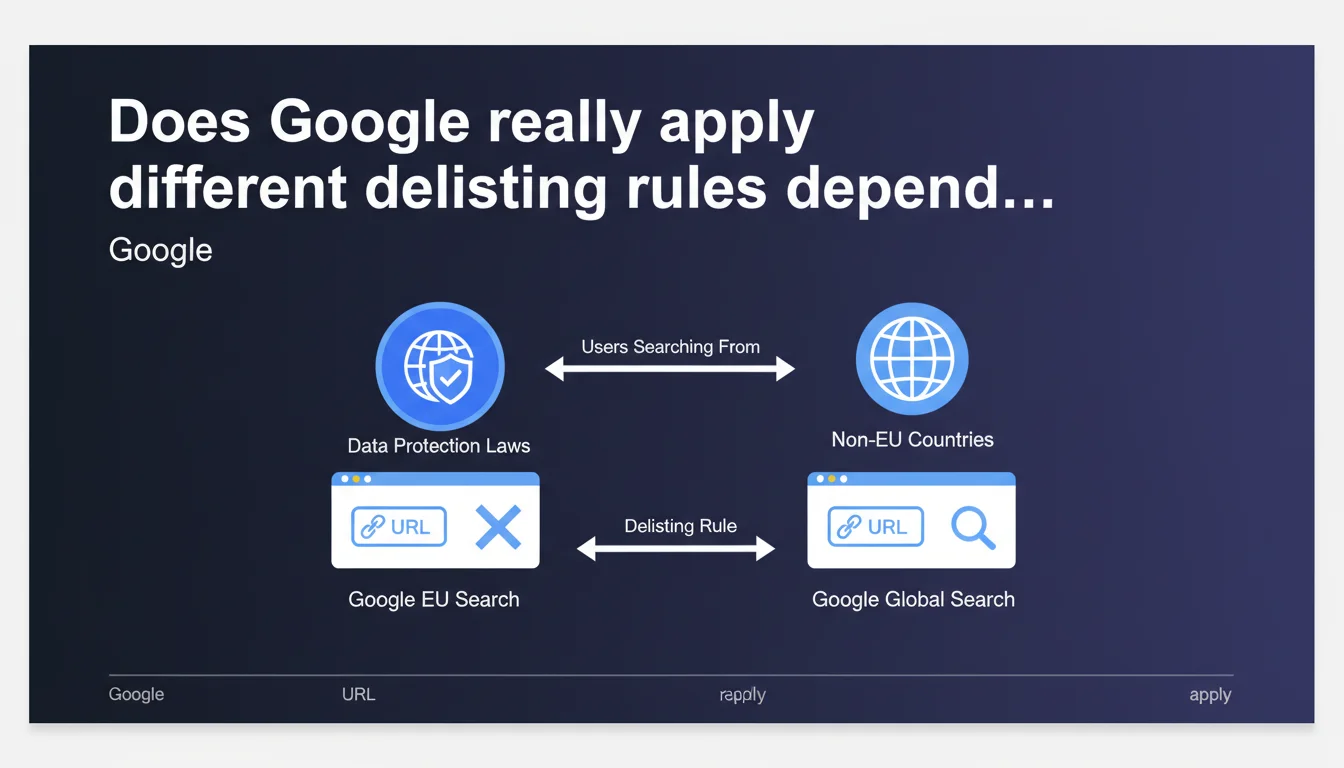
Google enforces the right to be forgotten only in countries subject to European data protection laws. In practice, a delisted URL remains accessible on google.com and non-EU versions. This fragmented territorial scope creates gray areas for international SEO strategies.
What you need to understand
What exactly is the territorial scope of delisting?
Google doesn't remove a URL globally. When a European user obtains delisting of a link through the GDPR right to be forgotten, that link disappears only from European versions of Google (google.fr, google.de, etc.).
On google.com or Asian, African, or American versions, that same content remains fully indexed and accessible. The removal follows jurisdiction, not the user.
Why does this geographic limitation exist?
Google respects the principle of territorial law. GDPR applies to European residents, but has no legal authority in Brazil, the United States, or India.
Technically, Google has the means to delete a URL everywhere. Legally, the company refuses to enforce European legislation in territories that haven't adopted it — and vice versa.
What are the implications for SEO?
- Content delisted in Europe continues to generate organic traffic from other geographic zones
- Backlinks to these URLs retain their SEO juice outside the EU
- The geographic fragmentation of indexes complicates international visibility audits
- A competitor can exploit this asymmetry by targeting non-European markets with content blocked in the EU
SEO Expert opinion
Is this statement consistent with observed practices?
Yes — and it's verifiable in a few clicks. Take a URL delisted on google.fr, test it on google.com with a US IP: it reappears. Geographic segmentation works exactly as Google states.
The problem is that Google doesn't specify how this limitation applies to European users traveling abroad. If a French person searches from New York on google.com, do they see the delisted content? The documentation remains unclear on this. [Needs verification]
What nuances should be considered?
Google talks about "search versions" but doesn't detail the technical mechanism. Is geolocation based on user IP, chosen ccTLD, or Google account settings? The answer changes everything for international SEO audits.
Another blind spot: universal results. Is a YouTube video delisted from European web search still visible in the "Videos" tab on google.fr? And in Google Images? No official clarity on the exact scope of delisting by result type.
In which cases does this rule not apply?
If a European court orders global removal — not just GDPR delisting — Google can be forced to remove the URL everywhere. But the company systematically contests these decisions, arguing that European law cannot dictate what's accessible from Tokyo or São Paulo.
Legal ambiguity persists. Meanwhile, the default rule remains: GDPR delisting = EU only.
Practical impact and recommendations
How do you verify the geographic scope of a delisting?
Use a multi-region VPN and test the same query on different Google versions (google.fr, google.com, google.co.jp). Compare results for the same URL. This is the only reliable way to map actual visibility.
Be cautious with standard SEO tools: many aggregate data from US datacenters. If your tool shows a ranking while the URL is delisted in Europe, it's not a bug — it's a geographic limitation the tool doesn't capture.
What should you do if your content is delisted in Europe?
- Audit your organic traffic distribution by geography via Google Analytics: identify non-European regions still generating visits
- Check if your strategic backlinks come from European or international sites — their SEO impact varies by zone
- Adjust your content strategy: if an article is blocked in the EU but performing elsewhere, consider a geolocation-specific alternative version
- Document precisely which URLs are delisted and in which zones — this mapping is crucial for any migration or redesign
What mistakes should you avoid in an international context?
Never assume a GDPR delisting impacts your global visibility. It doesn't. If 60% of your audience comes from Asia or America, the impact may be marginal.
Conversely, if you manage a multi-country site with European ccTLDs (.fr, .de, .es), a delisting can fragment your domain authority across geographic zones. SEO consistency becomes a technical nightmare.
❓ Frequently Asked Questions
Une URL déréférencée en Europe peut-elle encore ranker sur google.com ?
Le déréférencement géographique affecte-t-il les backlinks ?
Comment Google détermine-t-il la localisation d'un utilisateur pour appliquer le déréférencement ?
Un site non-européen peut-il être affecté par le déréférencement RGPD ?
Le déréférencement s'applique-t-il aussi à Google Images et Google News ?
🎥 From the same video 5
Other SEO insights extracted from this same Google Search Central video · published on 15/02/2022
🎥 Watch the full video on YouTube →
💬 Comments (0)
Be the first to comment.