
Official statement
Other statements from this video 5 ▾
- □ Does Google's cache really update automatically when you change a page?
- □ Why does Google reject delisting requests submitted with search links instead of direct URLs?
- □ Does Google really conduct a human review of every delisting request?
- □ Can Google actually delete content directly from your website servers?
- □ Does Google really apply different delisting rules depending on where users are searching from?
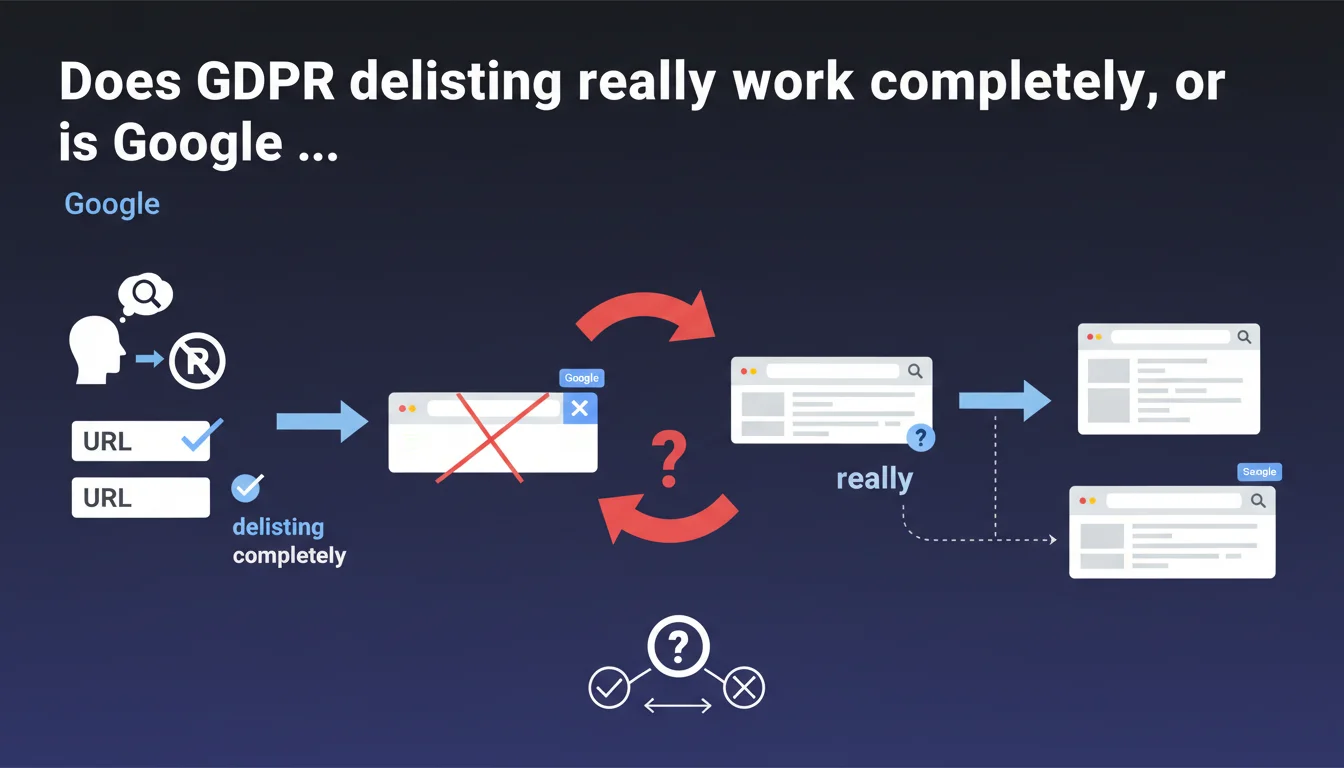
When a URL is delisted for the right to be forgotten, it disappears only from results linked to the person's name — not from other queries. In practice, the content remains indexed and accessible through other search paths. This is a crucial distinction for understanding the real scope of GDPR delisting.
What you need to understand
Does GDPR delisting work on a per-URL or per-query basis?
Google applies delisting on a per-specific-query basis, not globally. A URL removed from results for "John Smith" can perfectly well appear in searches for "corporate fraud 2018" or "commercial court New York".
This mechanism reveals that the right to be forgotten doesn't delete content — it only masks the direct association between a proper name and certain compromising results. The URL remains in Google's index, crawlable and rankable on other terms.
Why does this selective approach create problems?
Because it creates a false impression of complete removal. People often believe that delisting permanently erases content from the web, when it only cuts off one access path among many others.
For an SEO professional, this means that managing a client's reputation requires much more than a simple GDPR request. You need to identify every query pathway that could lead to the sensitive content.
So which queries remain exposed after delisting?
All of those that don't contain exactly the name targeted by the request. A search by position, company, event, location, or even a peripheral long-tail query can bring the problematic URL back into results.
Google only filters the name-to-URL connection, not the URL itself. This is consistent with their restrictive interpretation of GDPR: limiting the impact on freedom of information.
- GDPR delisting operates on query-URL pairs, not on global indexation
- The URL remains accessible via searches that don't contain the person's name
- The content is never removed from crawling or Google's index
- This selective approach partially protects the person without censoring information
- A complete audit of alternative queries is essential for genuine reputation management
SEO Expert opinion
Is this statement consistent with real-world observations?
Completely. We regularly observe URLs delisted for a proper name that continue to rank on related queries. This is actually a major source of frustration for people who believe they've "erased" their digital trace.
Google applies strict legal logic: GDPR requires removing results that are "inadequate, outdated or excessive" for searches on the name. Nothing requires them to delete the URL everywhere. This position minimizes their liability while respecting the letter of the regulation.
What nuances should we consider with this mechanism?
First nuance: geographic scope. Delisting applies only to European versions of Google (.co.uk, .de, .fr, etc.). On Google.com or from outside Europe, URLs often remain visible even for the targeted name. [To be verified] depending on recent jurisprudential developments.
Second nuance: query granularity. Does Google consider "John Smith" and "J. Smith" as two separate queries? What about "John-Michael Smith"? Real-world testing shows glaring inconsistencies — some variations are filtered, others aren't. It's impossible to get clear rules from Google on this point.
When does this logic become problematic for SEO?
When you're managing reputation for a personal brand or company executive. You may obtain delisting for the exact name, but if negative coverage remains accessible via "CEO Company X scandal" or "property fraud Los Angeles 2017", the problem persists.
Worse: some content can actually gain relative visibility after name delisting. Less competition on peripheral queries can cause pages you wanted to suppress to rise in rankings. It's a perverse effect rarely anticipated.
Practical impact and recommendations
What concrete steps should you take to manage a delisting?
First, map every possible query that could lead to the problematic content. Name alone, name plus title, name plus city, name plus event — each combination is a potential access pathway.
Then, manually verify results across multiple Google versions (minimum .fr, .com, .de). Since GDPR delisting is geographically limited, a URL can disappear from Google.fr but remain visible elsewhere.
What mistakes should you avoid in a reputation management strategy?
Never rely solely on legal delisting. It's a temporary patch that doesn't address the root issue. As long as the content exists and remains indexed, it can resurface through other pathways.
Classic mistake: forgetting about images, videos, and news. Delisting applies to standard web results, but the mechanics may differ for Google Images or Google News. Test each vertical separately.
How do you build a solid reputation strategy beyond GDPR?
Combine multiple levers: GDPR delisting to sever the name-to-content connection, positive content creation to occupy top positions, optimization of controllable third-party entities (social profiles, official websites), and continuous SERP monitoring across all sensitive queries.
In some cases, direct action with the original publisher is more effective than a Google request. Removing the page at source eliminates all access paths at once — but this is rarely achieved without solid legal arguments.
- List all query variations (name alone, name plus context, spelling variants)
- Test delisting across multiple geographic Google versions (.fr, .com, .de minimum)
- Check Web, Images, News, and Video separately — each vertical has its own specifics
- Set up automated monitoring on critical queries to detect any reappearances
- Develop positive content in parallel, optimized to occupy top positions
- Document every request and result to build a legally actionable history
❓ Frequently Asked Questions
Une URL déréférencée pour droit à l'oubli disparaît-elle complètement de Google ?
Le déréférencement RGPD s'applique-t-il à toutes les versions de Google ?
Peut-on demander le déréférencement d'une URL sur toutes les requêtes possibles ?
Comment vérifier qu'un déréférencement est effectif ?
Un contenu déréférencé peut-il réapparaître avec le temps ?
🎥 From the same video 5
Other SEO insights extracted from this same Google Search Central video · published on 15/02/2022
🎥 Watch the full video on YouTube →
💬 Comments (0)
Be the first to comment.