
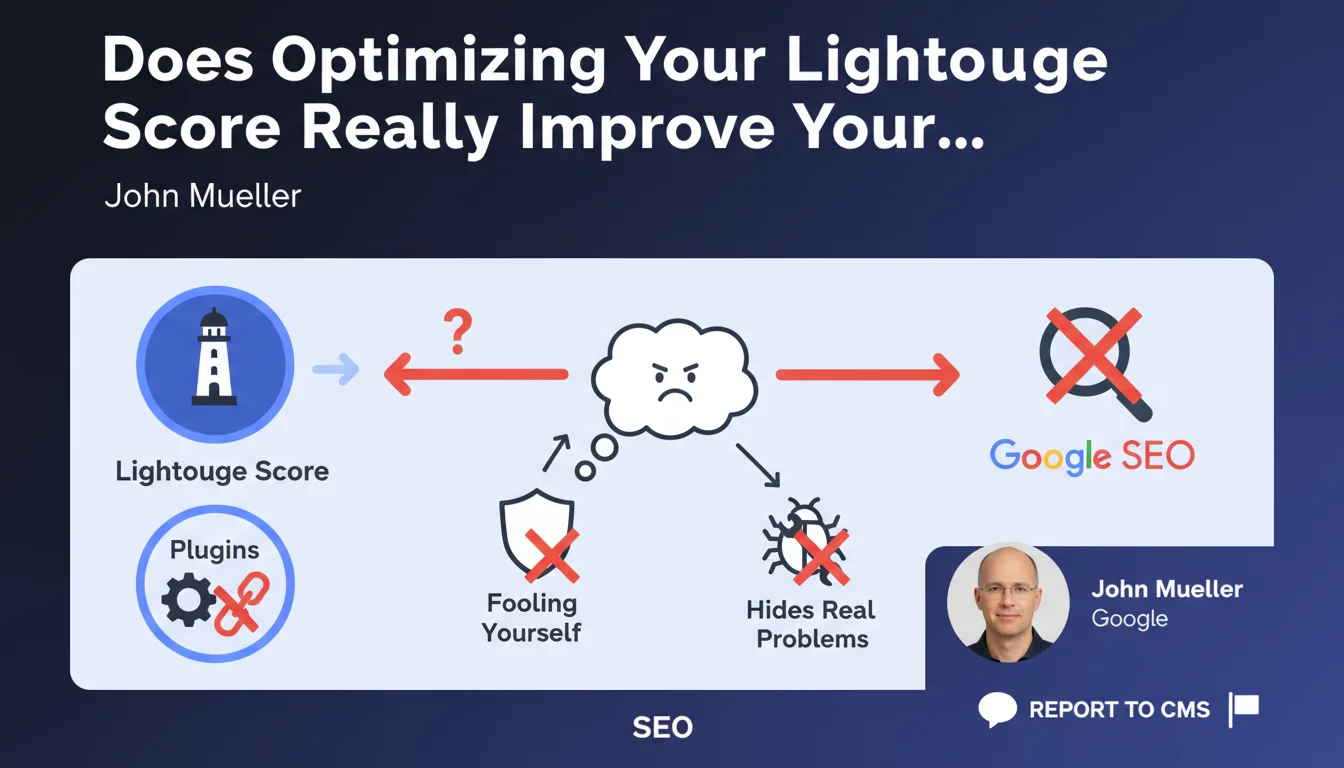
Official statement
What you need to understand
What's the Difference Between Lighthouse and Core Web Vitals?
Lighthouse is a Google audit tool that generates an overall performance score, but this score is not used directly by the search algorithm. It's a synthetic indicator based on lab tests.
Core Web Vitals (LCP, FID, CLS), on the other hand, are real field metrics collected from users via the CrUX report. It's these data only that impact SEO rankings as part of the page experience signal.
Why Do Some Plugins Manipulate Lighthouse Scores?
Some plugins detect the Lighthouse user-agent and modify the site's behavior only during the audit. This artificially creates a good score without actually improving the user experience.
This practice is classified as cloaking and masks real performance issues. It prevents identifying the optimizations genuinely necessary for your real visitors.
What Are the Risks of This Manipulation?
By manipulating Lighthouse scores, you get distorted results that don't reflect the reality of the user experience. You miss the real performance problems that affect your conversions.
Moreover, Google considers this practice as cloaking, which could theoretically expose you to penalties. But most importantly, you're investing time and resources in a completely ineffective strategy.
- Lighthouse generates a synthetic score that is not used by Google's ranking algorithm
- Only Core Web Vitals (LCP, FID, CLS) from real user data count for SEO
- Manipulating Lighthouse scores through plugins is counterproductive and masks real problems
- User-agent cloaking is a discouraged practice that can be considered contrary to guidelines
- Real optimization must target user experience measured by field Core Web Vitals
SEO Expert opinion
Is This Statement Consistent with What We're Seeing in the Field?
Absolutely. The correlation analyses we've been conducting since the introduction of the Page Experience algorithm clearly show that positions in SERPs are linked to CrUX data from Core Web Vitals, not to Lighthouse scores.
Many sites with excellent Lighthouse scores but poor field metrics stagnate in rankings. Conversely, sites with average Lighthouse scores but excellent real Core Web Vitals perform much better.
Why Does This Confusion Between Lighthouse and Core Web Vitals Persist?
The problem stems from the fact that Lighthouse also measures Core Web Vitals, but in a controlled lab environment. Less experienced SEO practitioners then confuse the overall Lighthouse score with the metrics that truly matter.
Tools like PageSpeed Insights display both Lighthouse data (lab) and CrUX data (field), which creates confusion. Only the field section with real user data matters for SEO.
When Is Lighthouse Still Useful Despite Everything?
Lighthouse remains an excellent diagnostic tool for identifying technical issues: unoptimized images, render-blocking JavaScript, lack of caching, etc. It's a valuable starting point for optimization.
But it should be considered as a development tool, not as an SEO indicator. Lighthouse recommendations help improve the technical foundation, which will eventually positively impact field Core Web Vitals if correctly applied.
Practical impact and recommendations
What Should You Monitor Specifically for SEO?
Focus exclusively on Core Web Vitals measured in the field via the CrUX report. This data is available in Google Search Console, "Core Web Vitals" section.
Regularly check the LCP (Largest Contentful Paint), INP (Interaction to Next Paint) which replaces FID, and CLS (Cumulative Layout Shift) metrics. These values at the 75th percentile determine your "Good", "Needs Improvement" or "Poor" classification.
What Mistakes Should You Absolutely Avoid in Your Performance Strategy?
Never use plugins or techniques that detect and manipulate user-agents of audit tools. This approach is completely counterproductive and takes you away from real optimization.
Don't settle for optimizing in a test environment. A site can be perfect on your development machine but catastrophic for your real users on mobile with an average 3G connection.
Avoid focusing solely on the overall Lighthouse score at the expense of real user experience metrics. This is the most common mistake we observe on sites that invest heavily without SEO results.
How Do You Implement an Effective Optimization Strategy?
Start with an audit of field Core Web Vitals via Search Console and CrUX. Identify pages and page types that are problematic and require priority attention.
Then use Lighthouse and PageSpeed Insights as diagnostic tools to understand technical causes. But always validate your optimizations with tests on real devices and RUM (Real User Monitoring) measurements.
- Regularly consult the "Core Web Vitals" report in Google Search Console
- Check CrUX data (field) rather than Lighthouse scores (lab)
- Focus on LCP, INP and CLS measured at the 75th percentile of real users
- Uninstall any plugin that manipulates user-agents or hides performance issues
- Use Lighthouse only as a technical diagnostic tool, not as an end goal
- Test optimizations on real devices with average network conditions (3G/4G)
- Implement RUM monitoring to continuously track the evolution of field metrics
- Prioritize optimizations based on actual user impact and traffic volume of affected pages
In summary: Lighthouse scores have no direct impact on your SEO. Only Core Web Vitals measured on your real users matter to Google. Any strategy aimed at artificially manipulating audit scores is not only ineffective, but prevents you from identifying and solving your real performance problems.
Optimizing Core Web Vitals requires a thorough technical approach: analysis of field data, diagnosis of root causes, implementation of complex optimizations (intelligent lazy-loading, critical path optimization, JavaScript reduction, etc.), and continuous monitoring. Given this complexity and the associated business stakes, relying on an SEO agency specialized in web performance allows you to benefit from specialized expertise and personalized support to obtain measurable results quickly.
💬 Comments (0)
Be the first to comment.