
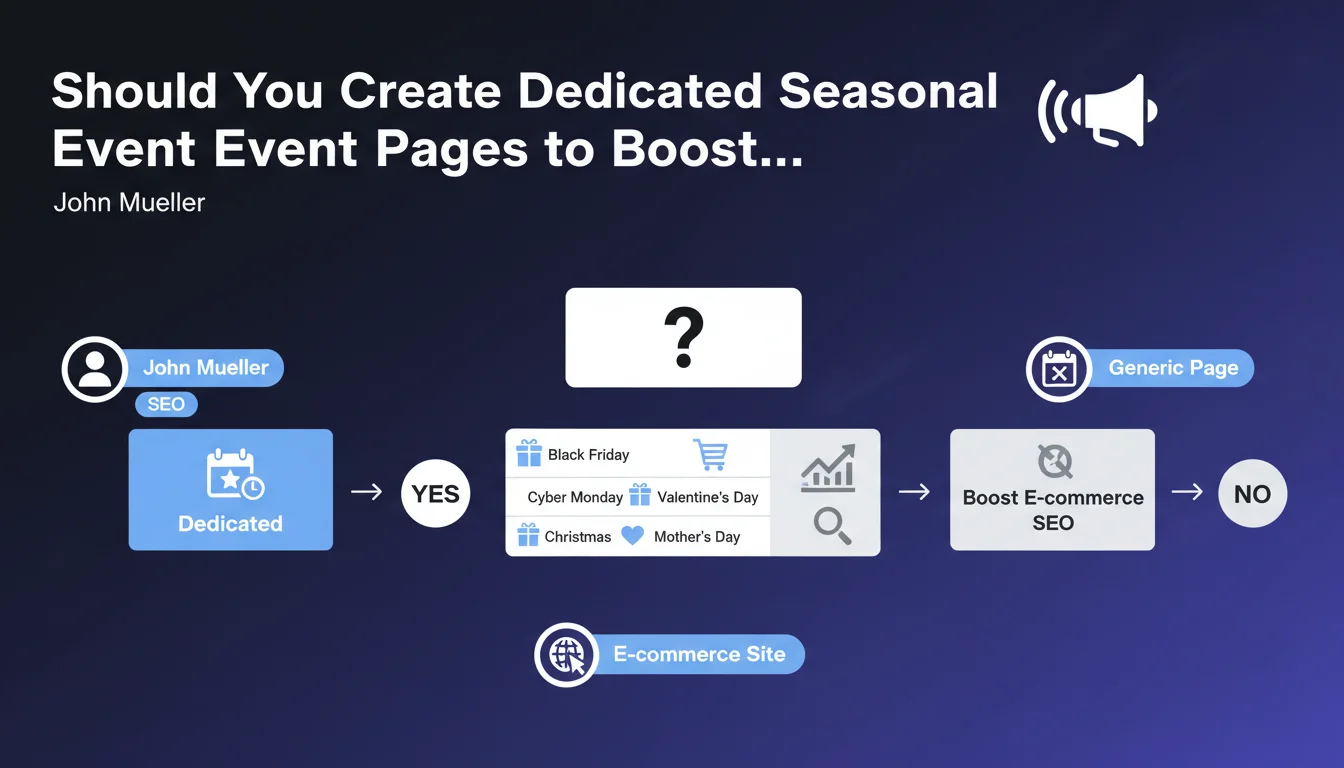
Official statement
What you need to understand
Why does Google emphasize seasonal pages for e-commerce sites?
Google constantly seeks to provide the most relevant results based on user searches. During seasonal events like Black Friday, Christmas, or Valentine's Day, search intent evolves massively.
Internet users employ specific queries ("Valentine's Day gifts", "Black Friday smartphone deals") and expect to find targeted content. A dedicated page captures this qualified traffic with an optimized user experience.
What makes a seasonal page effective for SEO?
A seasonal page isn't simply a renamed category. It must bring together relevant product selections, contextualized editorial content, and reassurance elements adapted to the event.
The objective is to create a specific landing page that precisely meets visitor expectations during this period. It must be optimized for both search engines and conversion.
What's the ideal timing to publish these seasonal pages?
The commentary specifies that these pages should be published at least one month before the event. This timeframe allows Google to crawl, index, and position the page before the search peak.
This anticipation also provides time to generate relevance signals: internal links, initial organic traffic, user engagement. Waiting until the last week is a classic mistake that severely limits SEO potential.
- Dedicated seasonal pages: strategic element for capturing traffic during search peaks
- Crucial timing: publication minimum 1 month before the event for indexing and positioning
- Specific content: relevant product selections and adapted user experience
- Conversion opportunity: responding to precise search intents of internet users
SEO Expert opinion
Is this recommendation really applicable to all e-commerce sites?
The seasonal pages strategy works particularly well for established e-commerce sites with sufficient domain authority. For a new site with few backlinks, the effort may generate fewer immediate results.
Relevance also varies by sector. A jewelry or cosmetics site will derive enormous benefit from Valentine's Day or Mother's Day pages. Conversely, an e-commerce site for industrial spare parts will have less interest in investing in these mass-market events.
What risks should you anticipate with seasonal content?
The main pitfall is internal duplicate content. Creating a "Black Friday" page that features exactly the same products as an existing category without editorial differentiation can dilute your SEO.
You must also manage the persistence of these pages after the event. Leaving them active with outdated content harms user experience. Brutally deleting them generates 404s. The solution: 301 redirect to an evergreen page or transformation into an "anticipation" page for the following year.
Is the mentioned e-commerce blog really indispensable?
An integrated blog isn't mandatory but constitutes a powerful complementary lever. It allows targeting informational queries ("Christmas gift ideas for men") that bring traffic upstream of the purchase decision.
Blog articles also create internal linking opportunities to transactional seasonal pages. However, this approach requires substantial editorial resources. A site with 50 products doesn't necessarily benefit from dispersing efforts on a blog rather than optimizing product pages.
Practical impact and recommendations
How do you concretely structure a high-performing seasonal page?
Start by defining a clear and predictable URL (example: /black-friday-2024/ rather than /promo-bf24/). Integrate the main keyword in the title, meta description, and H1.
Create unique editorial content of minimum 300 words explaining the event, your specific offers, and their added value. Don't just display products without context.
Organize products into thematic subcategories ("Smartphones on sale", "Tech under $100") rather than a simple list. Add filters facilitating navigation.
What common mistakes must you absolutely avoid?
The number one mistake is creating the page too late. Publishing 3 days before Black Friday leaves no chance for organic positioning.
Another pitfall: using generic recycled content from year to year without updating. Google values freshness and temporal relevance.
Finally, neglecting internal linking to this page from your homepage, main categories, and blog articles drastically reduces its visibility for both Google and your visitors.
What should you implement to maximize SEO impact?
- Publish the seasonal page minimum 4-6 weeks before the event to optimize indexing
- Create unique editorial content (300-500 words) contextualizing the event and your offers
- Optimize SEO tags: title with the year, compelling meta description, clear H1
- Implement strategic internal linking from homepage, navigation menu, and blog articles
- Plan complementary blog articles targeting informational queries (gift guides, comparisons)
- Prepare the post-event strategy: 301 redirect or transformation into anticipation page
- Monitor indexing via Google Search Console and request reindexing if necessary
- Analyze previous year's performance to identify keyword opportunities
- Configure structured data (Offer, Product) to improve SERP display
💬 Comments (0)
Be the first to comment.