
Official statement
Other statements from this video 11 ▾
- □ Faut-il vraiment compter sur les service workers pour le SEO ?
- □ Googlebot peut-il indexer un site qui dépend de service workers pour afficher son contenu ?
- □ Comment diagnostiquer les problèmes d'indexation causés par les service workers dans Search Console ?
- □ Comment les outils de test en direct de Google révèlent-ils les failles de rendu de votre site ?
- □ La console JavaScript révèle-t-elle vraiment les problèmes de rendu critiques pour le SEO ?
- □ Pourquoi la collaboration avec les développeurs est-elle la clé pour débloquer les problèmes d'indexation ?
- □ Faut-il vraiment injecter des console.log pour diagnostiquer les échecs de rendu côté Googlebot ?
- □ Pourquoi les service workers peuvent-ils rendre votre contenu invisible pour Googlebot ?
- □ Faut-il vraiment vérifier le HTML rendu dans Search Console pour diagnostiquer vos problèmes d'indexation ?
- □ Votre page indexée mais invisible : problème technique ou simplement mal classée ?
- □ Comment désactiver un service worker pour diagnostiquer des problèmes SEO ?
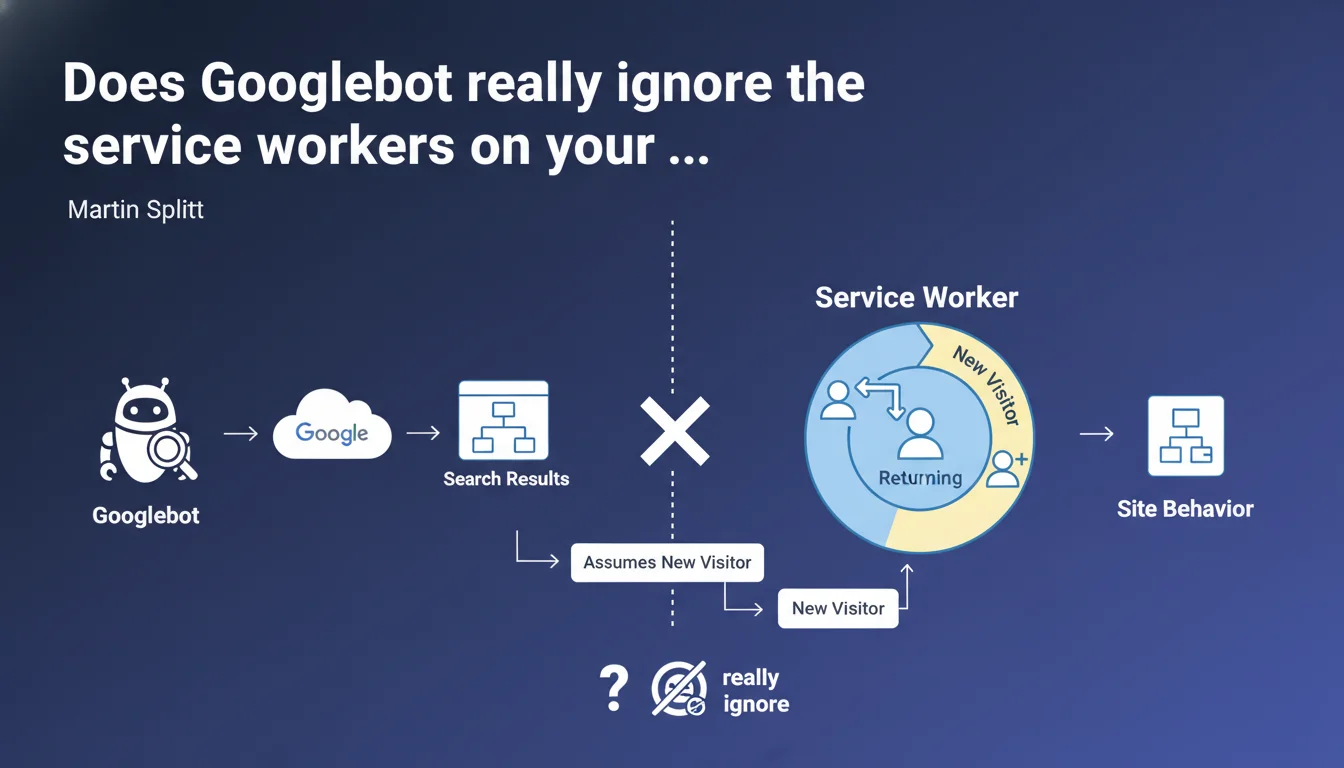
Google consistently treats visitors coming from its search results as new visitors. Direct consequence: Googlebot does not execute service worker-enabled features during crawling. If your site relies on service workers to display content or optimize experience, this content risks being invisible to Google.
What you need to understand
What is a service worker and why is Google wary of it?
A service worker is a JavaScript script that runs in the background in the browser. It enables cache management, intercepting network requests, and modifying site behavior based on context.
Typically, a service worker can serve different content to a returning visitor (who has already visited the site) versus a new visitor. That's precisely where the SEO problem lies.
Why does Googlebot behave like a new visitor?
Martin Splitt explains it clearly: Google assumes that people clicking on a search result are discovering the site. Therefore, Googlebot simulates this behavior during crawling and rendering.
The problem? If your service worker activates features only for returning visitors — say, enriched cached content or optimized navigation — Googlebot will never see them.
What's the difference with a real user?
A user who discovers your site through Google and then returns to it directly later will gradually benefit from service worker optimizations. But on the first visit (the one Google simulates), these optimizations are not yet active.
This makes sense from a UX perspective, but it creates an asymmetry between what the user sees (over time) and what the bot sees (always in "first visit" mode).
- Googlebot never benefits from features reserved for returning visitors.
- Service workers can drastically modify the experience — and therefore visible content.
- If content essential to SEO is served only via service worker in "returning visitor" mode, it will be invisible to Google.
- Rendering on Google's side always reflects the "new visit" state, without cache or history.
SEO Expert opinion
Does this statement match what we observe in the field?
Yes, and it's consistent with Google's logic. Service workers, by nature, introduce behavioral variability that complicates indexing. Google has neither the time nor the interest to crawl a site multiple times to capture all possible variations.
On PWA (Progressive Web App) sites that heavily rely on service workers, we regularly observe indexing issues if critical content isn't served on the first visit. And that's exactly what Splitt describes.
What gray areas remain in this statement?
What's missing is precision on which types of service workers cause problems. Not all are equal: some only manage static cache (images, CSS), while others intercept and dynamically modify HTML content.
[To verify] Google doesn't clarify whether a minimal service worker — for example, just for offline cache — is problematic or not. We assume it isn't, but the statement remains vague on nuances.
In which cases does this rule not apply?
If your service worker only modifies the cache to speed up subsequent visits, without touching the initial HTML content, you're probably safe. The content remains identical, only loading speed changes.
Conversely, if you use a service worker to personalize content (recommendations, dynamic blocks, adaptive navigation), and this content appears only on returning visits, you need to rethink your strategy.
Practical impact and recommendations
What should you concretely do if you use service workers?
First step: audit what your service worker does. Does it intercept HTML requests? Does it modify the DOM after the first visit? If yes, you must verify that critical content is served on first load.
Use the URL Inspection tool in Google Search Console to see what Googlebot actually renders. Compare it with what a returning user sees. The gap will indicate if a problem exists.
What errors must you avoid at all costs?
- Never condition the display of important SEO content to an active service worker.
- Avoid serving different HTML content between first and second visit if that content impacts keywords or structure.
- Don't rely on service worker cache to speed up rendering on Google's side — it won't use it.
- Systematically test rendering in private browsing mode (= simulation of new visit) to see what Google sees.
- Precisely document what each service worker does, especially if multiple scripts coexist.
How do you verify that your site remains crawlable despite service workers?
Temporarily disable your service worker and compare the site's rendering. If elements disappear or navigation becomes broken, that's a red flag. Content must be fully accessible without an active service worker.
Another check: review crawl logs. If Googlebot encounters 404 errors or timeouts on resources intercepted by the service worker, something is wrong.
❓ Frequently Asked Questions
Est-ce que tous les service workers posent problème pour le SEO ?
Comment Google détecte-t-il qu'un site utilise un service worker ?
Puis-je utiliser un service worker pour une PWA sans impacter le SEO ?
Que se passe-t-il si je sers du contenu différent via service worker ?
L'outil de test des résultats enrichis prend-il en compte les service workers ?
🎥 From the same video 11
Other SEO insights extracted from this same Google Search Central video · published on 01/11/2022
🎥 Watch the full video on YouTube →
💬 Comments (0)
Be the first to comment.