
Official statement
Other statements from this video 5 ▾
- □ Google utilise-t-il les scores d'autorité et de spam des outils SEO dans son algorithme ?
- □ Pourquoi devriez-vous vous méfier des scores SEO proposés par les outils d'audit ?
- □ Faut-il ignorer les scores Lighthouse pour optimiser son référencement ?
- □ Les scores d'outils SEO ont-ils vraiment une valeur opérationnelle ?
- □ Les scores transparents sont-ils vraiment la clé pour détecter vos problèmes d'UX ?
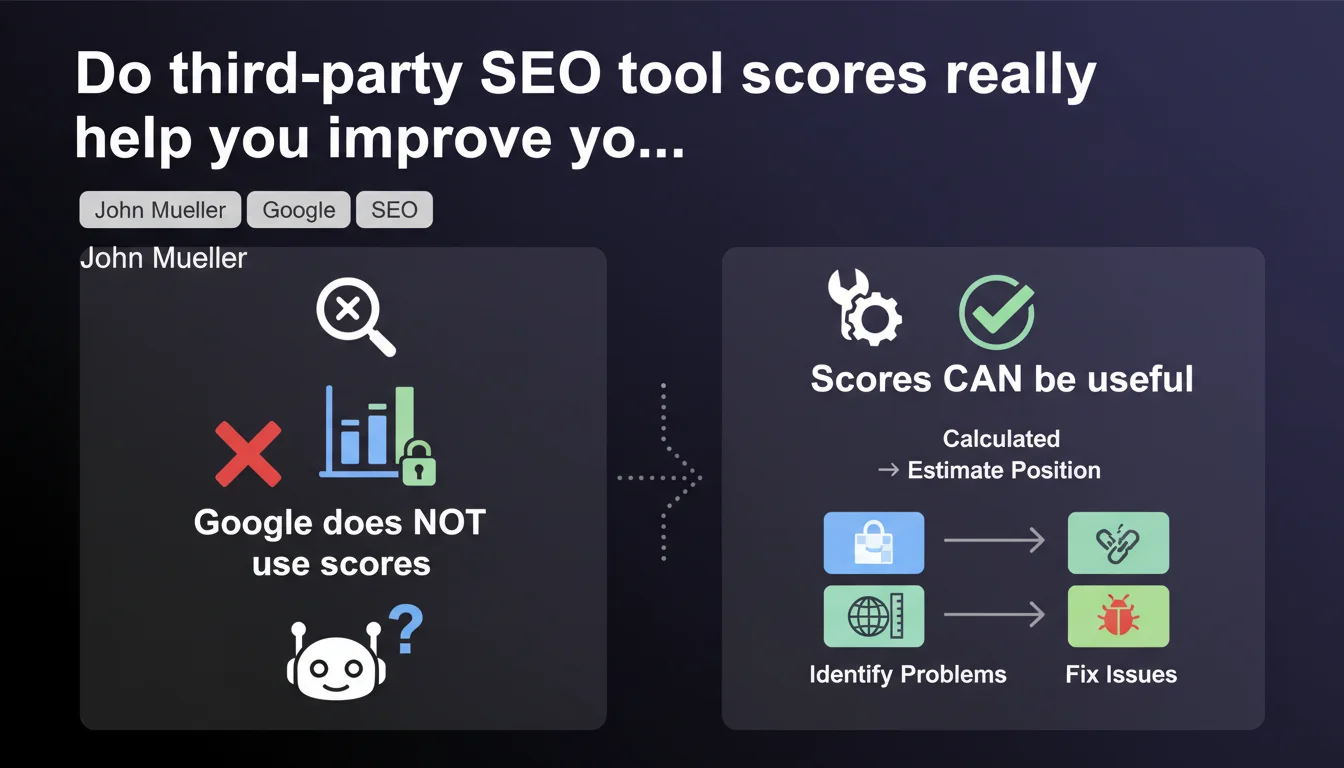
Google does not consider third-party SEO tool scores in its algorithm, but Mueller clarifies that they retain practical utility. As long as they are calculated transparently, these scores can serve as benchmarks for assessing a website's health or detecting real technical issues.
What you need to understand
Does Google use metrics from third-party tools like Semrush, Ahrefs, or Moz?
The answer is no, unambiguously. Google does not consult the proprietary scores generated by these platforms — whether it's Domain Authority, Trust Flow, or any other indicator calculated outside its ecosystem.
These metrics are based on approximate models of how Google works. They compile publicly accessible data (backlinks, estimated traffic, technical signals) to produce a score meant to reflect a site's "quality." But none of them have access to the actual algorithm data.
Why does Mueller clarify that they can still be useful?
Because there's a difference between "Google doesn't use these scores" and "these scores have no value." If the tool is well-designed and its methodology is transparent, it can serve as a relative benchmark — to compare sites with each other, track a domain's evolution, or spot technical anomalies.
Mueller emphasizes calculation transparency: a score that doesn't explain how it's built remains a useless black box. Conversely, if the tool documents its criteria (link volume, diversity of referring domains, loading speed, etc.), it becomes a workable indicator to guide your analysis.
What is the important nuance to understand here?
Don't confuse correlation with causality. A site with a good Domain Authority isn't well-ranked because it has a good DA — it has a good DA because it possesses signals (quality backlinks, thematic authority, etc.) that Google values elsewhere.
Third-party scores are proxies, not direct levers. Optimizing to boost a Moz metric guarantees nothing if the SEO fundamentals (content, architecture, UX, links) don't follow suit.
- Google integrates no third-party metrics into its ranking algorithm
- Third-party tool scores remain useful as comparative benchmarks or for identifying technical weaknesses
- Transparency of methodology is crucial: an opaque score has no operational value
- These indicators reflect signals that Google can use, but they are not themselves ranking signals
SEO Expert opinion
Is this statement consistent with real-world observations?
Yes, and it's actually one of Google's rare takes that perfectly aligns with what we observe in practice. I've seen sites with a DA of 15 crush competitors with 40+ on competitive queries — because their content was better, their architecture better thought out, their intent better targeted.
Conversely, third-party tools often detect real problems before Google Search Console flags them. A sudden collapse in Trust Flow can indicate a toxic backlink problem that's worth addressing quickly, even if Google doesn't publish an equivalent metric.
In what cases can these scores be misleading?
When you take them at face value without analyzing what they actually measure. Some tools inflate scores by incorporating low-relevance signals (raw link volume without quality assessment, estimated traffic based on incorrect keywords, etc.).
The classic pitfall: a client obsessed with their DA who refuses to work on content or technical issues because they're buying links to boost the metric. Result? The score climbs, organic traffic stagnates. [To verify]: some tools claim their score "predicts" ranking — let's be clear, no third-party model can predict an algorithm it doesn't fully understand.
What is the real added value of these tools for an SEO practitioner?
Comparative monitoring. Tracking the relative evolution of multiple domains in the same sector provides useful insights: who's gaining links, who's losing ground, what types of content perform well with competitors.
But be careful — and this is where experience makes the difference — you need to know how to interpret anomalies. A DA spike after buying Fiverr backlinks isn't a win, it's a warning sign. A sudden collapse with no real traffic loss might indicate a tool crawl bug, not an SEO problem.
Practical impact and recommendations
How do you use these scores intelligently without falling into traps?
First, choose your tools based on the transparency of their methodology. Prefer those that clearly document what they measure and how. Moz, for example, regularly publishes updates on DA calculation — Ahrefs does the same with its Domain Rating.
Next, never use them in isolation. A score is a starting point for analysis, not a conclusion. If your DA drops, dig deeper: did you lose backlinks? Did your competitors gain some? Was there a change in the tool's own algorithm?
What mistakes must you absolutely avoid?
Don't try to optimize for the score rather than for Google. Buying backlinks solely because they boost your Majestic metric is counterproductive — Google can very well ignore or penalize them.
Another trap: comparing scores between different tools. Moz's DA and Ahrefs' DR don't measure the same thing with the same scale. You can't say "my DA is 30 but my DR is 45, which one is real?" — neither is "real", they're two distinct models.
Concretely, what should you do to leverage these tools?
Integrate them into a comprehensive dashboard where they coexist with your actual metrics: organic traffic, average positions, conversions, bounce rate. Use them to monitor competitors, detect backlink opportunities, quickly audit a new site.
But always keep in mind that a good score guarantees nothing if user experience is poor, if content doesn't match search intent, or if technical foundations are shaky.
- Prioritize tools that clearly explain how they calculate their metrics
- Use scores as relative indicators, never as absolute goals
- Always cross-reference with Google Search Console and your actual Analytics data
- Monitor evolution over time rather than obsessing over a single number at one point in time
- Only compare scores from the same tool with the same methodology
- Invest first in fundamentals (content, technical, UX) before trying to improve a third-party metric
❓ Frequently Asked Questions
Google utilise-t-il le Domain Authority de Moz ou le Domain Rating d'Ahrefs ?
Un bon score sur un outil SEO garantit-il un bon classement ?
Pourquoi Mueller dit-il que ces scores peuvent quand même être utiles ?
Dois-je investir dans des backlinks pour améliorer mon Domain Authority ?
Quels outils SEO privilégier pour suivre la santé de mon site ?
🎥 From the same video 5
Other SEO insights extracted from this same Google Search Central video · published on 15/08/2023
🎥 Watch the full video on YouTube →
💬 Comments (0)
Be the first to comment.