
Official statement
What you need to understand
Third-party SEO tools like Moz, Ahrefs, SEMrush, or Majestic have been offering proprietary metrics for years that supposedly evaluate a site's quality. Among them, the spam score claims to identify at-risk websites.
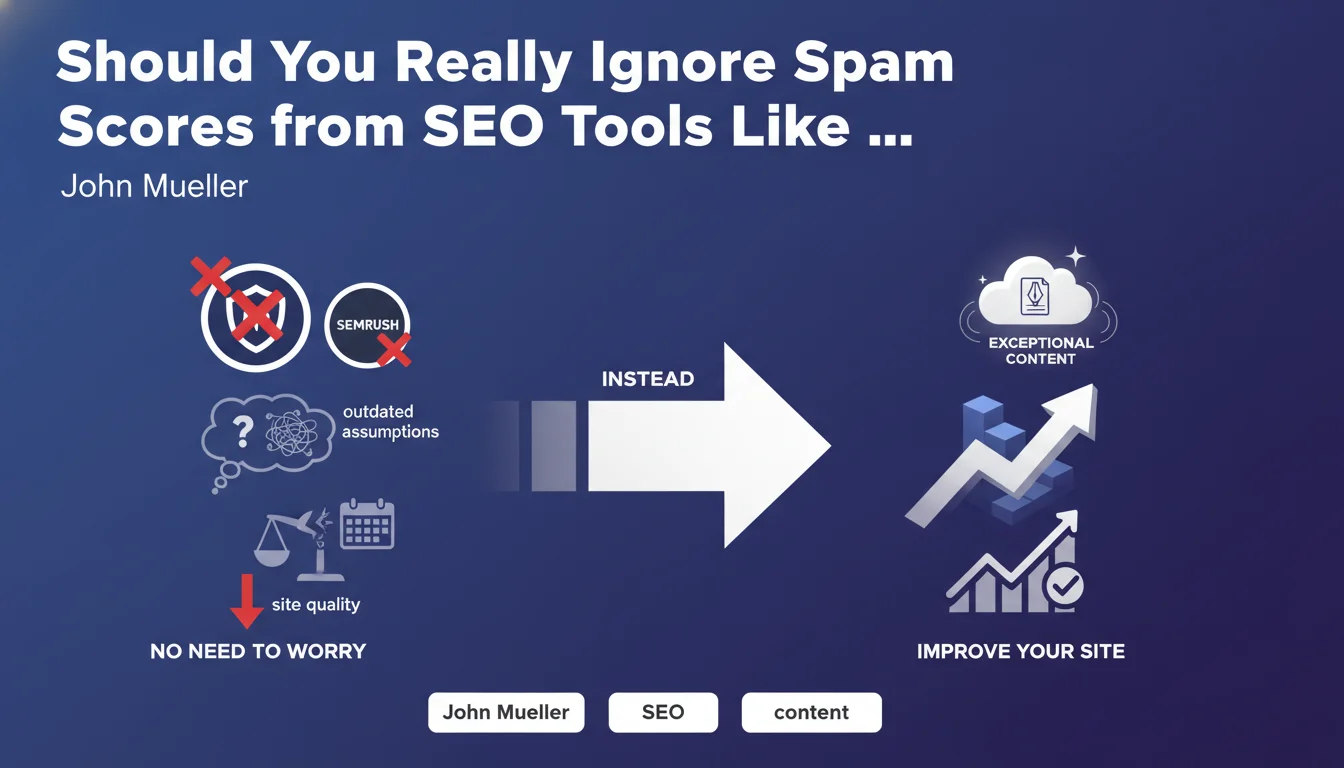
Google has clearly stated that these scores in no way reflect its own assessment of a site's quality. These metrics are built on assumptions and correlations established by third-party companies, without access to Google's actual algorithms.
The official position is unequivocal: focus on the real quality of your content rather than on approximate indicators created by external tools.
- Spam scores are based on assumptions, not on Google's actual criteria
- Google doesn't share its evaluation methods with third-party tool publishers
- These metrics can create false alerts and be misleading
- Energy should be directed toward creating exceptional content
- A good spam score is not a guarantee of good rankings
SEO Expert opinion
This statement is perfectly consistent with what I've observed in the field for 15 years. I've seen countless sites with high spam scores ranking well, and conversely "clean" sites according to these tools completely invisible in Google.
However, an important nuance must be added: these tools remain useful for comparative analysis and competitive benchmarking. Their metrics for backlinks, visibility, or keywords have real value. The problem lies in the absolute interpretation of their quality scores.
The real question isn't "is my spam score good?" but rather "does my content answer my users' search intents better than the competition?" That's where the real SEO work lies.
Practical impact and recommendations
- Stop using spam score as your main KPI or strategic decision criterion
- Don't systematically refuse a backlink or partnership solely based on a high spam score
- Invest your time in qualitative analysis of your content rather than optimizing third-party metrics
- Focus on official signals: Core Web Vitals, EEAT, user experience, content relevance
- Use third-party tools for what they do well: keyword discovery, competitive analysis, rank tracking
- Train your teams to distinguish useful metrics from approximate metrics
- Audit your content according to qualitative criteria: comprehensiveness, originality, real usefulness for the user
- Prioritize expertise and real authority rather than synthetic scores
The key takeaway: spam scores from third-party tools shouldn't guide your SEO strategy. They can serve as secondary indicators, but never as your primary compass.
Redirect your efforts toward creating exceptional content, improving user experience, and building real authority in your field. These are the factors that truly determine your visibility in Google.
Implementing these principles often requires a deep overhaul of content strategy and expert knowledge to distinguish high-value actions from superfluous optimizations. Given the growing complexity of SEO and the multiplication of contradictory signals, support from a specialized SEO agency can prove wise to establish a personalized strategy based on Google's actual quality criteria rather than third-party approximations.
💬 Comments (0)
Be the first to comment.