
Official statement
What you need to understand
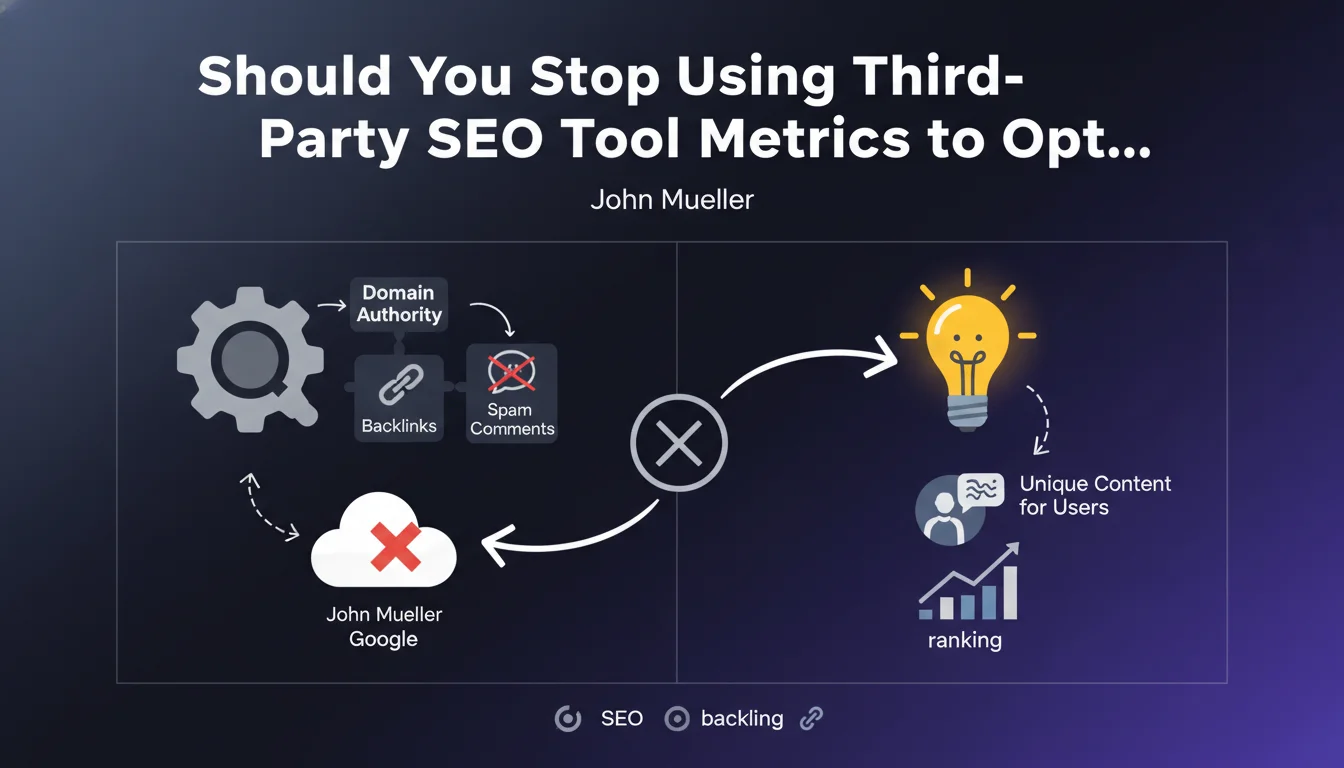
Google has just reminded us of a reality often overlooked by SEO professionals: third-party tools have no access to Google's actual data. Metrics like Domain Authority, Trust Flow, or backlink estimates are approximate reconstructions based on independent crawls.
This warning underscores that these indicators don't necessarily reflect Google's perception of your site. A site with high DA isn't necessarily well-ranked, and vice versa. Google uses its own algorithms and proprietary data to evaluate quality and relevance.
The main message is clear: obsessing over third-party metrics can distract from what's essential—namely, creating quality content that addresses users' real needs.
- Third-party SEO tools use their own crawlers, not Google's data
- Metrics like DA, DR, or TF are approximations, not official scores
- These indicators can be useful but shouldn't dictate your entire strategy
- Google prioritizes unique and useful content for users above all else
- Optimizing for scores can be counterproductive if it neglects user experience
SEO Expert opinion
This statement is consistent with what we observe in the field. Many sites with modest third-party metrics outperform sites with impressive scores, simply because they better match search intent and offer a superior user experience.
However, this needs nuance: third-party tools remain valuable for comparative analysis and trend monitoring. They help identify backlink opportunities, analyze competitors, and detect technical issues. The danger lies in over-optimization based solely on these metrics, not in their reasoned use.
In practice, balance is necessary. SEO tools are excellent for keyword research, technical audits, and competitive analysis. But they shouldn't become your strategy's only compass. The real question is: does this content provide genuine value to my audience?
Practical impact and recommendations
- Don't set objectives based solely on DA or DR - Prioritize KPIs related to qualified organic traffic and conversions
- Use third-party tools for analysis, not for final validation - Always verify your hypotheses with actual data from Google Search Console
- Focus your efforts on creating high-value content - Systematically ask yourself: "Does this truly help my user?"
- Analyze backlinks by their contextual quality, not just by referring domain metrics
- Prioritize user experience and behavioral signals - Time on page, bounce rate, internal navigation
- Use third-party metrics to identify opportunities, then validate their relevance with your industry expertise
- Regularly audit your strategy to verify you're not optimizing for artificial scores
- Train your teams to put these indicators in perspective and keep focus on real business objectives
In summary: Third-party SEO tools are valuable allies for analysis and opportunity discovery, but they should never replace a user-centered strategy. Use them wisely as decision-making tools, not as final objectives.
Implementing such a balanced approach requires deep expertise and a nuanced understanding of different signals. Building a high-performing SEO strategy that combines technical analysis, quality content creation, and comprehensive strategic vision represents a complex challenge. For companies looking to structure a coherent SEO approach without falling into the trap of metric over-optimization, guidance from an experienced SEO agency can prove valuable to benefit from an outside perspective and a proven methodology tailored to your specific context.
💬 Comments (0)
Be the first to comment.