
Official statement
Other statements from this video 5 ▾
- □ Les scores d'outils SEO tiers ont-ils vraiment une utilité pour optimiser votre positionnement ?
- □ Pourquoi devriez-vous vous méfier des scores SEO proposés par les outils d'audit ?
- □ Faut-il ignorer les scores Lighthouse pour optimiser son référencement ?
- □ Les scores d'outils SEO ont-ils vraiment une valeur opérationnelle ?
- □ Les scores transparents sont-ils vraiment la clé pour détecter vos problèmes d'UX ?
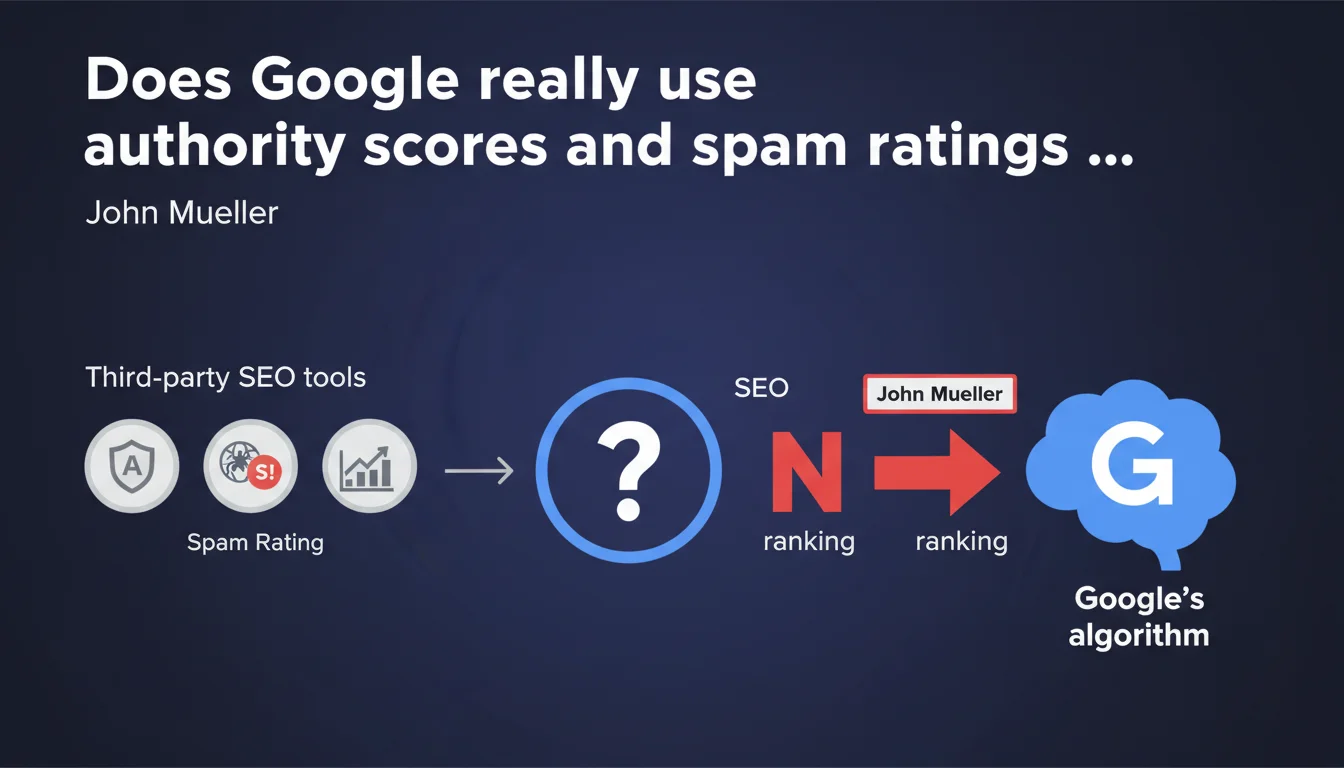
Google does not take into account any score provided by third-party SEO tools (domain authority, spam score, etc.) in its ranking algorithm. These proprietary metrics serve only to guide your work, but have no direct impact on your rankings. What matters are the signals that Google measures itself.
What you need to understand
Why does Google claim it doesn't use these third-party scores?
SEO tools like Ahrefs, Semrush, or Moz calculate proprietary metrics (Domain Authority, Trust Flow, Spam Score...) based on their own data and algorithms. These scores aim to approximate a site's quality or authority, but remain external interpretations.
Google has its own measurement systems — historical PageRank, quality signals, content analysis, user behavior — which it does not share publicly. Using third-party scores would amount to delegating part of its judgment to private actors, which makes no strategic sense for a search engine.
Do these scores have any use for SEO professionals?
Absolutely. Even though Google doesn't use them directly, these metrics remain useful indicators for comparing sites, prioritizing link-building actions, or identifying opportunities.
The trap would be to take them at face value. A site with a high DA is not necessarily well-positioned, and vice versa. These scores provide a general trend, not an absolute truth about SEO performance.
What signals does Google actually use?
Google relies on a combination of hundreds of factors: content quality, semantic relevance, user experience (Core Web Vitals), incoming link profile (quantity, quality, diversity), visitor behavior, E-E-A-T signals...
Unlike third-party scores that simplify into a single number, Google's algorithm analyzes each signal in its specific context. A backlink can be valuable for one site and worthless for another depending on the topic, anchor text, and editorial context.
- Third-party scores are external approximations, not Google ranking factors
- Google directly measures quality through its own signals (content, links, UX, E-E-A-T...)
- These tools remain valuable for guiding your strategy, but guarantee nothing about rankings
- A high DA never compensates for weak content or poor user experience
SEO Expert opinion
Is this statement consistent with real-world observations?
Yes, completely. We regularly see sites with a DA of 20-30 outranking DA 60+ on competitive queries, simply because their content is more relevant, their UX is better, or their link profile is more natural and thematic.
Conversely, some sites display artificially inflated scores — for example through PBNs or massive link purchases — without this translating into lasting rankings. Google detects these manipulations and neutralizes them, sometimes brutally.
Why do so many SEOs continue to focus on these scores?
By habit, and because these metrics offer a reassuring shortcut. It's easier to say "I want to reach DA 40" than to define a complex E-E-A-T strategy over 18 months.
The problem: this approach often leads to absurd decisions. Buying backlinks solely to boost a score, without asking whether these links truly provide contextual value. Result? Wasted budget, penalty risk, no traffic gains.
[To verify] — some SEOs claim to observe strong correlations between DA and rankings. It's possible, but this is a correlation, not causation. Well-positioned sites naturally attract more quality backlinks, which raises their DA. The reverse is not true: artificially increasing your DA guarantees no rise in SERPs.
Should you completely ignore these scores?
No, but you must use them as relative indicators, not as objectives. When prospecting partners for link-building, a DA 50 generally indicates more potential than a DA 10. But what really matters is thematic relevance, editorial quality, and real traffic.
Use these scores to filter and prioritize. Then analyze manually: does the site produce original content? Does it have an engaged readership? Will the link be in a natural editorial context? That's what makes the difference.
Practical impact and recommendations
How should you adjust your link-building strategy?
Stop chasing scores and focus on contextual link quality. A link from a thematic blog with 500 engaged monthly visitors is often worth more than a link from a DA 60 directory with no real traffic.
Prioritize source diversity: industry media, expert blogs, editorial partnerships, natural mentions. Google values a varied and coherent link profile aligned with your target audience.
What criteria should you use to evaluate a partner site?
Analyze real organic traffic (using tools like Semrush or Ahrefs, but for traffic estimation, not the score). A site receiving thousands of monthly visits from Google proves it ranks well and is appreciated.
Check editorial quality: well-researched articles, identified authors, consistent editorial line. Look at engagement: comments, social shares, time on page. These signals indicate a real readership.
Examine the partner site's own link profile. If it displays high DA but 90% of backlinks come from questionable directories, run away. A natural profile shows progressive growth and diversified sources.
What should you measure to track your SEO progress?
Forget DA as a main KPI. Focus on actionable metrics: rankings for your target keywords, qualified organic traffic, conversion rate, time on page, bounce rate.
Track the evolution of your thematic visibility: how many queries rank you in top 3, top 10? How is your semantic coverage evolving in your sector? This data reflects your real authority in Google's eyes.
- Evaluate link-building partners on their real organic traffic, not their DA
- Verify thematic relevance and editorial quality before any backlink
- Analyze the partner site's link profile to detect potential toxic signals
- Measure your progress via rankings, qualified traffic and conversions, not third-party scores
- Prioritize diversity and naturalness in your link strategy
- Invest in content that generates spontaneous mentions and editorial backlinks
❓ Frequently Asked Questions
Les outils SEO sont-ils inutiles si Google n'utilise pas leurs scores ?
Un site avec un DA élevé a-t-il plus de chances de bien se positionner ?
Comment Google mesure-t-il réellement l'autorité d'un site ?
Faut-il ignorer complètement le Domain Authority dans mes choix de partenaires ?
Pourquoi certains sites avec peu de backlinks se positionnent mieux que des concurrents avec des profils massifs ?
🎥 From the same video 5
Other SEO insights extracted from this same Google Search Central video · published on 15/08/2023
🎥 Watch the full video on YouTube →
💬 Comments (0)
Be the first to comment.