
Official statement
Other statements from this video 5 ▾
- □ Les opinions Google sur le Web3 reflètent-elles vraiment la position du moteur de recherche ?
- □ Google est-il vraiment neutre dans la distribution du contenu web ?
- □ Les contenus en communautés privées sont-ils vraiment invisibles pour Google ?
- □ Les créateurs doivent-ils vraiment contrôler ce qui est indexé par Google ?
- □ Pourquoi Google ne peut-il pas indexer les contenus sans URL crawlable ?
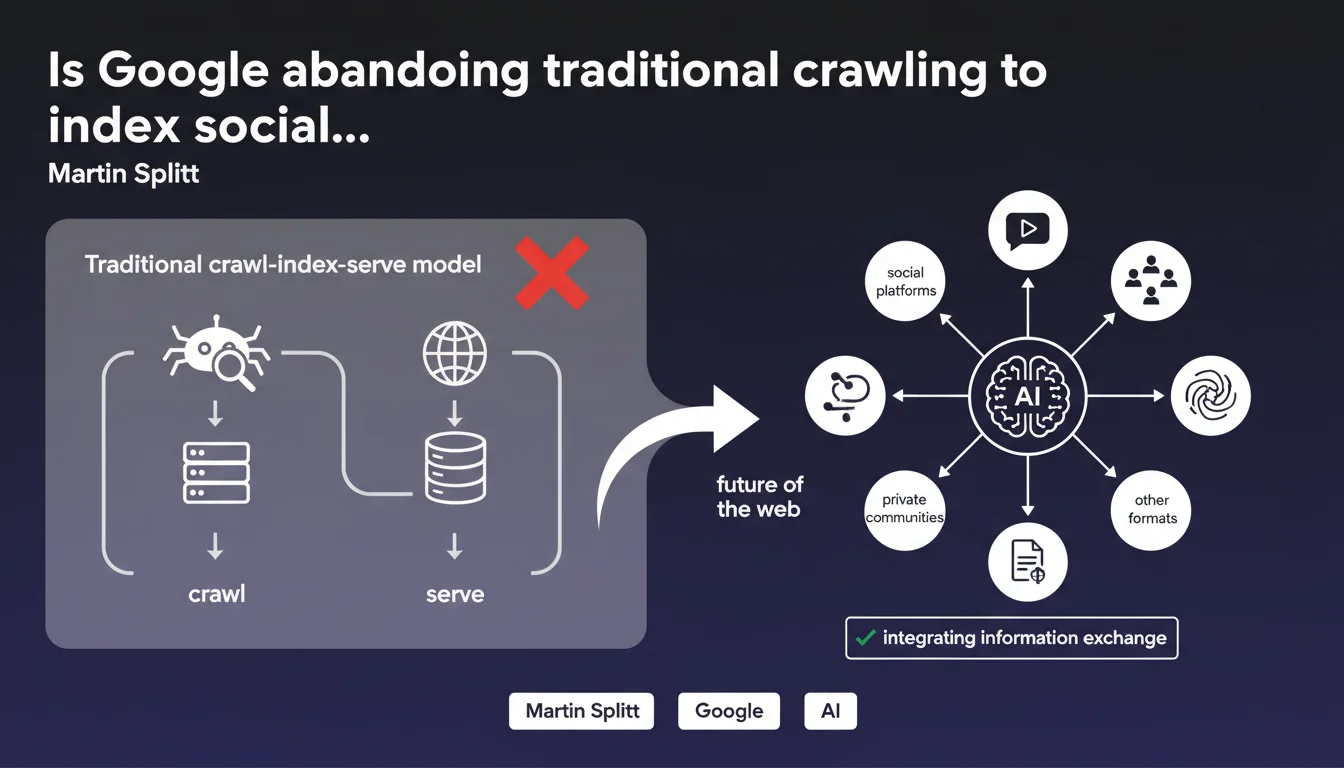
Martin Splitt announces that Google is considering moving away from the classic crawl-index-serve model to adapt to new spaces where people actually exchange information: social networks, closed communities, emerging formats. Concretely, this means that SEO visibility will no longer depend solely on your website — but also on your presence where your audience actually is.
What you need to understand
Why is Google questioning its own indexing model?
The observation is simple: a growing portion of conversations and information seeking completely escapes traditional search engines. People ask questions on Reddit, Discord, private Facebook groups, TikTok — places Google cannot crawl effectively, if at all.
Splitt admits that the historical model — crawling a page, indexing it, serving it in the SERPs — is no longer suited to today's fragmented web reality. If Google wants to remain relevant, it must go fetch information where it's being created, not just where it's published as a static HTML page.
What does this change for traditional SEO?
For now, nothing radical. But the direction is clear: Google officially acknowledges that traditional SEO (website optimized for crawling) is no longer enough to capture all the web's informational value.
This aligns with field observations: for months now, we've seen Google surface Reddit threads, TikTok videos, Twitter discussions directly in search results. This isn't an accident — it's a deliberate transition toward a hybrid model where the publishing platform matters as much as the content itself.
What formats still escape traditional crawling?
Everything behind authentication or in closed community spaces. Slack groups, private Discord servers, restricted-access forums, LinkedIn DMs — so many places where quality expertise and information now concentrates, yet Google cannot index them.
The paradox: these spaces are becoming increasingly influential in purchasing decisions and user journeys, yet they remain invisible to search engines. Hence the need to evolve.
- The crawl-index-serve model no longer captures all useful web information
- Google is seeking to integrate directly into social and community platforms
- Content behind authentication or in private spaces completely escapes crawling
- Future visibility will depend on multi-platform presence, not just your website
SEO Expert opinion
Is this statement consistent with what we observe in the field?
Absolutely. For several months now, Google is prominently displaying Reddit content, Quora, TikTok, YouTube Shorts — often at the expense of traditional websites. This isn't a bug, it's a strategy.
But — and this is where it gets interesting — Google doesn't say how it technically plans to integrate with platforms it doesn't control. Partnership agreements with Reddit? Privileged APIs? Crawling adapted to social feeds? [To be verified] because for now, it's declarative without execution details.
What nuances should we add to this vision?
Splitt talks about evolution, not a sudden break. Traditional crawling won't disappear overnight — it will coexist with other content acquisition modes. Your website remains essential, but it will no longer be sufficient on its own.
Another point: this statement says nothing about how Google will manage quality and truthfulness of social content. A Reddit thread can be excellent — or completely false. How will Google filter? What weight for platform reputation vs. author reputation? Radio silence.
In what cases doesn't this model apply yet?
For complex B2B sectors, in-depth technical content, documentary resources — anything requiring depth and structure — the website remains the dominant format. Google won't index a 40-page whitepaper published on a private Discord server.
Likewise, for transactional queries (purchase, booking, quote request), the website remains the logical destination. Social networks can influence, but conversion happens elsewhere.
Practical impact and recommendations
What should you do concretely right now?
First priority: map where your audience actually exchanges information. Not where you'd like them to be, but where they actually are. Reddit? Discord? LinkedIn? TikTok? Specialized forums? Once this mapping is done, you need to be present there — not with promotional content, but with real value.
Second axis: adapt your content strategy to be multi-format and multi-platform. The same topic can become a blog post, a Twitter thread, a short video, a Reddit discussion. Each format has its codes — you must respect them.
Third point: monitor SERP evolution for your key queries. If Google starts heavily surfacing social content on your strategic keywords, that's a signal. You need to adjust accordingly.
What mistakes should you avoid during this transition?
Don't abandon your website on the pretext that Google is opening to social networks. Your website remains your digital property, the only platform you fully control. Social algorithms can change overnight.
Another trap: create social content solely for Google. Communities instantly spot content designed for SEO rather than for them. Result: rejection, even banning. Authenticity is non-negotiable.
How do you measure the impact of this evolution on your visibility?
Start by tracking your classic SERP positions, but add a layer of monitoring for social appearances. When Google displays a Reddit thread on your topic, who wrote it? Your brand? A competitor? An independent user?
Also measure indirect traffic: mentions on Reddit or TikTok don't always generate an immediate click, but they influence subsequent brand searches. Attribution becomes more complex, requiring adapted tools.
- Identify platforms where your audience actually exchanges information
- Create a multi-format content strategy adapted to each channel
- Monitor the appearance of social content in your strategic SERPs
- Don't abandon your website — it remains your reference foundation
- Avoid purely SEO social content, prioritize authenticity
- Implement multi-platform tracking to measure overall impact
❓ Frequently Asked Questions
Google va-t-il arrêter de crawler les sites web classiques ?
Comment Google peut-il indexer du contenu dans des communautés privées ?
Faut-il créer des comptes sur toutes les plateformes sociales maintenant ?
Le contenu publié sur Reddit ou TikTok peut-il cannibaliser mon site web ?
Cette évolution impacte-t-elle tous les secteurs de la même manière ?
🎥 From the same video 5
Other SEO insights extracted from this same Google Search Central video · published on 19/05/2022
🎥 Watch the full video on YouTube →
💬 Comments (0)
Be the first to comment.