
Official statement
Other statements from this video 5 ▾
- □ Is Google really just a neutral guide to the web, or does it control what you see?
- □ Are private community contents really invisible to Google?
- □ Should content creators really have full control over what Google indexes?
- □ Why can't Google index content without a crawlable URL?
- □ Is Google abandoning traditional crawling to index social web content?
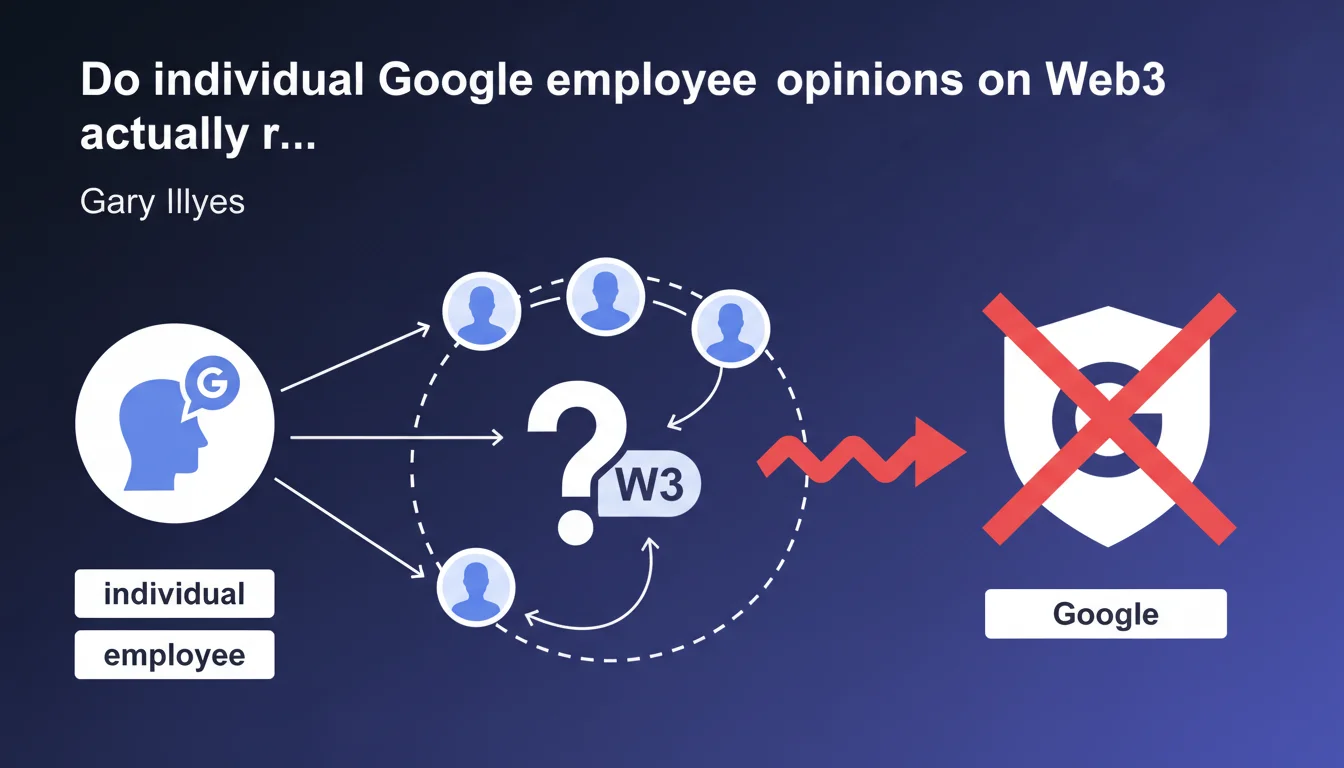
Gary Illyes clarifies that a podcast episode about Web3 does not constitute Google's official position, but rather the personal reflections of participants. Critical distinction: individual opinion ≠ SEO doctrine to apply. Let's stay vigilant about what truly carries authority versus what amounts to speculation.
What you need to understand
Why is this clarification necessary?
Google communicates through multiple channels: official documentation, Webmaster Central blog, YouTube videos, podcasts, conferences, individual tweets. Not all of this content carries the same weight.
Some Google employees — even highly visible ones like John Mueller or Gary Illyes — regularly share their personal opinions that may diverge from documented official positions. This distinction becomes blurred when their statements are repeated as gospel by the SEO community.
What's the difference between opinion and official position?
An official position appears in Google Search Central documentation, blog announcements signed by the team, or explicit guides. It commits Google as an organization.
A personal opinion, even coming from a senior Googler, remains an individual interpretation. It may reflect an internal trend, a technical viewpoint, but does not constitute a directive to follow blindly.
Does Web3 raise specific questions for SEO?
Web3 — with its decentralized architectures, on-chain content, wallets as identity — raises issues Google has never formally addressed: how to crawl IPFS content? Are smart contracts indexable? Do NFT metadata count?
Without clear doctrine, speculation abounds. Hence the importance of Gary's clarification: what's said in an informal podcast should not be viewed as an SEO roadmap for Web3.
- Distinguish official source from individual opinion: crucial to avoid building strategy on shifting ground
- Google Search Central documentation = absolute reference, everything else = indicators to contextualize
- Web3 and SEO: officially undocumented terrain, so any statement remains hypothetical
- Podcasts, Twitter, conferences: rich in insights but not in contractual guarantees
SEO Expert opinion
Does this clarification actually change anything concrete?
Yes and no. It reinforces a hygiene rule: always verify the source before adjusting strategy. Too many practitioners modify their approach based on a tweet or an out-of-context statement.
The problem? Google itself perpetuates this confusion by allowing its employees to speak freely without clear guidelines. Result: an ecosystem where every statement becomes fodder for debate and reinterpretation. [To verify]: no official framework distinguishes binding channels from informational ones.
Is Web3 really a priority for Google Search?
Let's be honest: nothing indicates Google is investing heavily in indexing decentralized or blockchain-native content. Experiments probably exist internally, but no public roadmap.
This absence of official position suggests either strategic indifference or calculated caution toward a still-volatile ecosystem. Googlers' personal opinions may reflect their technical curiosity, not the search engine's business direction.
Should we ignore podcasts and informal appearances?
Absolutely not. These formats often deliver valuable nuance about internal workings, tacit priorities, upcoming shifts. But consume them with a critical filter.
When Gary or John speak, they reveal their understanding of the system — sometimes richer than official docs. But it's not an executable directive. Treat these insights as hypotheses to test, not revealed truths.
Practical impact and recommendations
How to distinguish what carries authority?
Systematically prioritize officially documented sources: Google Search Central, blog announcements signed by the Search team, developer documentation. Everything else — podcasts, tweets, YouTube videos — should be considered supplementary.
When you come across an interesting statement from a Googler, check if it echoes in the documentation. No confirmation? Treat it as an exploratory lead, not a certainty.
Should we anticipate Web3 in SEO right now?
Not urgently. No evidence that Google penalizes or favors decentralized architectures. If your business relies on Web3, ensure that content remains accessible via standard HTTP for crawling.
Experiments are welcome — IPFS mirrors, enriched metadata, custom structured data — but without compromising basic indexability. Google has never promised to follow technological innovations in real time.
What to do when faced with contradictory Google information?
Document the source, date, and context. Compare with recent official positions. In case of conflict, official documentation prevails. If ambiguity persists, test cautiously on a limited scope before scaling.
- Systematically verify whether a Google statement appears in official documentation
- Treat podcasts and interviews as insights, not directives
- Don't invest heavily in Web3 SEO without field validation
- Always maintain a standard crawlable version of your decentralized content
- Document your sources before justifying a strategic decision to a client
- Cross-reference multiple Google channels before modifying your approach
❓ Frequently Asked Questions
Un podcast Google a-t-il la même valeur qu'une page de documentation officielle ?
Google a-t-il publié des guidelines officielles sur le SEO Web3 ?
Comment savoir si une information Google est fiable pour ma stratégie SEO ?
Les opinions de Gary Illyes ou John Mueller sont-elles sans valeur alors ?
Dois-je ignorer les contenus Web3 pour l'instant en SEO ?
🎥 From the same video 5
Other SEO insights extracted from this same Google Search Central video · published on 19/05/2022
🎥 Watch the full video on YouTube →
💬 Comments (0)
Be the first to comment.