
Official statement
Other statements from this video 5 ▾
- □ Les opinions Google sur le Web3 reflètent-elles vraiment la position du moteur de recherche ?
- □ Google est-il vraiment neutre dans la distribution du contenu web ?
- □ Les créateurs doivent-ils vraiment contrôler ce qui est indexé par Google ?
- □ Pourquoi Google ne peut-il pas indexer les contenus sans URL crawlable ?
- □ Google va-t-il abandonner le crawl traditionnel pour indexer le web social ?
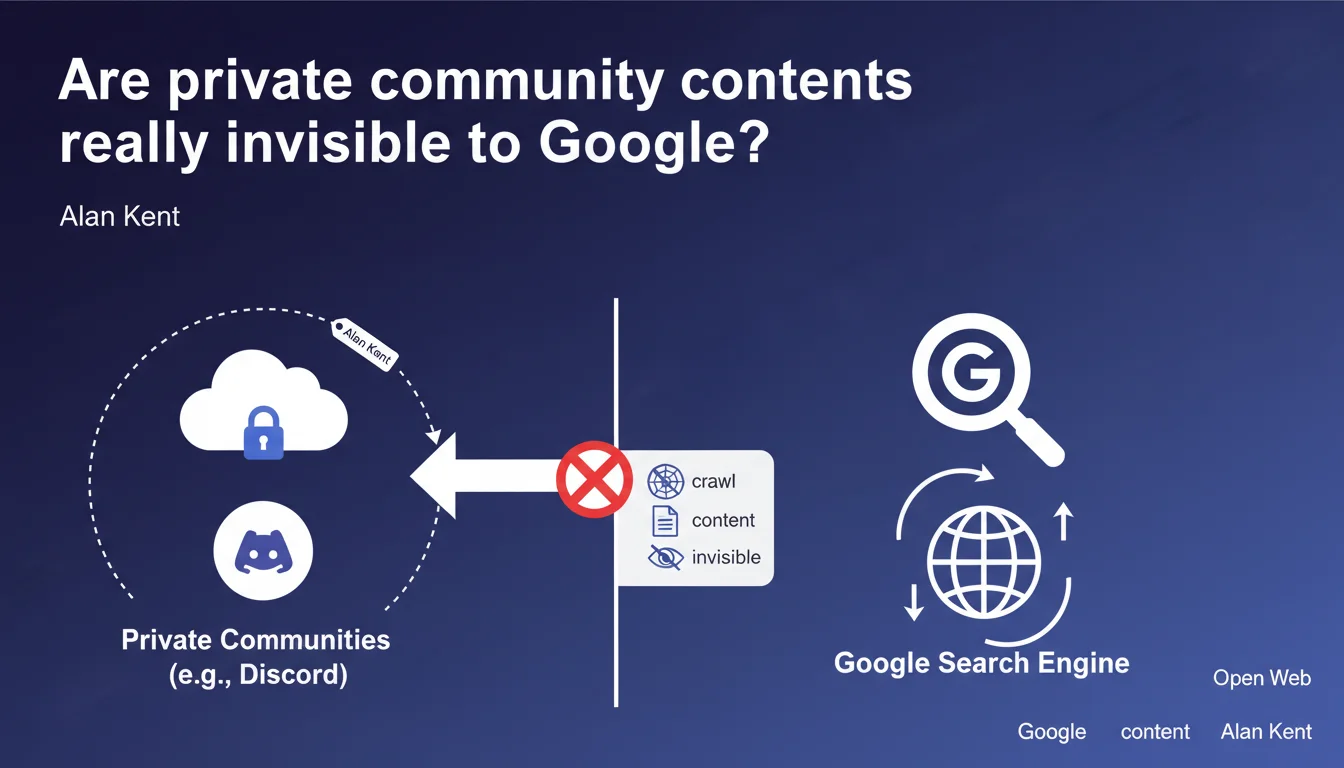
Google confirms that content hosted in private communities like Discord, Slack, or other closed platforms cannot be crawled or indexed by its robots. Only content accessible on the open web can appear in search results. This statement reinforces a technical reality often overlooked: no public access = no SEO visibility.
What you need to understand
Why can't Google crawl Discord or Slack?
The answer boils down to one word: permissions. Google's robots — like all crawlers — don't have user accounts to access private spaces. Discord, Slack, Circle, Mighty Networks and similar platforms require authentication to view their content.
Technically, these platforms use access control mechanisms (OAuth, tokens, session cookies) that block any unauthenticated access. Googlebot cannot — and should not — cross these barriers. Crawling stops at the entrance door.
What does the "open web" mean in this context?
The open web refers to any content accessible publicly via a URL, without requiring prior login or registration. Public forums, blogs, institutional websites, marketplaces with visible product pages: anything that can be reached through a simple HTTP/HTTPS link.
Even non-indexable content (noindex) is part of the open web if it's technically accessible. Openness concerns access, not indexation. This distinction is fundamental.
Does this limitation only apply to Discord and Slack?
No. Any space requiring authentication or mandatory registration falls into this category: private Facebook groups, member areas, corporate intranets, restricted-access forums, educational platforms like LMS.
Even LinkedIn restricts access to certain content (private group posts, direct messages). Google can crawl public LinkedIn profiles, but not internal conversations.
- Private communities are inaccessible to search engines by design
- Only open web content can be indexed and ranked
- This rule applies to all platforms requiring authentication
- Technical crawling impossibility eliminates any risk of unintentional duplication
- Content strategic for SEO must be published on a publicly accessible platform
SEO Expert opinion
Does this statement bring new information?
Let's be honest: no. It's a technical reality that every SEO professional knows. But Alan Kent is likely restating it because some brands or content creators still wonder if their activity on Discord or private Slack groups can generate organic traffic.
The value of this statement lies in official confirmation. It shuts down fantasies about Google being able to "guess" or "synthesize" private content through AI. No access = no indexation. End of story.
Are there exceptions or edge cases?
Some platforms offer hybrid zones. For example, a Discord server might have public channels accessible through open invitations while others remain private. If a channel is technically accessible without authentication (rare but possible), Googlebot could theoretically crawl it.
Another edge case: communities with public landing pages. A platform like Circle can expose certain posts for public reading while keeping participation reserved for members. These public fragments can be indexed — but that remains marginal.
[To verify]: Could Google extract data from private communities through open APIs (like Zapier, webhooks)? Technically no, because the API requires an authentication token. But if a third party automatically publishes public summaries of private discussions, those summaries become crawlable. The source remains inaccessible, not its reformulation.
Should you abandon private communities for SEO?
No. That's confusing objectives and channels. Private communities serve to create engagement, build audience loyalty, and generate quality discussions. Not to rank on Google.
The real strategic issue: how to intelligently repurpose content born in these closed spaces. A Discord discussion can inspire a public blog post. A Slack thread can become a FAQ. A private webinar can be synthesized into a downloadable guide. This transformation is what creates SEO value.
Practical impact and recommendations
What should you do if your strategic content is locked in a private platform?
First step: audit where your best content lives. If your expertise, lessons learned, and tutorials exist only in a Slack or Discord, you're missing every organic visibility opportunity.
Next, implement a republication process. Identify high-value content and transpose it to public platforms: blog, help center, knowledge base, public YouTube videos. The format can change; what matters is accessibility.
How do you avoid diluting engagement by making everything public?
This is the classic dilemma: exclusivity vs visibility. The solution? Segment. Keep certain premium content (in-depth analysis, live Q&A, insider tips) in the private community to reward members.
But publish light versions or strategic excerpts in open access. For example: a 50-message Discord thread can become an 800-word article summarizing key points. Members keep exclusive access to details, the public discovers the value.
What mistakes should you avoid in this transition?
Don't fall into the internal duplicate content trap. If you republish the same content word-for-word across multiple public platforms (blog, Medium, LinkedIn articles), you create cannibalization.
Another common mistake: neglecting URL structure. When migrating content from a community to a public site, ensure each page has a unique, descriptive URL and that architecture facilitates discovery.
- Identify strategic content currently inaccessible to search engines
- Create a republication schedule with rephrasing and enrichment
- Segment: keep exclusives private, publish essentials publicly
- Verify each public piece has an indexable and optimized URL
- Anonymize and obtain necessary consent before republication
- Avoid duplicating the same text entirely across multiple public platforms
- Measure impact: organic traffic, conversions, time spent on republished content
❓ Frequently Asked Questions
Google peut-il indexer des extraits de Discord partagés sur Twitter ou LinkedIn ?
Un forum privé avec inscription gratuite est-il considéré comme du web ouvert ?
Les groupes Facebook privés peuvent-ils apparaître dans les résultats de recherche ?
Est-il légal de republier des discussions privées sur un blog public ?
Peut-on optimiser le SEO d'une communauté Discord elle-même ?
🎥 From the same video 5
Other SEO insights extracted from this same Google Search Central video · published on 19/05/2022
🎥 Watch the full video on YouTube →
💬 Comments (0)
Be the first to comment.