
Official statement
Other statements from this video 7 ▾
- □ Hreflang : HTML ou sitemap XML, quelle méthode choisir pour votre référencement international ?
- □ Peut-on vraiment utiliser des balises noscript dans le <head> sans pénalité SEO ?
- □ Pourquoi Google distingue-t-il le HTML source du DOM rendu ?
- □ Les iframes dans le <head> peuvent-ils vraiment casser votre SEO technique ?
- □ Pourquoi croiser plusieurs sources de données est-il crucial en diagnostic SEO ?
- □ La Search Console affiche-t-elle vraiment les variations d'impressions en temps réel ?
- □ Comment tester le user-agent Googlebot directement dans Chrome sans extension tierce ?
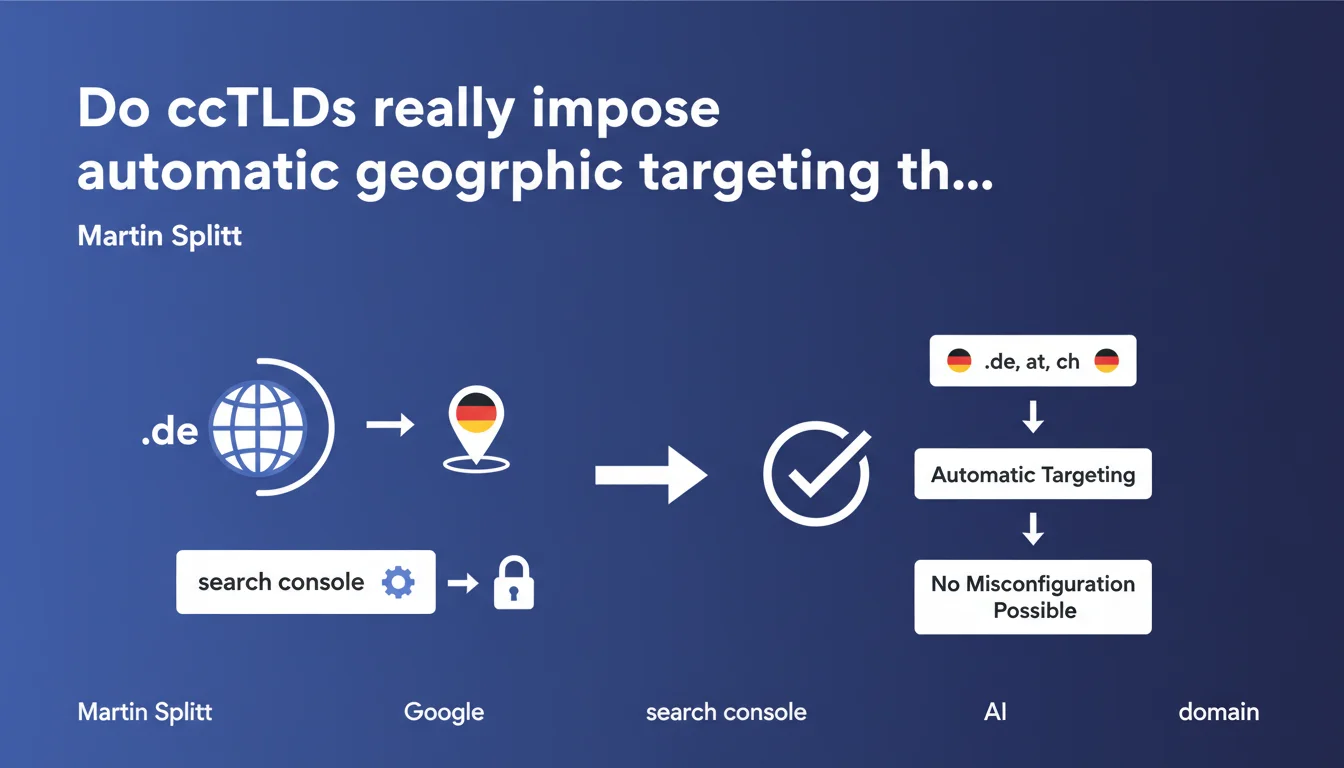
Google confirms that geographic domains (.de, .fr, .ch, etc.) automatically set targeting in Search Console. It's impossible to modify this parameter — targeting follows the domain extension. A structural constraint that eliminates the flexibility offered by gTLDs like .com.
What you need to understand
What is a ccTLD and why does this automatic targeting exist?
A country code top-level domain (ccTLD) is a national extension like .fr, .de, .ch or .be. Google treats them differently from generic domains (.com, .org) by applying a non-modifiable default geographic targeting.
This mechanism is based on simple logic: a .de signals to Google that the site primarily targets Germany. The search engine considers this intention as structural. Unlike gTLDs where you can choose your targeting in Search Console, here the parameter is locked.
What happens in practice in Google Search Console?
In the Search Console interface, the "International Targeting" section displays the country associated with the ccTLD. This field is grayed out — impossible to modify. Google sets it automatically according to the domain extension.
This is a fundamental difference from a .com where you can manually select a target country or leave the parameter neutral for an international site. With a ccTLD, the decision is made as soon as you choose the domain.
What are the implications for a multi-country site?
If you operate in multiple markets with different ccTLDs, you must manage multiple distinct domains: example.fr for France, example.de for Germany, etc. Each domain remains anchored in its geographic zone.
This constraint eliminates the possibility of using a ccTLD to target another country. A .de can never be optimized for the French market in Search Console — Germany targeting remains locked.
- ccTLDs automatically set geographic targeting in Google Search Console
- The parameter is non-modifiable — it follows the domain extension
- Unlike gTLDs, no manual targeting flexibility exists
- To target multiple countries, you must use multiple distinct ccTLDs
- This logic eliminates geographic targeting errors on ccTLD
SEO Expert opinion
Does this statement really reflect Google's behavior?
Yes, it's one of the rare points where official documentation perfectly matches real-world observations. ccTLDs have always been treated as strong geographic signals by Google, and this statement from Martin Splitt merely confirms an already-known mechanism.
Let's be honest: this constraint is not new. SEO professionals managing international sites have known for years that a ccTLD locks in targeting. What's useful here is the official clarification — it puts an end to attempts to work around this limitation.
Are there any exceptions or edge cases?
Not really. Google applies this rule in a systematic and rigid manner. Even if your content is in English, your hosting is in the United States, and your Search Console shows 90% US traffic, a .de will remain Germany-targeted.
Some ccTLDs like .co (Colombia) or .io (British Overseas Territory in the Indian Ocean) have been adopted for generic uses (.co for "company", .io for tech startups). Google now treats them as de facto gTLDs, but these are historical exceptions — not the norm.
Is this rigidity a hindrance or a help?
It depends on your strategy. For a single-country site, it's a net advantage: geographic targeting is guaranteed without manual configuration. For a poorly designed international project, it's a technical dead end.
The real problem occurs when a company chooses a ccTLD due to constraints (availability, cost) without anticipating the impact on targeting. At that point, the only solution is to migrate to a gTLD with subdirectories or subdomains — an expensive operation. [To verify] Some SEO professionals think they can "force" targeting with secondary signals (hreflang, localized content, backlinks from the target country). In practice, these signals never compensate for the ccTLD lock.
Practical impact and recommendations
How do you choose between ccTLD and gTLD for an international project?
If you're launching a multi-country site, the question arises from the start. A gTLD + subdirectories (example.com/fr/, example.com/de/) offers complete flexibility with a single domain. A ccTLD per country (example.fr, example.de) imposes scattered management but sends a strong geographic signal.
The ccTLD can strengthen local trust — a .fr reassures a French user. But it multiplies domains, so dilutes authority and complicates technical management. If you don't have the resources to manage multiple domains, stick with a gTLD with manual targeting by section.
What if my ccTLD targets the wrong country?
Bad news: you can't do anything in Search Console. Targeting follows the extension, period. If your .de targets Germany when you aimed for German-speaking Switzerland, your options are limited.
You can reinforce secondary signals (hreflang to de-CH, localized content, Swiss backlinks), but — let's be clear — these signals don't reverse structural targeting. The only clean solution remains migration to an adapted domain: a .ch or a gTLD with /de-ch/ subdirectory.
What mistakes should you avoid when choosing a ccTLD?
The classic mistake is choosing a ccTLD for reasons of availability or cost without measuring the impact on targeting. A .io might seem cool for a tech startup, but if Google still treats it as a ccTLD for the British Overseas Territory (this is no longer the case today, but the example remains relevant), you end up stuck.
Another pitfall: using a ccTLD for an international project thinking that multilingual content will compensate. No. The geographic targeting of the domain takes precedence over content language.
- Analyze your target market before choosing the domain type
- If multi-country, favor a gTLD with subdirectories unless you have the resources to manage multiple ccTLDs
- Verify in Search Console that the ccTLD targeting matches your primary market
- Don't try to work around a ccTLD's geographic targeting with secondary signals — they're never sufficient
- If migration is necessary, plan it early to avoid prolonged loss of authority and traffic
- Document your domain strategy to prevent mistakes when expanding geographically in the future
❓ Frequently Asked Questions
Peut-on modifier le ciblage géographique d'un ccTLD dans Search Console ?
Un ccTLD peut-il quand même ranker dans un autre pays que celui ciblé par défaut ?
Vaut-il mieux utiliser plusieurs ccTLDs ou un gTLD avec sous-répertoires pour un site multi-pays ?
Les ccTLDs comme .co ou .io sont-ils également concernés par ce ciblage automatique ?
Si j'ai un .de mais que je cible la Suisse alémanique, que faire ?
🎥 From the same video 7
Other SEO insights extracted from this same Google Search Central video · published on 18/10/2022
🎥 Watch the full video on YouTube →
💬 Comments (0)
Be the first to comment.