
Official statement
Other statements from this video 7 ▾
- □ Les ccTLDs imposent-ils vraiment un ciblage géographique automatique impossible à contourner ?
- □ Peut-on vraiment utiliser des balises noscript dans le <head> sans pénalité SEO ?
- □ Pourquoi Google distingue-t-il le HTML source du DOM rendu ?
- □ Les iframes dans le <head> peuvent-ils vraiment casser votre SEO technique ?
- □ Pourquoi croiser plusieurs sources de données est-il crucial en diagnostic SEO ?
- □ La Search Console affiche-t-elle vraiment les variations d'impressions en temps réel ?
- □ Comment tester le user-agent Googlebot directement dans Chrome sans extension tierce ?
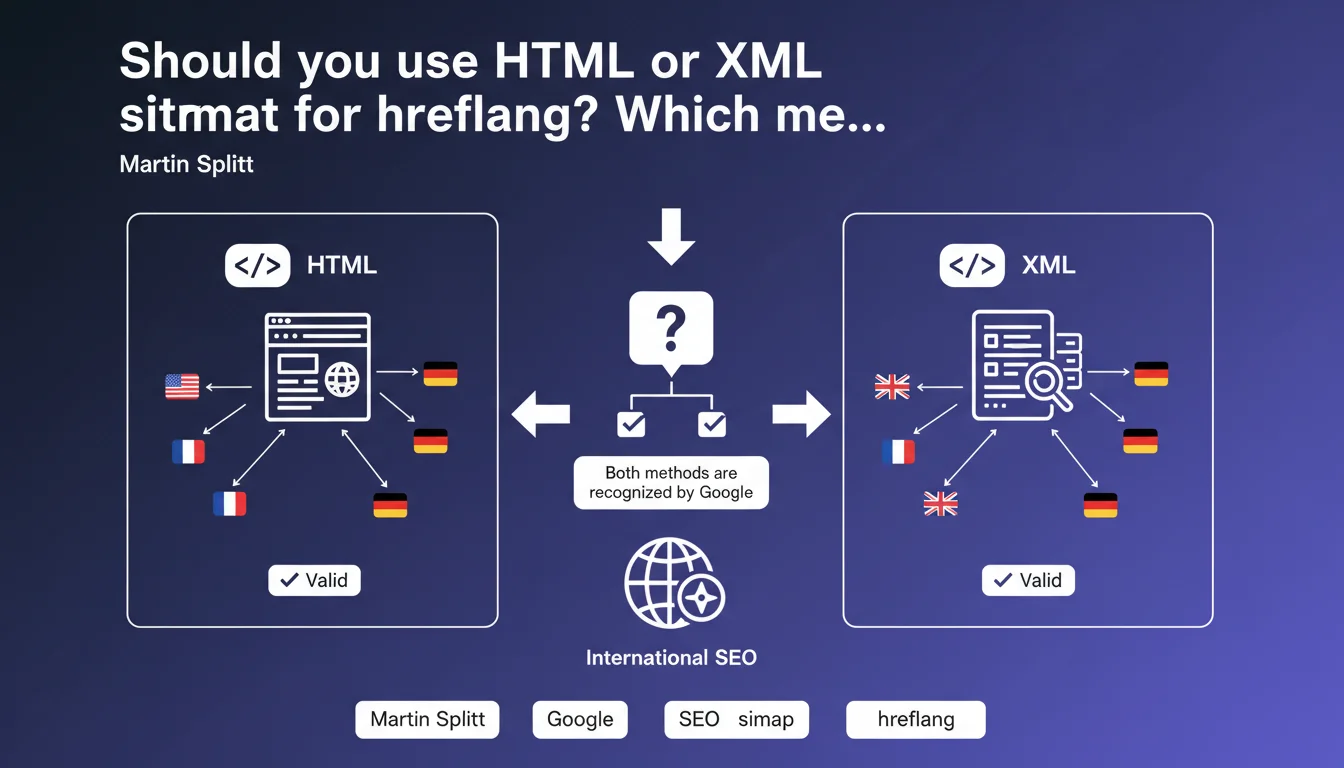
Google recognizes two valid implementations for hreflang: in the HTML of pages or via an XML sitemap. Martin Splitt confirms that both methods are equivalent in Googlebot's eyes. The choice depends primarily on technical constraints and maintainability, not SEO performance.
What you need to understand
Why does Google accept two different implementation methods?
The flexibility offered by Google responds to diverse technical realities. Some CMS platforms allow granular HTML control, others do not. Sites with thousands of multilingual pages struggle to manage link tags in every template.
Google adapts to infrastructure constraints rather than imposing a single method. Both approaches — HTML and XML — are crawled and interpreted by the same algorithms.
What's the difference between HTML and sitemap implementation?
The HTML implementation places <link rel="alternate" hreflang="x"> tags directly in the <head> of each page. Each language version references all other versions, including itself.
The XML sitemap implementation centralizes these annotations in a separate file. Each URL declares its variants through <xhtml:link> tags. This method avoids overloading HTML but requires rigorous sitemap maintenance.
Does Google show a preference between the two methods?
No. Martin Splitt doesn't prioritize one approach over the other. Googlebot handles hreflang annotations independently of their source. What matters is the consistency and completeness of declarations.
What counts: each page correctly references all its linguistic or regional variants with perfect reciprocity. The technical vector — HTML or XML — is secondary.
- Both methods (HTML and XML sitemap) are equivalent for Google
- The choice depends on your technical constraints, not SEO performance
- Reciprocity of annotations remains mandatory regardless of method
- A single site can mix both approaches if needed (Google then prioritizes HTML)
- Maintenance and consistency are more critical than implementation choice
SEO Expert opinion
Is this statement consistent with real-world observations?
Yes, absolutely. Tests show that Google indeed treats both methods without apparent discrimination. Sites with hreflang only in XML sitemap position correctly in local Google versions.
That said — and Splitt doesn't mention this — there are edge cases. When a site uses both methods simultaneously with contradictory declarations, Google generally prioritizes HTML. [To verify] but this is the behavior observed in our audits.
What nuances should be added to this statement?
The statement remains intentionally simplified. It omits HTTP headers, a third valid method but rarely used for hreflang (more common for PDFs or non-HTML files).
Another point: saying that "both methods are valid" doesn't mean they're equally practical. A site with 50 languages and 10,000 URLs generates potentially 500,000 hreflang annotations. Managing them in HTML becomes a nightmare. The sitemap becomes necessary by operational necessity.
In which cases is one method preferable to the other?
HTML suits sites with few languages (2-5), simple structure, and a CMS that handles templates well. Advantage: immediate visibility during crawl, easier debugging.
XML sitemap is necessary for massive multilingual catalogs, complex architectures, or when modifying HTML is technically blocked. It centralizes hreflang logic but requires absolute rigor in automated generation.
Let's be honest: most hreflang errors stem from reciprocity issues, not from the HTML vs XML choice. A tool that generates annotations poorly will produce errors in both cases.
Practical impact and recommendations
What should you concretely do if you manage a multilingual site?
Start with an audit of the current state. Use Search Console (International Targeting) and a crawler (Screaming Frog, Sitebulb) to identify current annotations and their errors.
If you're starting fresh, choose the method based on your technical stack. Flexible CMS with good head control? HTML. Complex or high-volume site? Sitemap. Don't change methods without reason — migration introduces risks.
What errors should you absolutely avoid?
Don't mix both methods without coherence. If you declare hreflang in HTML AND sitemap with different values, Google must arbitrate — and you lose control.
Avoid incomplete annotations. If FR points to EN and DE, but EN doesn't point back to FR, reciprocity is broken. Google may then ignore all annotations in the cluster.
Don't forget the x-default tag which indicates the default version for users outside targeting. Its absence creates ambiguities that Google resolves... its own way.
How do you verify your implementation works?
Use the URL inspection test in Search Console. It displays hreflang annotations detected by Google for a given page. Compare with your declarations.
Crawl your XML sitemap with a dedicated tool (such as an online hreflang validator) to detect reciprocity errors. An Excel file with all combinations allows you to spot inconsistencies quickly.
Monitor traffic metrics by language in Analytics. A sudden drop on one language version may signal an undetected hreflang problem.
- Audit existing hreflang annotations via Search Console and crawler
- Choose HTML for simple structures, sitemap for large volumes
- Ensure perfect reciprocity between all language versions
- Systematically include an x-default tag
- Avoid mixing HTML and sitemap unless you fully master the logic
- Regularly validate with specialized tools and Search Console
- Document your implementation to facilitate future maintenance
- Monitor traffic metrics by language to detect anomalies
❓ Frequently Asked Questions
Peut-on utiliser hreflang en HTML et en sitemap simultanément sur le même site ?
Le sitemap XML ralentit-il la découverte des annotations hreflang par Google ?
Faut-il inclure la page elle-même dans ses propres annotations hreflang ?
Les annotations hreflang en HTTP headers sont-elles encore pertinentes ?
Combien de temps faut-il à Google pour prendre en compte un changement d'annotations hreflang ?
🎥 From the same video 7
Other SEO insights extracted from this same Google Search Central video · published on 18/10/2022
🎥 Watch the full video on YouTube →
💬 Comments (0)
Be the first to comment.